Description
Westermo MDW-45 RS-232 to RS-422/485 Serial Converter
Product Overview
The Westermo MDW-45 is an industrial serial communication converter designed to connect equipment using RS-232 with equipment using RS-422 or RS-485. In a typical automation installation, it sits between a legacy serial device and a multidrop or point-to-point field communication network. Westermo documentation specifically identifies applications involving PCs, PLCs, drives, and other automation equipment. The unit can operate in two-wire half-duplex RS-485 applications and can automatically control the bus direction from transmitted data, which is useful when the connected RS-232 device does not provide suitable handshaking signals.
The Westermo MDW-45 supports communication speeds from 1,200 bit/s to 115.2 kbit/s on the RS-232 and RS-422/485 interfaces, with configurable data formatting and DIP-switch setup. The RS-422/485 side provides selectable termination and fail-safe biasing, while the design incorporates galvanic isolation and transient protection. The MDW-45 is available in LV and HV power versions: the LV version is intended for DC supplies, while the HV version accepts a substantially higher AC/DC supply range. The exact power variant is therefore an important procurement detail; MDW-45 by itself does not establish whether the required unit is LV or HV.
From a plant-maintenance perspective, the Westermo MDW-45 is particularly useful when a functioning legacy serial device must remain connected to a longer RS-485 or RS-422 network. It does not translate application protocols such as Modbus into another protocol. Instead, it performs the physical/interface conversion required to move serial data between electrically different interface standards. That distinction is important when troubleshooting a communication failure.
Product Introduction
Legacy PLCs, drives, meters, and supervisory computers often remain in service long after the original serial network architecture has become difficult to maintain. The Westermo addresses that physical-layer problem by connecting RS-232 equipment with RS-422/RS-485 networks while providing configurable bus control, termination, and electrical isolation.
For a DCS system upgrade, serial network extension, or legacy PLC communication replacement, the can be useful where the original RS-232 equipment must remain unchanged. The key qualification is interface compatibility—not simply connector compatibility.
Key Technical Specifications
| Parameter | Specification |
|---|---|
| Product Model | |
| Manufacturer | Westermo |
| Product Type | RS-232 to RS-422/RS-485 serial converter |
| RS-232 Interface | 1 × 9-pin D-sub |
| RS-422/RS-485 Interface | 1 × 4-position detachable screw terminal |
| RS-232 Data Rate | 1,200–115.2 kbit/s |
| RS-422/RS-485 Data Rate | 300–115.2 kbit/s |
| Communication Mode | RS-422 or RS-485, 2-wire or 4-wire |
| Data Format | Configurable data bits, parity, and stop bits |
| RS-485 Termination | 120 Ω, DIP-switch selectable |
| Fail-Safe Biasing | 680 Ω, DIP-switch selectable |
| Bus Protection | Installation fault tolerant up to ±60 V |
| LV Rated Supply | 12–48 VDC |
| LV Operating Supply | 9.6–57.6 VDC |
| HV Rated Supply | 95–240 VAC / 110–250 VDC |
| HV Operating Supply | 85.5–264 VAC / 88–300 VDC |
| Operating Temperature | -40 to +70°C |
| Mounting | DIN rail |
| Dimensions | Approximately 35 × 121 × 119 mm |
| Weight | Approximately 0.19 kg |
The supply specifications differ between LV and HV versions, so the installed article number should be checked before ordering. Westermo identifies 3617-0001 as LV and 3617-0101 as HV in its ordering information.
Major Features / Practical Advantages
RS-232 to RS-422/485 Conversion
The primary function is straightforward: the allows an RS-232 device to communicate through an RS-422 or RS-485 physical interface. This is useful with older PLC programming ports, serial drives, industrial computers, instrumentation, and supervisory equipment.
It is worth emphasizing that this is interface conversion, not protocol conversion. If the existing system communicates using Modbus RTU, for example, the does not convert Modbus into another application protocol. It carries the serial data across the electrical interface.
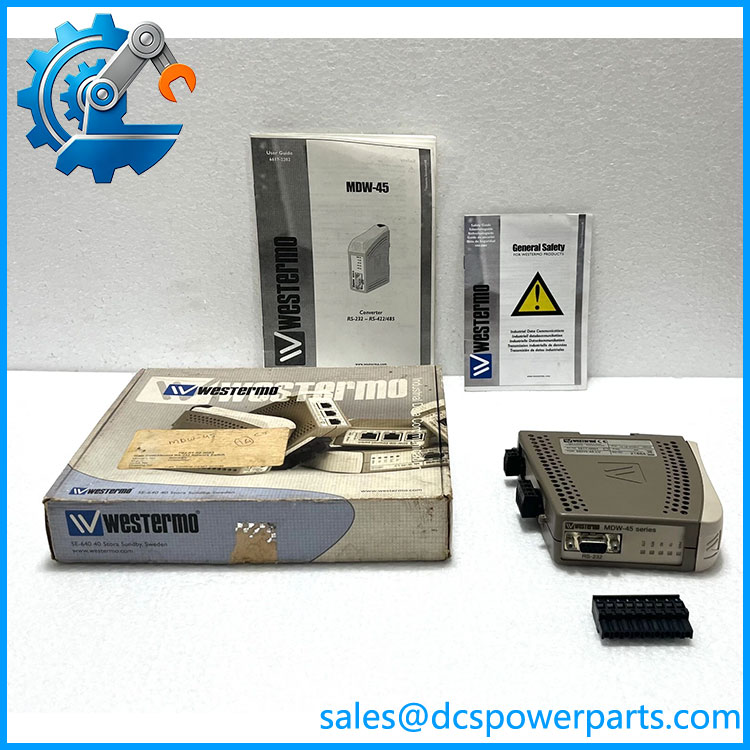
MDW-45
Automatic RS-485 Direction Control
Two-wire RS-485 is half-duplex, so the transmitter must be enabled at the appropriate time. The can automatically determine bus direction from the data it receives, allowing operation with RS-232 equipment that does not expose the necessary handshaking signal. The maximum documented transmission rate is 115.2 kbit/s.
This feature can save an otherwise awkward interface redesign when integrating older serial equipment into an existing RS-485 network.
Galvanic Isolation
The incorporates galvanic isolation between the relevant interface sections and an isolated power supply. Transient protection is also part of the design. For plant networks crossing different cabinets or equipment with different electrical reference potentials, this can be more important than the nominal baud rate.
Isolation should not, however, be interpreted as permission to ignore grounding and shield design. Cable routing, termination, reference conductors, and shield bonding still matter.
Selectable Termination and Fail-Safe Bias
The RS-422/485 interface provides DIP-switch selectable 120 Ω termination and 680 Ω fail-safe biasing. This gives the installer control over the physical bus configuration instead of forcing one fixed termination arrangement.
On a multidrop network, termination belongs at the appropriate ends of the transmission line—not automatically at every node. Incorrect termination can create communication faults that look like software or protocol problems.
Industrial DIN-Rail Installation
The uses a dedicated DIN-rail enclosure with an integral mounting clip. Front LEDs provide status information for power and serial activity, while DIP switches handle the communication configuration.
The documented operating range of -40 to +70°C makes the unit suitable for demanding cabinet environments, and Westermo documentation also records EMC, shock, vibration, and railway-trackside testing.
Two Power Variants
This is an easy detail to overlook during procurement. The and are not simply different labels for the same power input.
- rated 12–48 VDC; operating 9.6–57.6 VDC.
- rated 95–240 VAC or 110–250 VDC; operating 85.5–264 VAC or 88–300 VDC.
Before replacing a failed unit, read the complete article number from the existing label. Installing the wrong power variant is an avoidable commissioning error.
Related Products
- Westermo MD-45 LV/HV — Related RS-232 to RS-422/485 converter family. Verify mechanical, electrical, and interface requirements before considering substitution.
- Westermo MD-52 — RS-232 isolator rather than an RS-232-to-RS-422/485 converter; useful for a different isolation requirement.
- Westermo MD-54 — RS-232 CTS generator; intended for serial handshaking applications rather than direct RS-422/485 conversion.
- Westermo MD-52 LV/HV — Related serial-interface isolation equipment for legacy communication systems.
- Westermo MD-45 — Closely related converter family for RS-232 and RS-422/485 applications.
- Westermo EDW-100 — Industrial serial/Ethernet communication equipment for applications where network architecture has moved beyond a purely serial link.
- Westermo SDW-550 — Industrial Ethernet switching equipment for installations requiring Ethernet network infrastructure rather than direct serial conversion.
- Westermo DIN-rail serial converters — Related equipment for maintaining legacy serial communication in industrial cabinets.
FAQ
What exactly does the Westermo do?
It converts the electrical serial interface between RS-232 and RS-422/RS-485. It can connect equipment such as PLCs, drives, PCs, and other serial automation devices.
Is a Modbus converter?
Not in the protocol-conversion sense. The is a physical/interface converter. If the connected devices use Modbus RTU, the Modbus messages can pass through the serial link, but the does not independently translate one application protocol into another.
Can I use for a two-wire RS-485 network?
Yes. The documentation specifically supports two-wire half-duplex RS-485 and provides automatic bus-direction control. Four-wire RS-422/RS-485 configurations are also supported.
What baud rates does support?
The RS-232 interface supports 1,200 to 115.2 kbit/s, while the RS-422/485 interface is documented from 300 bit/s to 115.2 kbit/s. The exact system baud rate still needs to match the connected equipment.
Is available in 24 VDC and high-voltage versions?
Yes. The accepts 12–48 VDC rated supply, while the is rated for 95–240 VAC and 110–250 VDC. Their operating ranges are wider. Confirm the complete article number before replacement.
Can I hot-swap the ?
Do not assume unrestricted hot swapping. Although it is a DIN-rail communication device rather than a safety controller, removing it interrupts the serial communication path. If the link is supporting an operating PLC, drive, protection device, or SCADA connection, perform the replacement under the site’s approved maintenance procedure.
Does support firmware v3.1?
The base part number does not establish a firmware version. Configuration is primarily performed through DIP switches, while the hardware contains an internal microcontroller for data-flow management.
What should I check before replacing an existing ?
Check the complete article number, especially LV versus HV, then verify RS-232 pin usage, RS-422/485 wiring, two-wire versus four-wire operation, baud rate, parity, stop bits, bus termination, fail-safe biasing, and grounding/shielding. If the existing unit is still operational, photograph the DIP-switch settings before removal.
Procurement Note
For Westermo procurement, do not stop at the family name. Confirm:
- Complete Westermo article number
- LV or HV
- Supply voltage and polarity requirements
- RS-232 connector and pin assignment
- RS-422/RS-485 two-wire or four-wire arrangement
- Communication speed
- Data bits, parity, and stop bits
- 120 Ω termination setting
- 680 Ω fail-safe bias setting
- Existing DIN-rail installation and wiring
- Condition and test evidence for used/refurbished stock
For the documented versions, Westermo lists 3617-0001 for LV and 3617-0101 for HV.
The practical lesson is simple: is a serial interface device, not a protocol gateway or PLC module. When diagnosing a failed unit, verify the physical serial layer first. A wrong baud rate, incorrect RS-485 polarity, missing termination, or incorrect DIP-switch configuration can produce symptoms that look exactly like a failed controller or communication protocol.