Description
Product Overview
9760-210 is the current-input termination panel used on Tricon v9 and v10 safety systems: a passive wiring assembly that takes 32 field current loops, current-limits each one through a 180 Ω series resistor, and converts the loop current to a 0–5 VDC signal across a precision 250 Ω shunt so the analog input module behind it has something it can measure. The assembly part number 3000470-510 identifies the same panel in Triconex’s hardware numbering, with a revision suffix (REV A and later) that tells you which build you are holding.
Nothing about this device is intelligent. There is no processor, no address, no firmware, no configuration file and no diagnostic bus — it cannot be “reflashed” or “re-addressed” because it has nothing to flash and nothing to address. That is precisely why it deserves its own article: it fails in ways that look exactly like a failed analog input module, and it costs a fraction of one.
The structural detail that causes most site confusion is the arithmetic. Tricon analog input modules such as the 3704E and 3720 are 64-point devices, while each panel terminates 32 points — so every module needs two panels, and each panel ships with two sets of labels, 1-32 and 33-64. Wire the second half of a module into a panel still labelled 1-32 and the symptom is not a wiring error but “the top half of the module works and the bottom half reads zero”, which sends maintenance after the module instead of the terminal block.
The other detail is the resistor pair. A panel built for a 0–5 VDC module carries a 250 Ω shunt; the 0–10 VDC variant, 9760-410, carries 500 Ω. Fit the wrong one and every channel reads at roughly half scale, consistently and quietly, which reads on the operator screen as a calibration or transmitter problem rather than as the wrong spare part in the cabinet.
Technical Specifications
| Parameter | Value |
|---|---|
| Panel model | 9760-210 |
| Assembly part number | 3000470-510 (with revision suffix, e.g. REV A) |
| Manufacturer | Triconex (Invensys / Schneider Electric) |
| Product type | Analog input termination panel, current input |
| Panel class | 32-point current input, 0–5 VDC |
| Points per panel | 32 |
| Terminal arrangement | 32 power output terminals (+) and 32 current input terminals (–) |
| Series element per point | 180 Ω current-limiting resistor on each positive terminal |
| Shunt per point | 250 Ω precision resistor for current-to-voltage conversion |
| Field power | Redundant 24 VDC sources with diode ORing |
| Compatible modules | 3704E and 3720 analog input modules, 64 points each |
| Panels per module | Two — one for points 1-32, one for points 33-64 |
| System generation | Tricon v9 and v10 |
| Reference document | Triconex Field Terminations Guide for Tricon v9–v10 Systems, Chapter 5 |
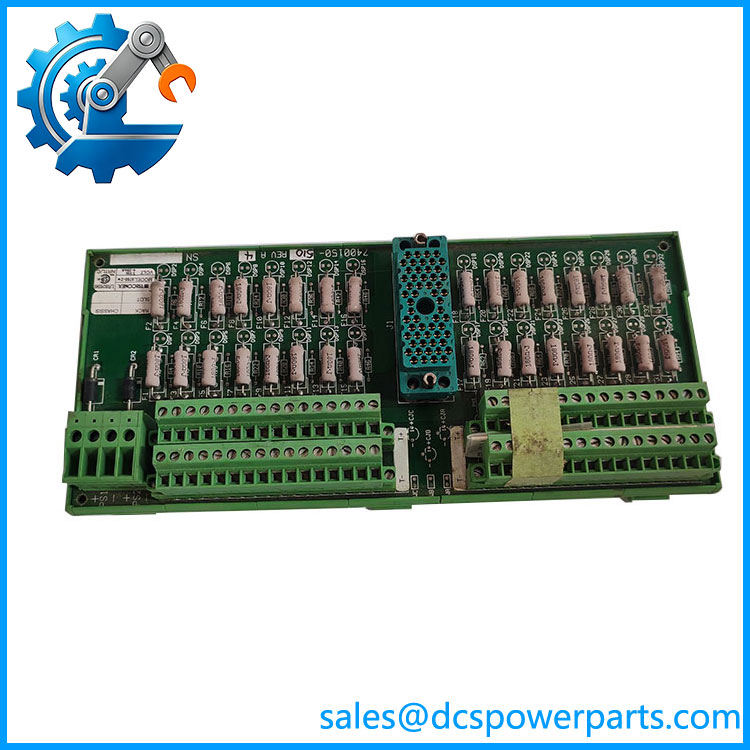
3000470-510–9760-210
Key Features and Advantages
Passive by design, so the failure is diagnosable with a meter: there is no state to lose and no software to corrupt. A channel that reads zero, reads high, or drifts can be traced at the terminals with a resistance check — 180 Ω across the series element, 250 Ω across the shunt — before anything is unplugged from the chassis. That is a fifteen-minute diagnosis that routinely replaces a four-figure module swap.
Two panels per module is a feature, not an inconvenience: the 32-point split keeps terminal density at a level a technician can wire and label without miscounting, and it lets a single failed field loop be isolated without disturbing the other half of the module. The cost of that convenience is the labelling discipline described above.
Redundant field power through diode ORing: each point’s loop supply can come from two 24 VDC sources without either back-feeding the other, so the loss of one supply does not take 32 process measurements with it. In a safety cabinet where the field power supplies are themselves redundant, this keeps the redundancy chain intact all the way to the terminal.
Signal-range variants that match the module, not the panel’s looks: 9760-210 serves 0–5 VDC modules, 9760-410 serves 0–10 VDC modules with a 500 Ω shunt, 9750-210 is the basic current input panel without the loop supply arrangement, and 9765-210 handles three-wire current input. Ordering by the module behind the panel, not by the picture on the quotation, is the whole selection decision.
Cheap enough to stock, critical enough to matter: 3000470-510 is one of the lowest-cost parts in a Tricon cabinet and one of the most frequently misdiagnosed. Holding two spares per system removes the temptation to “prove” a panel is good by swapping the module first.
Applications
Emergency shutdown and fire-and-gas systems in refineries and gas plants use 9760-210 on the analog input side of the SIS, where 4–20 mA transmitters for pressure, level and flow are terminated 32 points at a time and the loop’s integrity is the first thing a proof test exercises.
Offshore platforms and wellhead control panels rely on the same panel for compact analog termination in cabinets where space is measured in modules, and where a half-module failure caused by mislabelled points is indistinguishable, at the HMI, from a field transmitter failure.
Chemical and petrochemical units with 3704E or 3720 analog input modules use it for reactor temperature, column pressure and analyzer signals, and typically discover during a turnaround that the “drifting channel” they have been compensating in the DCS for years is a degraded shunt resistor on the panel.
Power generation and turbomachinery protection cabinets apply the panel where high-channel-count analog monitoring is needed and where the field wiring arrives on screw terminals rather than on a marshalling rack.
Water treatment and pipeline stations, running Tricon systems well past their original design life, keep 3000470-510 in stores specifically because the panel is the part that ages gently — it is the wiring, the ferrules and the resistor solder joints that fail, not the electronics that were never there.
Related Products
9760-410 — the 0–10 VDC variant of the same 32-point current input panel, with a 500 Ω shunt instead of 250 Ω; wrong choice shows as half-scale readings. 9750-210 — basic 32-point current input panel, 0–5 VDC, without the powered-loop terminal arrangement. 9765-210 — three-wire current input panel, 32 points, for transmitters that need the third wire. 3704E — 64-point analog input module, 0–5 VDC or 0–10 VDC, commoned, high-density, DC-coupled, TMR; the module this panel serves. 3720 — 64-point analog input module, 0–5 VDC, single-ended, high-density, TMR; the other compatible module. 3000470-510 assembly number — the hardware identity of 9760-210; quote it with the revision when the warehouse tracks builds rather than panel types. Tricon termination panel labels 1-32 / 33-64 — the accessory that decides whether the second half of a 64-point module is wired or lost.
Installation and Maintenance
Before installation: confirm which half of the module the panel serves, and apply the 33-64 label before any wire is landed — the single most common fault on 9760-210 is a correctly wired panel carrying the wrong label range. Verify the panel variant against the module’s signal range, check that the field loop supply polarity and the redundant 24 VDC feeds are correct, and isolate the loop before touching terminals, since a live 24 VDC loop on a safety input will register as a process value until someone notices.
Maintenance practice: at each proof test, measure rather than assume — 180 Ω across the series element and 250 Ω across the shunt, point by point, with the field wiring disconnected. Log any point that has drifted more than a few ohms, because a shunt that has moved is a channel that will read wrong under load. Keep ferrules tight, replace rather than re-tighten a terminal that has been torqued repeatedly, and hold at least one spare 3000470-510 per system so that a suspected panel can be substituted in minutes and the removed one tested on the bench instead of argued about on the phone.
Warranty and Quality
Each 9760-210 is supplied as the 32-point current input termination panel identified by assembly number 3000470-510, with the revision and signal range verified so the buyer receives the 0–5 VDC panel and not the visually identical 0–10 VDC variant. Panels are inspected for terminal condition, resistor values and label sets before dispatch, and carry a 12-month repair, replacement or refund commitment. Support concentrates on the decisions that actually determine whether the part works: matching panel variant to the 3704E or 3720 module behind it, confirming the 1-32 / 33-64 point range, and helping separate a genuine panel fault from the module, the field loop or the supply that usually gets blamed for it.