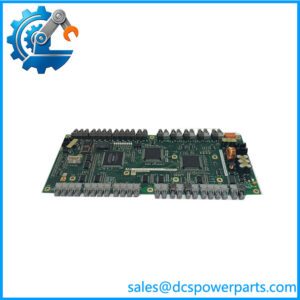
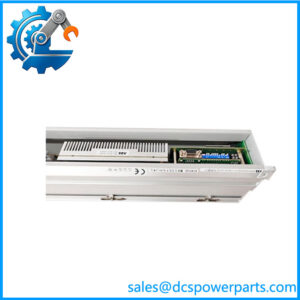
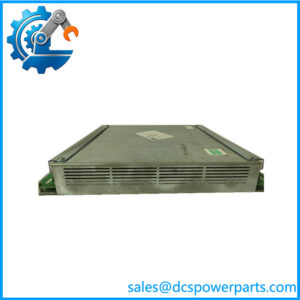
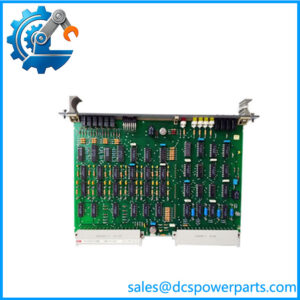
Description
ABB SPAJ 110 C Earth-Fault Relay
Product Overview
The ABB SPAJ 110 C is a microprocessor-based earth-fault protection relay from ABB’s SPACOM 100 series, designed for selective non-directional earth-fault protection in power-distribution systems. ABB identifies the relay for both primary and backup protection in solidly grounded and low-resistance grounded networks. Its protection arrangement consists of two neutral-overcurrent stages: a low-set earth-fault stage I₀> and a high-set stage I₀>>. The low-set stage can operate with either definite-time or inverse-time characteristics, while the high-set stage operates with a definite-time characteristic.
The ABB SPAJ 110 C is intended for applications including feeders, transformers, generators, and motors where residual-current measurement is used to detect earth faults. The relay accepts either 1 A or 5 A nominal current inputs and supports 50 Hz or 60 Hz systems. Its front panel provides indication and adjustment functions for measured residual current, protection-stage operation, and internal relay status. A serial interface is provided for connection to an optical object bus and higher-level substation or network control systems.
The SPAJ 110 C is now a legacy product. ABB lists the relay as no longer active since 2009 and includes it within its legacy relay portfolio. This makes correct identification particularly important when sourcing replacement equipment. The current replacement strategy should be based on the existing protection scheme, CT ratio, trip logic, communication requirements, panel dimensions, and relay settings rather than treating the SPAJ 110 C as a generic overcurrent relay.
Product Introduction
The SPAJ 110 C forms part of ABB’s SPACOM protection-relay family and was developed for medium-voltage distribution protection applications. The relay’s main measurement is zero-sequence or residual current, allowing it to detect current flowing as a result of an earth fault.
Residual current can be measured using the residual connection of three phase current transformers or by using a dedicated cable current transformer. ABB’s application documentation shows the relay being used as two-stage non-directional earth-fault protection for feeders.
The relay also provides configurable output-relay functions, external blocking/deblocking capability, self-supervision, fault recording, and front-panel indication. These functions make it suitable for protection schemes where the relay must provide both trip initiation and useful diagnostic information to maintenance personnel.
Main Features and Advantages
Two-Stage Earth-Fault Protection
The SPAJ 110 C provides two independent earth-fault protection stages. The low-set I₀> stage is intended to detect lower-level earth faults and can use either definite-time or inverse-time operation. The high-set I₀>> stage provides faster high-current earth-fault protection using definite-time operation.
This two-stage arrangement allows the protection engineer to coordinate the relay with upstream and downstream protection devices while maintaining faster clearing for severe faults.
Flexible CT Input Configuration
The relay is available for systems using 1 A or 5 A nominal current inputs, with 50 Hz or 60 Hz operation. The actual relay variant should be confirmed from the nameplate before replacement because the CT input and auxiliary-supply configuration are part of the ordering requirements.
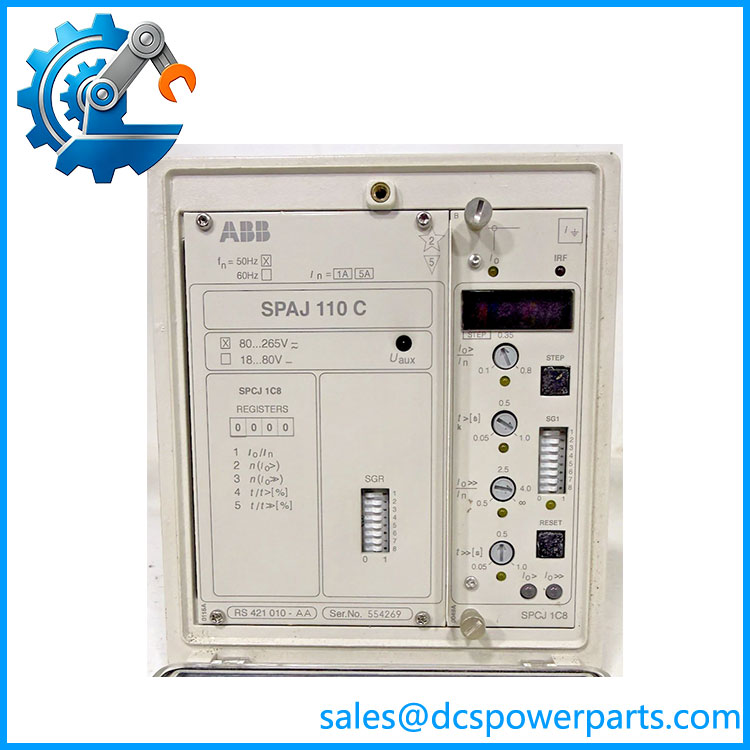
SPAJ110C
Selective Feeder Protection
ABB specifies the SPAJ 110 C for selective earth-fault protection of feeders and also identifies applications involving transformers, generators, and motors. It can therefore be used as either primary or backup earth-fault protection depending on the overall protection scheme.
Configurable Output Functions
The output-relay functions can be configured for the requirements of the particular protection application. This provides flexibility when integrating the relay into an existing trip, alarm, blocking, or indication scheme.
Self-Supervision and Diagnostics
The relay incorporates continuous self-supervision with automatic diagnostics of hardware and software. Front-panel indicators provide information about residual-current measurement, relay operation, and internal relay-fault conditions.
Serial Communication
A serial interface is provided for connection to an optical object bus and substation or network control systems. This capability is useful in installations where protection-relay information is integrated into a broader station-control architecture.
Legacy Replacement Considerations
The SPAJ 110 C has been inactive since 2009. For an existing installation, replacement should begin with the original relay’s complete ordering information, CT input rating, auxiliary supply range, protection settings, output-contact assignments, and communication arrangement.
Do not assume that another SPAJ-family relay is a direct functional substitute simply because the front-panel dimensions appear similar. Protection characteristics, measured quantities, terminal assignments, and application logic can differ between relay types.
For refurbished equipment, practical testing should include auxiliary-power startup, residual-current measurement, both protection-stage pickup tests, timing verification, output-contact operation, self-supervision indication, and communication checks where the serial interface is used.
Key Technical Specifications
| Parameter | Specification |
|---|---|
| Manufacturer | ABB |
| Model | SPAJ 110 C |
| Product Family | SPACOM 100 Series |
| Product Type | Earth-Fault Protection Relay |
| Protection Principle | Non-directional earth-fault / neutral overcurrent |
| Low-Set Stage | I₀> |
| High-Set Stage | I₀>> |
| Low-Set Characteristic | Definite-time or inverse-time |
| High-Set Characteristic | Definite-time |
| Rated Current | 1 A or 5 A |
| Rated Frequency | 50 Hz / 60 Hz |
| Auxiliary Supply | 80–265 VAC/DC or 18–80 VAC/DC, depending on version |
| Measurement | Residual / zero-sequence current |
| Communication | RS 421 serial interface |
| Communication Application | Optical object bus / substation and network control |
| Self-Supervision | Continuous hardware and software diagnostics |
| Typical Applications | Feeders, transformers, generators, motors |
| Output Functions | Configurable |
| Product Status | Legacy / not active since 2009 |
The auxiliary supply and current-input version must be confirmed from the specific relay nameplate. ABB documentation shows the available supply and input variants, so these should not be assumed from SPAJ 110 C alone.
Related Products
- ABB SPAJ 111 C — Sensitive Earth-Fault Relay
- ABB SPAJ 115 C — Earth-Fault Protection Relay
- ABB SPAJ 131 C — Three-Phase Overcurrent Relay
- ABB SPAJ 135 C — Combined Overcurrent and Earth-Fault Relay
- ABB SPAJ 140 C — Overcurrent and Earth-Fault Relay
- ABB SPACOM 100 Series Protection Relays
ABB’s current legacy-relay documentation lists SPAJ 110 C together with these related SPACOM protection products.
Frequently Asked Questions
What is the ABB SPAJ 110 C?
The SPAJ 110 C is a two-stage non-directional earth-fault protection relay used in power-distribution protection schemes.
What protection functions does SPAJ 110 C provide?
It provides a low-set earth-fault stage I₀> and a high-set earth-fault stage I₀>>. The low-set stage supports definite-time or inverse-time operation, while the high-set stage uses definite-time operation.
Where is SPAJ 110 C typically used?
ABB specifies it for primary or backup earth-fault protection of feeders, transformers, generators, and motors.
Does SPAJ 110 C support 1 A and 5 A CT inputs?
Yes. The relay documentation identifies 1 A and 5 A nominal current versions.
What auxiliary supply does SPAJ 110 C use?
The documented versions include 80–265 VAC/DC and 18–80 VAC/DC. The exact supply version must be checked against the relay nameplate.
Does the relay have communications?
Yes. ABB specifies a serial interface for connection to an optical object bus and substation/network control systems.
Is SPAJ 110 C still an active ABB product?
No. ABB identifies SPAJ 110 C as a legacy relay and states that it has not been an active product since 2009.
What should be checked before purchasing a replacement?
Verify the complete ordering code, 1 A/5 A CT input, auxiliary-supply range, frequency, protection settings, terminal arrangement, output configuration, communication requirements, and panel installation dimensions. For an operational protection system, secondary-injection testing should be performed before returning the replacement relay to service.