Description
SKF CMPT CTU
Product Overview
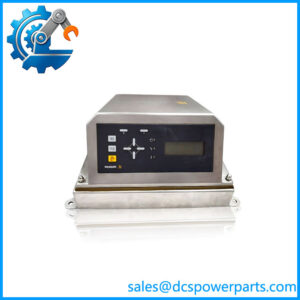
The SKF CMPT CTU is a Copperhead digital vibration and temperature transmitter designed to convert accelerometer signals into processed condition-monitoring values for machinery fault detection. Unlike a conventional vibration sensor that simply passes an electrical signal to another instrument, the SKF CMPT CTU performs selectable signal analysis inside the transmitter. Supported processing includes SKF Acceleration Enveloping (gE), acceleration, and ISO velocity. This makes the unit suitable for continuous monitoring of machinery where a PLC or DCS needs a usable vibration value rather than an unprocessed accelerometer waveform. SKF documentation identifies the CTU as part of a machinery fault-detection system and specifies compatibility with accelerometers from 10 to 230 mV/g.
From an automation-system perspective, the SKF CMPT CTU sits between the vibration sensor and the plant control or monitoring architecture. Its processed vibration and temperature outputs can be connected to PLC/DCS analog inputs or to SKF CMPT DCL display/alarm modules. The unit also provides a CAN-bus interface for connecting multiple CTUs and supporting remote configuration and monitoring through SKF software. The internal isolated DC/DC converter separates the sensor/input circuitry from the 24 V supply and CAN-bus circuitry, helping address grounding-loop problems in distributed installations.
For maintenance teams, the important point is that this is not a generic 4–20 mA vibration transmitter. Its signal processing, range selection, sensor sensitivity, averaging, and acceleration-enveloping behavior are part of the measurement chain. A replacement therefore needs to match the original sensor and configuration rather than simply matching supply voltage and physical dimensions. SKF documentation also identifies a buffered BNC output, front-panel configuration switches, sensor-status indication, and DIN-rail mounting.
Product Introduction
When a plant needs continuous bearing, gearbox, motor, pump, or fan monitoring without installing a full vibration-analysis rack, the SKF CMPT CTU provides local signal processing before the measurement reaches the PLC/DCS. That is particularly useful where maintenance personnel need acceleration enveloping for bearing or gear fault detection while the control system receives a conventional analog signal.
For a legacy replacement, do not treat the CTU as an interchangeable 24 VDC transmitter. Sensor sensitivity, selected analysis mode, output range, and existing CMPT configuration all affect the resulting engineering value.
Key Technical Specifications
| Parameter | Specification |
|---|---|
| Product Model | SKF CMPT CTU |
| SKF Part Number | 32163100 |
| Product Family | SKF CMPT Copperhead |
| Product Type | Digital vibration and temperature transmitter |
| Sensor Input | Industrial accelerometer, 2-wire constant-current type |
| Accelerometer Sensitivity | 10–230 mV/g |
| Sensor Bias Voltage | 12 VDC ±1 V |
| Sensor Supply Current | 4–8 mA |
| Power Supply | 24 VDC, 22–28 VDC |
| Maximum Current | 250 mA |
| Power Consumption | 6 W |
| Vibration Processing | Acceleration Enveloping, acceleration, velocity |
| Acceleration Enveloping Band | 500 Hz–10 kHz |
| Acceleration RMS / Peak Hold | 2 Hz–20 kHz |
| Velocity ISO Band | 10 Hz–1 kHz |
| Vibration Analog Output | 4–20 mA / 0–10 VDC |
| Temperature Output | 4–20 mA / 0–10 VDC |
| Temperature Measurement Scale | 0–120°C |
| Communication | CAN bus |
| Auxiliary Sensor Supply | +24 VDC, 20 mA maximum |
| Mounting | 35 mm DIN rail, EN50022 |
| Operating Temperature | 0–70°C |
| Storage Temperature | −40 to +85°C |
| Maximum Humidity | 95% |
| Protection Rating | IP20 |
| Dimensions | 75 × 45 × 118 mm |
| Approx. Weight | 0.225 kg |
| Enclosure | Thermoplastic ABS |
The specifications above are based on the SKF CMPT CTU documentation; configuration-dependent output ranges should be checked against the installed unit before commissioning.
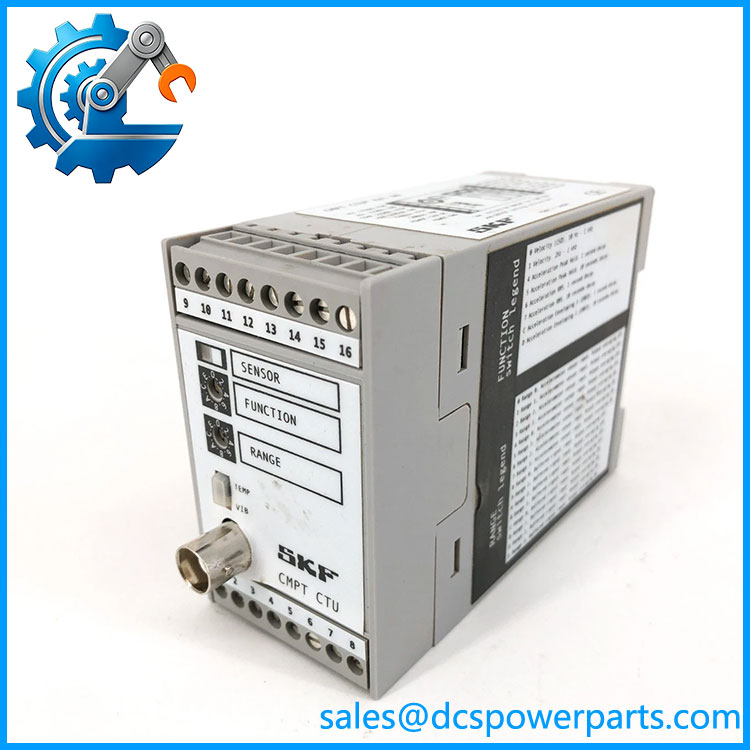
SKF CMPT CTU
Major Features / Practical Advantages
Selectable Vibration Processing
The CTU can process the accelerometer signal as Acceleration Enveloping (gE), acceleration (g), or velocity. These modes address different maintenance objectives. Acceleration enveloping is aimed at repetitive impact signatures associated with rolling-element bearing damage, gear faults, looseness, and lubrication-related problems. Overall acceleration is useful for general machinery and structural vibration, while velocity is commonly used for overall machine vibration assessment.
Direct PLC/DCS Interface
Processed vibration and temperature values are available as analog outputs, allowing the CTU to feed conventional PLC or DCS analog-input channels. The output can be configured as 4–20 mA or 0–10 VDC. A signal below 4 mA or above 20 mA can indicate a system fault, providing useful diagnostic separation from the normal measurement range.
Useful for Low-Speed Machinery
A particularly useful feature is the Acceleration Enveloping capability for low-speed equipment. SKF documentation specifically identifies operation on machinery below approximately 40 r/min when the appropriate peak-hold configuration is used. The CTU also supports velocity monitoring down to lower speeds than a basic fixed-band vibration transmitter.
CAN-Bus Networking
Multiple CTU modules can share a CAN-bus connection for remote monitoring and configuration. This can reduce the amount of individual communication wiring in a distributed condition-monitoring installation. The CAN interface is SKF-specific in its application; do not assume that a PLC can communicate with the CTU simply because the PLC has a generic CAN interface.
Built-In Sensor Diagnostics
The front-panel SENSOR OK indication provides a quick field check of the sensor/CTU chain. The documented indication changes when the sensor is faulty, disconnected, or when the vibration or temperature exceeds the configured range. This is useful during commissioning because it gives technicians a local diagnostic point before troubleshooting the PLC/DCS input.
Isolated Internal Power Architecture
The CTU uses an internal isolated DC/DC converter to separate the 24 V supply and CAN-bus circuitry from sensor and analog-output circuitry. Reverse-polarity protection is also documented. This is a practical advantage in plant installations where multiple instruments share power and grounding arrangements.
Field Configuration Without Opening the Housing
Configuration is performed through front-panel rotary switches rather than internal jumpers. The CTU supports selectable output range, vibration-processing mode, signal averaging, and acceleration-enveloping peak-hold decay options. For low-speed machinery, SKF documents a 10-second decay option compared with the normal 1-second setting.
Related Products
- SKF CMPT DCL — Single-channel display/alarm module designed to work with the CTU for local indication and relay-based alarm functions.
- SKF CMPT 2310T — CMPT accelerometer with temperature capability for use in CTU-based monitoring.
- SKF CMPT 2323T — CMPT sensor configuration supporting vibration and temperature monitoring.
- SKF CMPT Copperhead Sensors — Sensor family used as the measurement source for the CTU.
- SKF Microlog — Portable vibration-analysis equipment that can use the CTU’s buffered vibration output for diagnostic measurements.
- SKF CMPT CPHD — Related Copperhead monitoring architecture and configuration environment.
- SKF CMPT Condition Monitoring System — Broader monitoring architecture in which CTU and DCL modules can be deployed.
- SKF Acceleration Enveloping System — Relevant application technology for bearing and gear fault detection using processed vibration.
FAQ
What exactly does the SKF CMPT CTU do?
It accepts an accelerometer signal, processes the vibration measurement using a selectable analysis method, and provides processed vibration and temperature outputs for automation or condition-monitoring equipment. It is a transmitter/processing unit, not the accelerometer itself.
Can I connect the CTU directly to a PLC or DCS?
Yes. The documented analog outputs are intended for interface with PLC/DCS systems and CMPT DCL monitoring modules. Before wiring a replacement, confirm whether the existing control system expects 4–20 mA or 0–10 VDC and verify the configured measurement range.
What accelerometers are compatible?
The CTU is documented for industrial accelerometers with sensitivity from 10 to 230 mV/g. The original sensor’s sensitivity should be checked because the selected CTU range affects the engineering value represented by the analog output.
Can I hot-swap the CMPT CTU?
Do not assume hot replacement. The published documentation describes DIN-rail installation and electrical wiring but does not establish a hot-swap procedure for the CTU. For a live plant replacement, isolate the 24 VDC supply and follow the site’s machinery-monitoring and electrical work procedures.
Does the CMPT CTU support firmware v3.1?
The CTU contains embedded digital signal-processing software and calibration functionality, but the available documentation does not establish a firmware designation such as v3.1 for this model. Do not use a firmware number from another SKF CMPT product as evidence of compatibility.
Can one CTU monitor both vibration and temperature?
Yes. The CTU supports processed vibration output and temperature output when used with an appropriate sensor configuration. SKF documents temperature conversion for accelerometers with integral temperature sensors and a temperature output proportional to 0–120°C.
How far can the CTU be installed from the sensor?
SKF documentation states that the CTU can be located up to 100 m (330 ft) from the sensor when suitable shielded cabling is used. Cable type, routing, grounding, and the specific sensor should still be checked for the actual installation.
Is the SKF CMPT CTU a conventional vibration switch?
No. It is a digital vibration and temperature transmitter with configurable signal processing. That distinction matters: the CTU produces measurement outputs for a PLC/DCS or display/alarm system, while the alarm decision may be handled by the connected automation or CMPT DCL architecture.
Procurement Note
For replacement purchasing, the CMPT CTU identification alone is not enough. Verify the SKF part number, installed accelerometer sensitivity, selected vibration-processing mode, output type, output range, averaging setting, acceleration-enveloping decay setting, CAN-bus requirements, and existing DCL/PLC/DCS interface.
The SKF instruction manual identifies the CTU as Part No. 32163100. Older units may have configuration settings that are critical to maintaining the same engineering value after replacement. A visually identical transmitter configured for a different sensor sensitivity or measurement range can produce a technically valid 4–20 mA signal while representing the wrong vibration level.
For New Surplus, Used, or Refurbished units, verify the nameplate and configuration before installation. Request evidence of power-up testing, sensor-input operation, analog-output verification, and configuration where the application is machinery protection or condition monitoring. Do not assume that a generic “tested” statement confirms calibration accuracy.