Description
Siemens 6ES7 315-2AH14-0AB0
Product Introduction
The Siemens 6ES7 315-2AH14-0AB0 is a SIMATIC S7-300 CPU 315-2 DP central processing unit designed for PLC applications requiring integrated MPI communication and a dedicated PROFIBUS DP interface. Siemens identifies the exact order number as a CPU 315-2DP with 256 KB of work memory, integrated 24 VDC power supply, and a second DP interface that can operate as a PROFIBUS master or slave. A Siemens Micro Memory Card is required for program and data storage.
The Siemens 6ES7 315-2AH14-0AB0 provides a practical architecture for S7-300 systems built around distributed PROFIBUS I/O and field devices. The CPU has an integrated MPI interface for programming and communication and a separate PROFIBUS DP interface for distributed automation equipment. Siemens specifies support for isochronous operation, with typical processing times of 0.05 µs for bit operations, 0.09 µs for word operations, and 0.12 µs for fixed-point arithmetic. The CPU operates from 24 VDC, with an allowable range of 19.2 to 28.8 VDC.
The Siemens 6ES7 315-2AH14-0AB0 is particularly relevant to existing S7-300 installations where the control application is based on PROFIBUS rather than the newer PROFINET architecture. It should not be confused with the CPU 315-2 PN/DP variants such as 6ES7 315-2EH14-0AB0. That distinction is important during replacement because the communication architecture is different. Siemens currently lists 6ES7 315-2AH14-0AB0 as a spare part, so procurement should include firmware, STEP 7 project compatibility, Micro Memory Card requirements, PROFIBUS configuration, and the existing rack configuration in the replacement check.
Technical Specifications
| Specification | Details |
|---|---|
| Product Model | CPU 315-2 DP |
| Order Number | 6ES7 315-2AH14-0AB0 |
| Manufacturer | Siemens |
| Product Family | SIMATIC S7-300 |
| Product Type | Central Processing Unit |
| Work Memory | 256 KB |
| Load Memory | Micro Memory Card required |
| Integrated Interface | MPI |
| Second Interface | PROFIBUS DP |
| PROFIBUS Operating Mode | Master / Slave |
| PROFIBUS Type | DP |
| Supply Voltage | 24 VDC |
| Permitted Voltage Range | 19.2–28.8 VDC |
| Rated Current Consumption | 850 mA |
| No-load Current | Typical 150 mA |
| Typical Power Loss | 4.5 W |
| Inrush Current | Typical 3.5 A |
| Firmware Version | V3.3 |
| Isochronous Mode | Yes |
| Bit Operation Time | Typical 0.05 µs |
| Word Operation Time | Typical 0.09 µs |
| Fixed-point Arithmetic | Typical 0.12 µs |
| Programming Software | STEP 7 V5.5 SP1 or higher; applicable earlier configurations with HSP |
| Micro Memory Card | Required |
| MMC Maximum | 8 MB |
| Installation | SIMATIC S7-300 rack / profile rail |
| Protection Rating | IP20 |
The electrical, memory, interface, processing-time, firmware, and programming specifications above are based primarily on Siemens’ exact product data sheet.
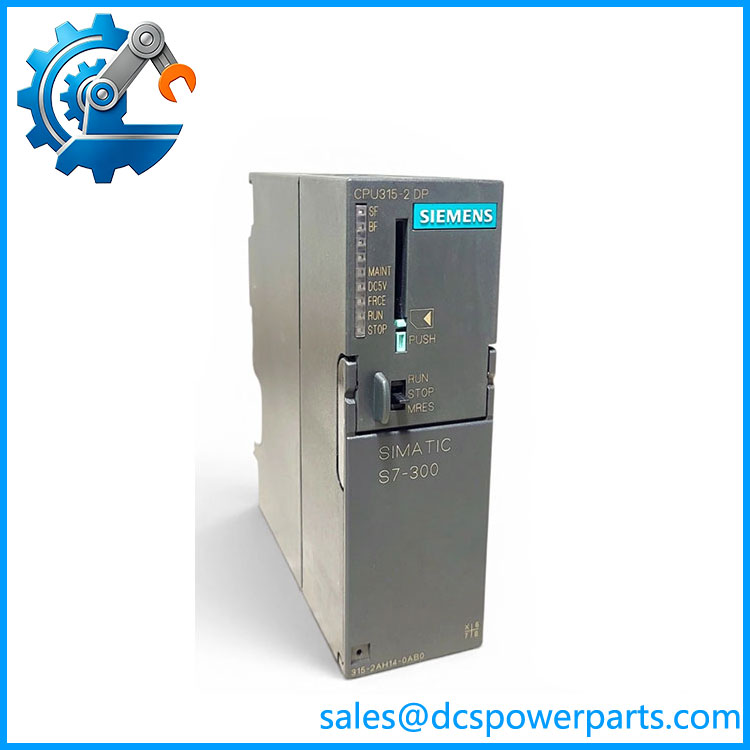
6ES7315-2AH14-0AB0
Main Features and Engineering Considerations
1. CPU 315-2 DP architecture
The 6ES7 315-2AH14-0AB0 is a dedicated PROFIBUS-generation S7-300 CPU. Its second communication interface is DP rather than PROFINET. This makes it a suitable replacement candidate for existing S7-300 machines where ET 200 or other distributed devices are connected through PROFIBUS DP.
2. MPI plus PROFIBUS DP
The CPU combines an MPI interface with the second DP interface. The DP interface can operate as a master or slave, allowing the CPU to control distributed I/O or participate as a subordinate station in a larger PROFIBUS architecture. Siemens documentation also lists the CPU as compatible with SINAUT communication applications.
3. 256 KB work memory
The CPU provides 256 KB of integrated work memory. The memory cannot simply be treated as equivalent to the load-memory capacity because the user program and stored data architecture of the S7-300 depends on the Micro Memory Card and CPU memory organization.
4. Micro Memory Card requirement
A Siemens Micro Memory Card is required. This is an important point during CPU replacement. Having the physical CPU alone does not guarantee that the machine can be returned to RUN. The correct MMC, stored program, retained data requirements, and CPU configuration must all be considered.
5. Firmware compatibility
The exact Siemens data sheet identifies firmware V3.3. The hardware revision is therefore important when replacing an earlier CPU. Siemens also documents this part as a spare-part CPU, so the replacement process should be based on the actual STEP 7 project and configured hardware rather than only the front-panel model number.
6. PROFIBUS configuration is a critical replacement issue
The DP master configuration contains station addresses, module arrangements, diagnostic behavior, and timing parameters. If the replacement CPU is introduced into an existing system, the original STEP 7 hardware configuration should be retained and verified before downloading.
7. Do not confuse it with CPU 315-2 PN/DP
This is one of the easiest procurement mistakes. 6ES7 315-2AH14-0AB0 is CPU 315-2 DP, while 6ES7 315-2EH14-0AB0 is CPU 315-2 PN/DP. Siemens lists them as separate CPU variants.
The PN/DP version provides PROFINET capability; the 2AH14 unit does not. A plant that has migrated communication from PROFIBUS to PROFINET cannot assume the two CPUs are direct functional substitutes.
8. S7-300 lifecycle considerations
The S7-300 platform is a legacy automation architecture. This particular CPU is still identifiable through Siemens documentation as a spare part, which is useful for maintenance of installed equipment, but engineers planning a larger control-system modernization should evaluate the lifecycle of the complete S7-300 installation rather than only replacing individual CPUs.
Application Scenarios
- SIMATIC S7-300 PLC systems
- Machine automation
- Process automation
- Distributed ET 200 I/O systems
- PROFIBUS DP master applications
- PROFIBUS DP slave applications
- Legacy production machinery
- Packaging and material-handling systems
- Existing S7-300 control panels
- Brownfield automation maintenance
Engineer’s Guide: Field Pitfalls
1. Do not assume 6ES7 315-2AH14-0AB0 has PROFINET.
It does not. The second interface is PROFIBUS DP. For PROFINET, check the corresponding PN/DP CPU variant.
2. Check the Micro Memory Card.
The CPU requires an MMC. Confirm the installed card and program before removing the original CPU.
3. Verify the DP master/slave role.
The same CPU hardware can participate in different PROFIBUS architectures. The replacement must match the existing STEP 7 configuration.
4. Check the firmware baseline.
The Siemens data sheet specifies V3.3. Confirm that the installed project and configured CPU are compatible before commissioning.
5. Preserve the original hardware configuration.
Do not assume a CPU swap automatically preserves the rack and distributed-I/O configuration. Compare the actual HW Config project with the installed rack.
6. Check the power supply.
The CPU is rated for 24 VDC with a permitted range of 19.2–28.8 VDC. Siemens lists typical rated current consumption of 850 mA.
7. Check the SF/BF indicators after startup.
A PROFIBUS BF fault after replacement should first be investigated through station addressing, bus termination, configuration, wiring, and diagnostic buffer information before assuming that the replacement CPU is defective.
Frequently Asked Questions
What is Siemens 6ES7 315-2AH14-0AB0?
It is the SIMATIC S7-300 CPU 315-2 DP central processing unit.
Does it have PROFIBUS DP?
Yes. The second interface is PROFIBUS DP and can operate as master or slave.
Does it support PROFINET?
No. This is the CPU 315-2 DP variant. The CPU 315-2 PN/DP uses a different order number.
How much work memory does it have?
It has 256 KB of integrated work memory.
What supply voltage does it use?
24 VDC nominal, with an allowable range of 19.2–28.8 VDC.
Is a Micro Memory Card required?
Yes. Siemens specifies that an MMC is required for this CPU.
What programming software is applicable?
Siemens specifies STEP 7 V5.5 SP1 or higher, with certain earlier STEP 7 versions supported through the applicable hardware support package.
Is it suitable as a direct replacement for every CPU 315?
No. Check the exact CPU type, communication interfaces, firmware, memory requirements, STEP 7 hardware configuration, and PROFIBUS architecture before substitution.
Procurement Note
For an exact replacement, specify Siemens 6ES7 315-2AH14-0AB0 / CPU 315-2 DP. Before purchasing, verify the firmware version, Micro Memory Card, MPI/DP configuration, PROFIBUS master/slave role, connected DP stations, and STEP 7 project version. If the existing machine uses PROFINET, this CPU is not the appropriate equivalent; the PN/DP variant has a different order number and communication architecture.