Description
Product Overview
RS-FS-9001 is the standard-sensitivity member of the Flame Tracker family from Reuter-Stokes, the Twinsburg, Ohio business that has supplied ultraviolet flame detection to gas turbine packagers for decades and now operates within Baker Hughes. The sensor is a two-wire 4–20 mA transmitter with a silicon carbide photodiode behind a sapphire window, sealed in an argon-filled stainless housing — a device whose entire purpose is to answer one question fast enough that unburnt fuel never accumulates in a combustor.
That “fast enough” is the engineering point. Response is specified at under 25 ms, an order of magnitude quicker than flame scanners that need a second or more to report loss of flame. On a gas turbine, the interval between flame-out and fuel shutoff determines how much unburnt gas enters the exhaust and whether the lower explosive limit can be reached; a sensor that reports in 25 ms moves that decision into a range where the fuel control valve can still act usefully. This is why the same part number appears in SIL-rated burner Management and turbine protection architectures.
The optical choice behind the part number matters as much as the electronics. A silicon carbide photodiode peaks near 310 nm, matching the emission peak of a hydrocarbon flame, but is deliberately more responsive to the longer ultraviolet wavelengths than the older Geiger-Müller tubes. Longer-wavelength UV penetrates the fog of fuel, steam and water vapour that fills a low-NOx or water-injected combustor, so flame-on remains detectable during water wash cycles and heavy steam injection — the conditions under which conventional UV detectors lose sight of the flame and produce nuisance trips.
Technical Specifications
表格
| Parameter | Value |
|---|---|
| Model | RS-FS-9001 (Flame Tracker, standard gain) |
| Manufacturer | Reuter-Stokes, Twinsburg, Ohio, USA (GE heritage, now Baker Hughes) |
| Product type | UV flame sensor, silicon carbide photodiode, two-wire 4–20 mA transmitter |
| Sensing element | SiC photodiode behind a sapphire window; AISI 304 housing, sealed and argon filled |
| Output signal | 4–20 mA dc, maximum below 21 mA; power and signal on the same two wires |
| Supply | 24 VDC nominal, 12–30 VDC at 100 mA; sense resistor plus wire resistance limited to 560 Ω at 24 V |
| Response time | Under 25 ms |
| Sensitivity | Above 5 mA at 1×10^10 photons/in²/s at 310 nm; ILG build 6.5 mA at the same threshold |
| Ambient temperature | −40 to +150 °C standard; 235 °C with the specified water cooling coil |
| Process pressure and mounting | Up to 400 psig (2.8 MPa); 3/4 in NPT female, AISI 316 body mount |
| Electrical interface | MIL-C-38999 series III, shell size 15, 5 pin; approved cable assembly RS-E2-0285Pxxx |
| Hazardous area rating | Class I Division 2 Groups A–D T3; ATEX and IECEx II 3 G Ex nA / Ex ic IIC T3 Gc |
| Functional safety | SIL 3 capable per exida assessment to IEC 61508, EN 298 and EN 50156-1 |
| Mechanical robustness | IP54; 8 g continuous vibration 40–2000 Hz, 14 g peak at 10–40 Hz |
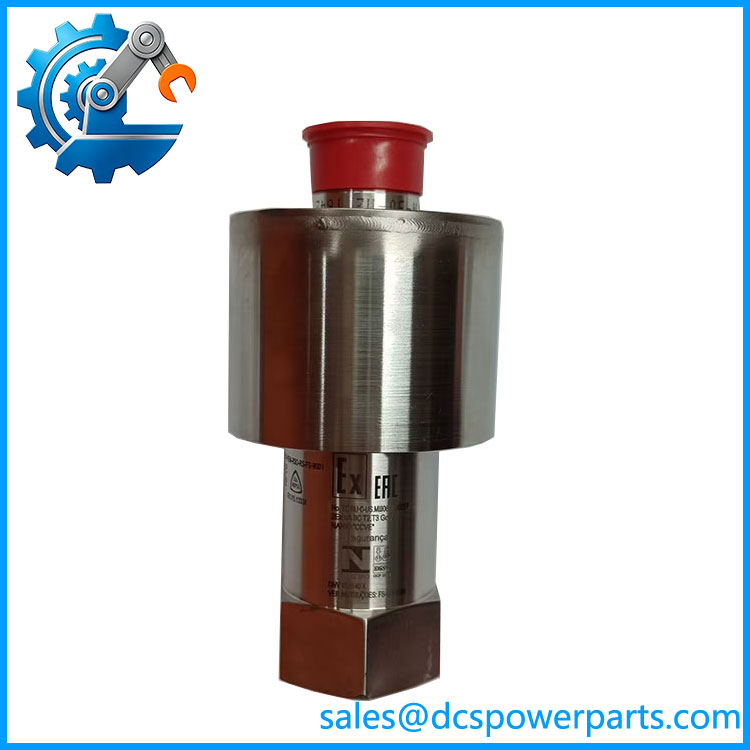
RS-FS-9001
Key Features and Advantages
Speed that changes what the trip logic can do
Twenty-five milliseconds is not a marketing figure; it is the interval within which a burner management system can still close the fuel valve before unburnt gas reaches a dangerous concentration. RS-FS-9001 reports flame loss at that speed while older scanners lag by a second or more, which is the practical difference between a protective action and a post-event record.
Spectral choice aimed at dirty combustion
The SiC element is sensitive to the longer UV wavelengths that survive the fuel-and-steam fog of dry low-NOx combustors, so the sensor keeps reading flame during water injection and during the water wash cycle itself. Operators therefore avoid the recurring nuisance trip that pushes plants toward defeating flame detection — a workaround that defeats the safety function while appearing to solve an availability problem.
Two wires, no special infrastructure
Power and signal share the same pair, the supply range spans 12 to 30 VDC, and the loop draws about 100 mA. Because the device operates at low voltage instead of the high voltage older detectors demanded, the installation avoids explosion-proof conduit and special cabling, and the quick-disconnect connector reduces a sensor swap from hours of turbine downtime to minutes of work at the sight tube.
A sealed optical path built for compressor discharge conditions
Sapphire is transparent to UV and withstands compressor discharge temperature and pressure; the transducer body is sealed and argon filled so that moisture and contaminants never reach the photodiode. RS-FS-9001 is rated to 400 psig and to 150 °C without cooling, 235 °C with the water coil — figures that place it inside the turbine compartment rather than in a remote cabinet.
Applications
Heavy-duty gas turbines in combined-cycle and simple-cycle plants are the primary home for RS-FS-9001: flame monitoring in the primary and secondary combustion zones, where a fast, fog-penetrating signal keeps the fuel control and protection logic honest through start-up sequences and water wash. Aeroderivative packages use the same sensing technology through the dedicated RS-FS-9006 variant, where air cooling rather than water cooling matches the enclosure arrangement.
Industrial boilers and process heaters in refining, petrochemical and pulp-and-paper plants form the second group: burner front plates on packaged boilers, duct burners in heat recovery trains, and kiln or furnace burners where the sight path is short and the background radiation is high. Steam methane reformers in hydrogen plants use the sensor where flame stability directly governs reformer tube life.
Hydrogen and hybrid-fuel combustion systems are an expanding application: the SiC element reads the UV signature of hydrogen flames without the black-body blindness that affects sensors tuned only to shorter wavelengths, so blending trials do not require a detector change. Marine gas turbines and offshore installations use the same part where vibration and salt-laden air rule out unsealed optics.
Plants upgrading from Geiger-Müller detectors choose RS-FS-9001 because conversion kits are mechanically and electrically interchangeable with the older mounting, letting a maintenance campaign replace the detection layer without re-machining sight tubes or re-routing conduit.
Related Products
RS-FS-9004 — the same Flame Tracker sensing core certified for Class I Division 1 and ATEX Zone 1, used where the combustor area demands a higher explosion protection category. RS-FS-9006 — aeroderivative turbine variant, Division 2 and Zone 2, with mounting arranged for aero engine packages. RS-FS-9001-25X — Increased Low Gain build of the same sensor, raising the flame-on signal to 6.5 mA at threshold so dim flames behind fouled sight tubes remain detectable. RS-FS-9009-03 / RS-FS-9010-03 — Flame Tracker Dry 325, remote-electronics evolution with a 325 °C hot end and no water cooling, the natural upgrade path where cooling maintenance is the cost driver. RS-FS-9100 / RS-FS-9101 — FT Lite burner sensors rated to 120 °C in Zone 2 and Zone 0 respectively, the cost-optimised option for industrial burners rather than turbines. RS-E2-0285P011 / RS-E2-0285P001 — approved interconnect cable assemblies with MIL-C-38999 connectors, required for the certification to remain valid. SP-566 — water cooling coil enabling operation to 235 °C at 1.0 gpm and 10 to 57 °C water. RS-E2-0259 — air cooling can for pressurised-air cooling where water is unavailable. RS-FS-9100-RELAY — DIN-rail module converting the 4–20 mA loop to a relay contact for controllers without an analogue input. RS-FSM-1002-001 — four-channel module translating 4–20 mA into open-collector logic outputs at the control-system interface.
Installation and Maintenance
Before installation: confirm the sight-tube geometry and that the 3/4 in NPT mounting will land the sapphire window on the flame axis, then decide the cooling method from the measured ambient — water coil SP-566 at 1.0 gpm and 10 to 57 °C water for locations up to 235 °C, ambient forced air of at least 1.5 m/s for enclosures, or the air-cooling can at 25 psi minimum where no water is available. Use an approved cable assembly; the certification depends on it. Wire white as positive and black as signal return, terminate the green conductor to earth at the junction box, and never bond the shields to each other. RS-FS-9001 tolerates reverse polarity without damage but will not function, so check the loop before energising.
Maintenance practice: record the normal running signal at commissioning and treat it as the reference, because output falls gradually as the lens dirties and the decline is far easier to trend than to diagnose. Verify the sensor on the bench with the port covered, expecting 3.7 to 4.1 mA in darkness and above 8 mA under a flashlight, then set the flame-off point at 6.25 percent (5 mA) and flame-on at 10 percent (5.6 mA). Clean the sapphire window with the approved procedure at each outage, keep the connector dry, and swap RS-FS-9001 through the quick disconnect rather than disturbing the mounting thread.
Warranty and Quality
RS-FS-9001 is supplied as a genuine Reuter-Stokes sensor with the manufacturer’s part marking intact, accompanied by the hazardous-area certification reference and, on request, the exida SIL assessment documentation covering systematic capability SC 3 and the IEC 61508 failure rates used in PFD calculations. Each unit is bench-checked for dark current and illuminated output before dispatch, so the receiving engineer can compare the delivered figures with the commissioning record. A 12-month warranty applies under standard practice for fired-equipment instrumentation, covering repair or replacement of quality-related failures. Support covers sight-tube and cooling selection, loop resistance calculation, controller setpoint configuration and the ILG decision where dim-flame detection is the actual problem.
免费
今天 11:20