Description
Rosemount 333U HART Tri-Loop
Product Introduction
When a plant has a multivariable HART instrument but the existing control system only has conventional analog inputs, adding separate transmitters is not always practical. The Rosemount 333U HART Tri-Loop addresses this interface problem by extracting digital HART variables and presenting them as up to three independent 4–20 mA signals. Emerson identifies Model 333U, part number 03095-0810-0001, as the High Alarm Tri-Loop, Standard Configuration.
The unit was designed as an accessory for instruments such as the Rosemount 3095 MV and 3244MV, and the broader Model 333 documentation also covers applications with compatible HART devices. Depending on the connected instrument, the available variables can include differential pressure, absolute pressure, gage pressure, process temperature, flow, or other HART variables. For legacy DCS integration, the important issue is not simply whether the device says “HART”; the actual HART burst data, channel configuration, loop resistance, and alarm behavior must match the receiving analog-input architecture.
Key Technical Specifications
| Parameter | Specification |
|---|---|
| Product Model | 333U |
| Manufacturer | Rosemount / Emerson |
| Product Family | Model 333 HART Tri-Loop |
| Full Part Number | 03095-0810-0001 |
| Product Type | HART-to-Analog Signal Converter |
| Configuration | High Alarm, Standard Configuration |
| HART Function | Digital HART variable extraction |
| Analog Outputs | 1, 2, or 3 |
| Output Signal | 4–20 mA |
| Output Variables | DP, AP, GP, PT, flow, depending on connected instrument |
| Power Supply | External supply required for each channel |
| Channel Voltage | 11–42.4 VDC |
| Channel 1 Requirement | Channel 1 must be powered for Tri-Loop operation |
| Turn-On Time | Analog signals within specification within 5 seconds |
| Reference Accuracy | ±0.045% of span |
| Ambient Temperature Effect | ±0.15% of span per 50°F (28°C) |
| Stability | ±0.1% of span for 12 months |
| Ambient Temperature | 50–104°F (10–40°C) |
| Storage Temperature | -40–158°F (-40–70°C) |
| Humidity | 0–95% RH, non-condensing |
| Electrical Connection | Screw clamps |
| Wire Size | 24–12 AWG solid or stranded |
| Mounting | DIN rail |
| Approx. Weight | 0.12 kg |
Emerson’s manual identifies the 333U as the high-alarm standard configuration and specifies one, two, or three 4–20 mA outputs. Each channel requires its own external power supply, while Channel 1 must be powered for the Tri-Loop to operate.
Application Scenarios & Pain Points
1. Legacy DCS analog-input expansion
A common field situation is an existing DCS with spare AI capacity but no practical way to consume several digital variables directly from a HART instrument. The 333U can convert selected HART variables into conventional 4–20 mA signals that the existing AI cards can process.
2. Multivariable transmitter integration
With compatible multivariable instruments, the Tri-Loop can expose variables such as differential pressure, absolute pressure, gage pressure, process temperature, and flow as separate analog outputs. This can avoid installing additional field measurement hardware solely to obtain another process variable.
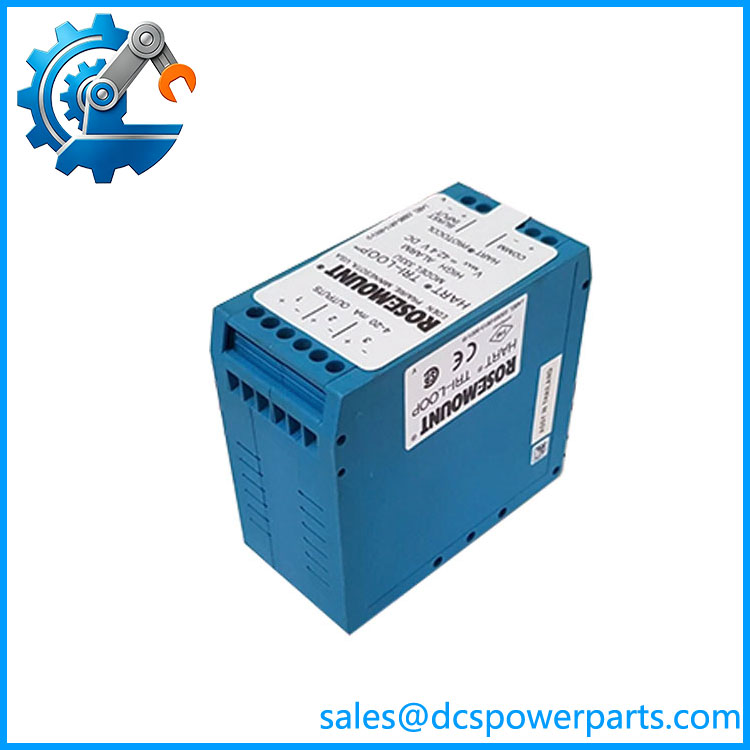
333U HART TRI LOOP-HART
3. Digital valve controller monitoring
Emerson documentation also describes the 333U with Fisher FIELDVUE digital valve controllers. HART Command 3 data from a compatible valve controller can be converted into up to three 4–20 mA signals for traditional AI channels. Depending on the controller and firmware, these variables can include travel, travel target, pressure, drive signal, and related diagnostic/process values.
4. Brownfield instrumentation upgrades
The Tri-Loop can be useful where the field instrument has HART capability but the control-system architecture has not been upgraded to a fully digital instrument network. This is particularly relevant to phased DCS modernization, where replacing the entire analog I/O infrastructure would create unnecessary project scope.
Related Products
- Rosemount 333D — Low Alarm version of the Model 333 Tri-Loop; part number 03095-0810-0002.
- Rosemount 333UC2 — High Alarm custom configuration; part number 03095-0810-0003. Custom configuration requires the applicable configuration data sheet.
- Rosemount 333DC2 — Low Alarm custom configuration; part number 03095-0810-0004.
- Rosemount 3095 MV — Multivariable instrument identified in the 333 documentation as an intended accessory application.
- Rosemount 3244MV — Another instrument identified in the Model 333 documentation as an accessory application.
- Rosemount 3051S Advanced HART Diagnostics — The 333 documentation describes compatible applications for extracting selected HART variables.
- Rosemount 3144P — Compatible application documented for extracting selected transmitter variables through the Tri-Loop.
- Fisher FIELDVUE digital valve controllers — Emerson documents use of the 333U/333D for presenting selected HART variables to conventional AI channels.
Engineer’s Guide — Field Pitfalls to Avoid
1. Do not confuse 333U and 333D
The final letter matters. 333U is the High Alarm configuration, while 333D is the Low Alarm configuration. Their alarm behavior is not an incidental software setting when sourcing a replacement.
2. Verify the exact part number
The standard 333U configuration is 03095-0810-0001. Custom high-alarm units use 333UC2 / 03095-0810-0003 and require configuration information. A physical unit marked 333U should therefore be checked against its complete identification before procurement.
3. Three outputs do not mean three independent field transmitters
The Tri-Loop derives its outputs from HART data. It is not three conventional analog input channels. The connected HART instrument must provide the variables that the Tri-Loop is configured to extract.
4. Check loop resistance carefully
Each channel has its own power supply and loop-resistance requirement. Emerson’s documentation provides the operating relationship between supply voltage and maximum loop resistance. Do not calculate the replacement only from the nominal 24 VDC supply; cable resistance, input resistance, barriers, and other loop components matter.
5. Channel 1 must be powered
The documentation specifically states that Channel 1 must be powered for Tri-Loop operation. A commissioning problem can therefore be caused by power distribution or channel wiring rather than a failed converter.
6. Treat alarm behavior as part of the control philosophy
For the 333U high-alarm configuration, the failure-mode output behavior differs from ordinary output saturation. Emerson documents separate alarm and saturation values. That distinction matters when the 4–20 mA signals feed a DCS interlock, alarm logic, or shutdown-related function.
7. Check configuration before replacing used hardware
The Tri-Loop is not a generic signal repeater. Channel assignment and variable selection affect what each analog output represents. A physically identical replacement can therefore produce the wrong process variable if configuration is not verified.
FAQ
What is the Rosemount 333U?
The 333U is a Rosemount Model 333 HART Tri-Loop HART-to-Analog Signal Converter. Its purpose is to extract digital variables from compatible HART instruments and provide up to three 4–20 mA analog outputs.
What is the full part number for 333U?
The standard high-alarm configuration is 03095-0810-0001. Emerson lists 333UC2, part number 03095-0810-0003, as the corresponding custom high-alarm configuration.
How many analog outputs does the 333U provide?
It can provide one, two, or three 4–20 mA outputs, depending on configuration. The outputs can represent selected HART variables such as pressure, temperature, or flow when supported by the connected instrument.
What is the supply voltage for the 333U?
Each channel operates from an external supply with a terminal voltage of 11–42.4 VDC. Each channel requires its own power supply, and Channel 1 must be powered for Tri-Loop operation.
Is 333U suitable for a conventional DCS?
Yes, where the connected HART instrument and the Tri-Loop configuration are compatible. The converter presents HART-derived variables as conventional 4–20 mA signals, allowing traditional DCS or PLC AI channels to receive those variables.
What is the difference between 333U and 333D?
Both are Model 333 HART Tri-Loop configurations. 333U is the High Alarm version, while 333D is the Low Alarm version. The alarm configuration should be matched to the existing control-system philosophy before replacement.
Is Rosemount 333U still a current-generation product?
The technical documentation clearly identifies the 333U as the Model 333 product, but current secondary procurement records classify 333U as discontinued. Because that status is not established by the Emerson manual itself, procurement should verify current manufacturer availability separately rather than assuming either active or discontinued status from a reseller listing.
What should procurement verify before buying a 333U?
Verify 333U, the full part number 03095-0810-0001, high-alarm configuration, physical condition, terminal condition, configuration data, and compatibility with the specific HART instrument. For used inventory, do not assume that a unit marked 333U has the same configured channel assignments as another unit; configuration should be checked before installation.