Description
Product Overview
Bender RCMA475-23 is a residual current monitoring device designed for continuous supervision of electrical installations where early detection of leakage and fault currents is required. Unlike conventional residual current devices that disconnect power, a residual current monitor primarily provides measurement, warning, and alarm functions to allow maintenance teams to respond before a critical shutdown occurs.
The Bender RCMA475-23 belongs to the RCMA family of AC/DC sensitive monitoring devices. It is designed to detect residual currents caused by insulation deterioration, damaged wiring, converter leakage, and equipment aging. The unit can monitor both AC residual currents and DC components, making it suitable for modern installations containing rectifiers, frequency converters, UPS systems, and power electronic loads.
Typical system architecture:
Electrical Load / Machine → Measuring Current Transformer → RCMA475-23 → Alarm Relay / PLC / Building Management System
The Bender RCMA475-23 is commonly integrated into industrial control panels where uninterrupted operation is important. Instead of waiting for an insulation fault to reach a shutdown threshold, the monitor provides advance warning through alarm outputs.
Applications include:
- Industrial automation cabinets
- Motor drive systems
- Renewable energy equipment
- Battery charging systems
- UPS installations
- Power conversion equipment
For replacement projects, engineers should verify the exact RCMA variant, measuring transformer type, response settings, supply voltage, and alarm configuration. Residual current monitors depend heavily on correct sensor selection and wiring practices. A replacement unit with matching dimensions may still produce incorrect readings if the connected measuring transformer or configuration differs.
Technical Specifications
| Parameter | Specification |
|---|---|
| Manufacturer | Bender GmbH & Co. KG |
| Model | RCMA475-23 |
| Product Type | Residual Current Monitor |
| Series | RCMA Series |
| Monitoring Type | Type B AC/DC sensitive residual current monitoring |
| System Application | TN / TT grounded systems |
| Measured Currents | AC, pulsating DC, smooth DC |
| Measurement Principle | Residual current transformer evaluation |
| Frequency Response | DC and AC frequency ranges (application dependent) |
| Alarm Function | Residual current threshold monitoring |
| Outputs | Relay alarm contacts |
| Installation | DIN rail / cabinet mounting |
| Power Supply | Model configuration dependent |
| Communication | Optional system integration depending on version |
| Application Environment | Industrial electrical installations |
Specifications are based on Bender RCMA series residual current monitoring technology and Type B AC/DC sensitive monitoring characteristics.
Main Features and Advantages
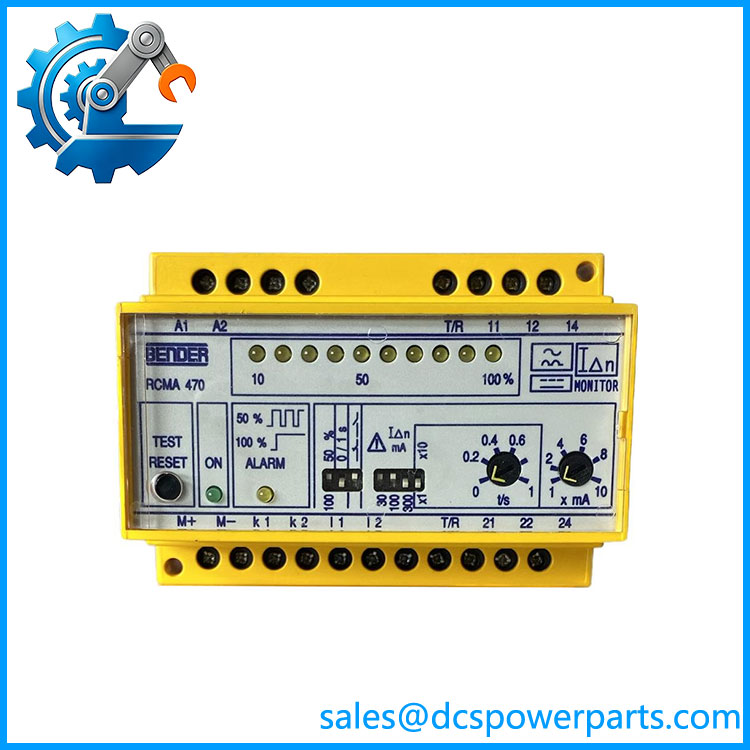
RCMA475-23
AC/DC Sensitive Residual Current Detection
The primary function of the Bender RCMA475-23 is detecting residual currents containing both AC and DC components.
This capability is important for systems using:
- Variable frequency drives
- Servo amplifiers
- Power converters
- Battery systems
- Charging equipment
Modern power electronics can create DC leakage components that standard AC-only monitoring devices cannot detect.
Early Fault Detection
The supports condition monitoring by identifying insulation deterioration before a serious fault develops.
Typical monitored conditions:
- Cable insulation degradation
- Equipment leakage increase
- Converter-related leakage currents
- Electrical installation aging
This approach helps maintenance teams investigate problems while equipment remains operational.
Integration Into Industrial Control Systems
The monitor can provide alarm signals to automation systems.
Typical connections:
Relay Output → PLC Digital Input → Alarm Handling / Maintenance System
Common uses:
- Remote alarm indication
- Preventive maintenance
- Electrical safety monitoring
- Equipment availability improvement
Suitable for Power Electronic Applications
Many industrial loads generate complex leakage current patterns.
Typical equipment:
- Variable speed drives
- Inverters
- UPS systems
- Welding equipment
- Renewable energy converters
The RCMA technology is designed for these environments where AC/DC sensitivity is required.
Compact Cabinet Installation
The device is designed for installation inside electrical control cabinets.
Common installation locations:
- MCC panels
- Automation cabinets
- Power distribution panels
- Machine electrical enclosures
Application Scenarios
Industrial Automation Cabinets
Monitoring:
- PLC-controlled machinery
- Motor control centers
- Production equipment
Drive Systems
Used with:
- Frequency converters
- Servo systems
- Regenerative drives
UPS and Power Systems
Applications:
- Backup power systems
- Critical electrical loads
- Data and communication equipment
Renewable Energy Systems
Used for monitoring:
- Solar inverter systems
- Energy storage systems
- Power conversion equipment
Related Components
| Model | Function |
|---|---|
| Bender RCMA420 | AC/DC sensitive residual current monitor |
| Bender RCMA423 | Residual current monitoring device for TN/TT systems |
| Bender RCMS Series | Multi-channel residual current monitoring systems |
| Bender Measuring Current Transformers | Residual current sensing components |
| Bender COMTRAXX Systems | Alarm and communication gateway platforms |
Engineer’s Guide: Field Pitfalls
⚠️ Verify Measuring Transformer Compatibility
The requires the correct current transformer.
Check:
- Transformer model
- Inner diameter
- Cable arrangement
- Connection polarity
- Maximum monitored current
Incorrect transformer selection can create false alarms or missed faults.
⚠️ Confirm System Grounding Type
Before installation verify:
- TN system
- TT system
- Grounding arrangement
- Neutral conductor routing
Residual current measurement depends on correct conductor routing through the measuring transformer.
⚠️ Check Power Electronics Leakage
Modern drives naturally produce leakage currents.
Investigate:
- VFD switching frequency
- EMC filters
- Cable length
- Motor cable shielding
A high leakage reading does not always indicate equipment damage.
⚠️ Preserve Existing Threshold Settings
Before replacement record:
- Alarm thresholds
- Delay times
- Output configuration
- System integration parameters
⚠️ Refurbished Unit Testing Requirements
A proper evaluation should include:
- Visual inspection
- Supply voltage verification
- Current transformer connection test
- Residual current simulation
- Alarm relay test
- Threshold verification
- Continuous monitoring test
A device powering up does not confirm accurate residual current measurement.
Frequently Asked Questions
What is Bender ?
It is an AC/DC sensitive residual current monitor used to detect leakage and fault currents in grounded electrical systems.
Is a circuit breaker?
No. It is a monitoring and alarm device, not a power disconnect device.
What type of current can it detect?
It is designed for AC, pulsating DC, and smooth DC residual current monitoring depending on configuration.
Where is commonly used?
Typical applications include industrial machinery, converter systems, UPS installations, and electrical control cabinets.
What should be checked before replacement?
Verify:
- Exact model:
- Measuring transformer type
- Supply voltage
- Alarm settings
- Grounding system