Description
Product Overview
PM866K01 is not a bare card. ABB sells it as a processor unit package, and the package is the product: a PM866 CPU that slides into a TP830 baseplate, plus the terminators that make the baseplate electrically complete, plus the lithium battery that keeps retentive memory alive through a power failure. Understanding that packaging is the difference between a controller that boots and a controller that sits dark while the plant waits for a second shipment.
The platform it belongs to is the AC 800M — ABB’s rail-mounted controller family for System 800xA and for standalone process control. Within that family, PM866 sits near the top of the classic range: 133 MHz, 64 MB of RAM, twelve communication modules on the CEX bus, up to ninety-six I/O modules on the ModuleBus in single configuration, and support for CPU redundancy when paired with an identical unit. It runs the control code built in Control Builder, publishes and subscribes data across the Control Network over MMS and IAC, and synchronises its clock with other controllers to within a millisecond.
PM866K01 is also the part where buyers most often lose money, for three reasons. It is frequently confused with PM866AK01 (3BSE076939R1), the later A revision that carries ISA Secure certification under IEC 62443 — the same 133 MHz and 64 MB, but a different article number and a different security posture. It is confused with PM866K02 (3BSE050199R1), which is the two-CPU redundant kit rather than one unit. And it is often ordered as a CPU alone, without the TP830 baseplate that actually holds the identity of the controller.
Technical Specifications
表格
| Parameter | Value |
|---|---|
| Model | PM866K01 |
| Article number | 3BSE050198R1 |
| Manufacturer | ABB |
| Product type | Processor unit package for AC 800M controllers |
| Processor | 32-bit RISC, 133 MHz clock |
| Memory | 64 MB RAM, approximately 51 MB available for application |
| Performance | 0.09 ms per 1000 Boolean operations |
| Redundancy | CPU redundancy supported when paired with a second identical unit |
| Package contents | PM866 CPU, TP830 baseplate, TB850 CEX-bus terminator, TB807 ModuleBus terminator, TB852 RCU-Link terminator, memory backup battery 4943013-6 |
| Software licence | Not included |
| Ethernet | 2 × RJ45, CN1 / CN2, IEEE 802.3, Control Network via MMS and IAC |
| Serial | COM3 RS-232C with modem control; COM4 isolated RS-232C for tool connection |
| Expansion | 12 communication modules on CEX-bus; CEX-bus can be sectioned with BC810 / BC820 |
| I/O capacity | Up to 96 ModuleBus I/O modules non-redundant, 84 with redundant CPU |
| Supply | 24 V DC (19.2–30 V DC), max 5 % ripple per IEC 61131-2 |
| Protection / mounting | IP20 per EN 60529; DIN-rail slide-and-lock, no enclosure required |
| Dimensions | 119 × 186 × 135 mm with baseplate, approximately 1.2 kg |
| Standards | CE per EN 61000-6-2 / -6-4 and EN 61131-2; UL 508; UL 60079-15 Class I Zone 2 |
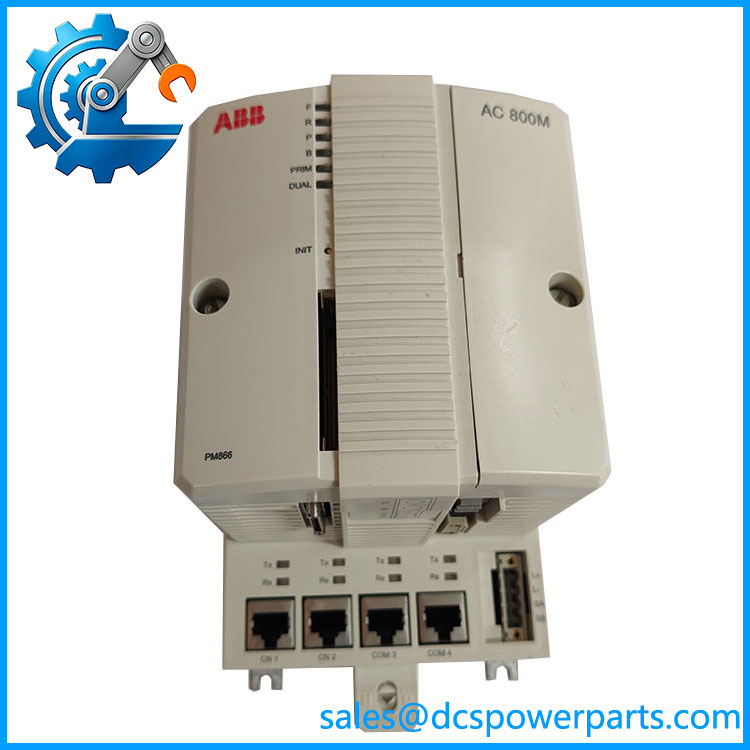
PM866K01 3BSE050198R1
Key Features and Advantages
The identity of the controller lives on the baseplate
Each TP830 baseplate carries its own Ethernet address, printed on a label on the plate, and that address is what the system recognises as this controller. PM866K01 therefore behaves differently from a generic CPU swap: replace the CPU into the existing baseplate and the controller keeps its network identity, its address and its place in the project; replace the whole package and you have introduced a new node that must be addressed and re-commissioned. Knowing which half of the package failed is worth more than a spare part.
A revision is a security decision, not a cosmetic one
PM866K01 and PM866AK01 share the clock speed, the memory and the instruction timing, which is exactly why they get treated as interchangeable. They are not equal in certification: the A revision appears on ABB’s ISA Secure CSA list under IEC 62443-4-1/-4-2, and the classic PM866 does not. A plant answering a security audit needs to know which one is installed, and the answer is in the article number on the label, not in the appearance of the module.
Redundancy is a matched pair, not two spare cards
The controller supports CPU redundancy across the processor, the CEX bus, the communication interfaces and the S800 I/O, with a defined switchover inside the same scan. PM866K01 can be one half of that pair, but only with a partner of the same type, the same firmware and the same application — and with the RCU-Link properly terminated. Redundancy that has never been tested is not redundancy; it is an assumption.
Twelve CEX modules is the real expansion currency
Where a smaller AC 800M CPU stops at one communication module, addresses twelve on the CEX bus, which is what allows a single controller to face PROFIBUS, MODBUS, a drive bus and a third-party PLC at the same time. For a plant consolidating several legacy networks into one controller, that headroom is the reason this part is specified rather than a cheaper CPU.
Applications
Power generation uses as the area controller for boiler and turbine auxiliary systems, where the ModuleBus carries S800 I/O across a plant room and the CEX bus carries the communication modules that tie the controller to the drives and to the unit-level network.
Oil, gas and petrochemical sites apply it on compressor and separation trains where redundant CPU pairs are specified, and where the controller must keep scanning through the loss of one processor without dropping the process to a safe state.
Pulp and paper machines use it where the controller coordinates drive sections and the quality control interface, and where the twelve CEX slots are consumed by PROFIBUS segments and drive buses rather than by I/O.
Water, cement and metallurgical plants running System 800xA apply the part as the mid-life controller in a plant-wide architecture, often as a like-for-like replacement in a cabinet whose drawings already name PM866.
Legacy systems facing an ISA Secure or IEC 62443 review use the distinction between and PM866AK01 as the basis for a documented upgrade decision rather than an undocumented substitution.
Related Products
PM866K02 / 3BSE050199R1 — the redundant package containing two PM866 CPUs, two TP830 baseplates, terminators, TK850 CEX-bus cable and TK851 RCU-Link cable. PM866AK01 / 3BSE076939R1 — the A revision of this processor unit, ISA Secure certified under IEC 62443, same 133 MHz and 64 MB. PM866AK02 / 3BSE081637R1 — the A revision redundant package, the current-preferred twin of this kit. TP830 — baseplate that carries the controller’s Ethernet address and all front-panel connectors; the part that must match the CPU. TB850 / TB807 / TB852 — CEX-bus terminator, ModuleBus terminator and RCU-Link terminator, each required for correct single or redundant operation. TK850 / TK851 — CEX-bus expansion cable and RCU-Link cable for redundant pairs and split CEX-bus arrangements. BC810K02 / BC820K02 — CEX-bus interconnection units for sectioning the bus in larger configurations. PM864AK01 / 3BSE018157R1-class CPU — the lower-power sibling in the same AC 800M range, used where 32 MB and fewer CEX modules suffice. PM891K01 / 3BSE053241R1 — the 450 MHz, 256 MB top-of-range controller for applications that outgrow . SD831 / SD832 / SD833 / SD853 / SD854 — the 24 V DC power supply modules that feed the rail this processor unit sits on. 4943013-6 — the lithium memory backup battery supplied in the package and replaced at intervals thereafter.
Installation and Maintenance
Before installation: confirm which half of the package is actually faulty — the CPU, the baseplate, or a missing terminator — because a ordered to fix a baseplate fault will arrive as a complete unit and still leave the cabinet with the same address problem if the plate is not replaced with it. In single configuration, the TB852 RCU-Link termination plug must be fitted at the RCU-Link connector; ABB’s own installation instructions single this out, and a controller that refuses to run alone is very often a controller missing that plug. Seat the CPU fully in the , lock it, connect CN1 and CN2 to the Control Network, and check the Ethernet address label against the project before applying 24 V.
Maintenance practice: replace the memory backup battery on a planned interval rather than after a retentive-data loss, and record the date on the module. Test the redundancy switchover during a maintenance window by transferring control deliberately, not by waiting for a real failure to find out. Keep the DIN rail and the module’s ventilation clear, since the controller dissipates continuously in a closed cabinet, and verify firmware and Control Builder compatibility after any CPU exchange — a classic swapped into a system engineered against the A revision, or the reverse, will run but may not satisfy the certification the plant believes it has.
Warranty and Quality
is supplied as a complete ABB processor unit package — CPU, baseplate, CEX-bus, ModuleBus and RCU-Link terminators, and memory backup battery — not as a stripped board, with the article number confirmed as 3BSE050198R1 so the buyer knows it is the classic and not the A revision. Units are powered up and checked for boot behaviour, Ethernet port function, serial port communication, CEX-bus recognition and battery voltage before dispatch, and carry a 12-month repair, replacement or refund commitment. Technical support covers the K01 versus K02 versus A-revision distinction, baseplate and address handling, RCU-Link termination in single and redundant configurations, firmware and Control Builder compatibility, and the licence question that catches buyers of unlicensed processor units.