Description
Product Overview
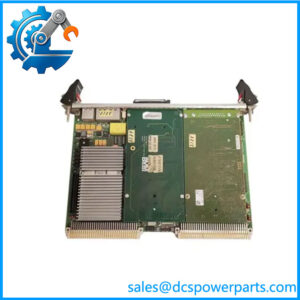
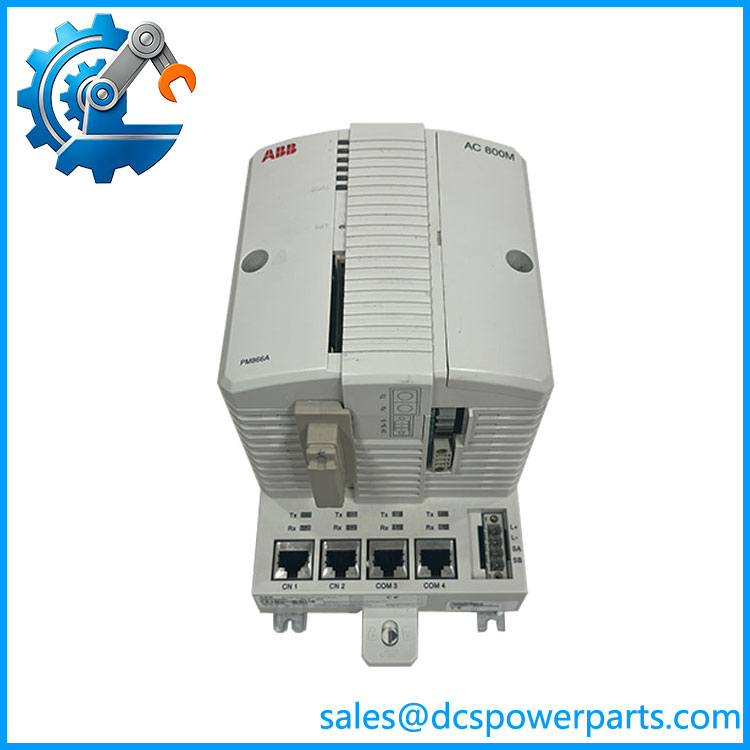
PM866A is the top of ABB’s standard AC 800M processor range — the CPU that sits in an Ability System 800xA controller when the application is large, the scan is tight, or both. The order code 3BSE076359R1 refers to the processor unit on its own: the slide-in module with its housing, front-panel ports and status LEDs, but without the baseplate it is designed to plug into. That distinction is the single most useful thing a buyer can know about this article number, because the AC 800M is built as a two-part device — a baseplate that stays wired in the cabinet and a processor unit that slides onto it — and only one of the two is what this code delivers.
The performance figures are worth stating precisely, since a great deal of secondary material gets them approximately right and then adds invented detail. 133 MHz clock, 64 MB of memory of which 51.389 MB is available to the application, 0.09 ms for one thousand boolean operations, and flash storage for the application program. Those numbers come from ABB’s own hardware selector, and the memory figure is the one that decides real projects: an application that grew past roughly 50 MB under a smaller CPU will not fit here either, no matter how fast the processor is.
Physically the module is 119 mm wide, 186 mm high and 135 mm deep, and 1.2 kg with its baseplate. On the front it carries two RJ45 Ethernet ports for the control network and two RJ45 serial ports, one RS-232C with modem control capability and one isolated — which is why a cabinet built in the 2000s can still dial out to a remote station or accept a service laptop without an extra converter. Communication beyond the CPU itself lives on the baseplate: the CEX-bus positions for PROFIBUS, PROFINET and other communication modules, and the ModuleBus connection for S800 I/O clusters.
The A in the model name marks the second generation of the PM866 design. It shares the 133 MHz clock and 64 MB memory of the original PM866, and ABB positions it as the long-term-availability revision of the same footprint — same dimensions, same baseplate, same engineering tool. What changed is not the arithmetic but the certification and lifecycle standing of the hardware, which matters when a plant’s security and lifecycle documentation has to name the exact processor type.
A CPU is not a controller. The controller is the combination of this unit, the baseplate that carries its I/O buses and power terminals, the firmware that must match the installed 800xA and Control Builder generation, the application that must be downloaded, and the network identity that must be restored. PM866A supplies the first of those five. Everything else has to be arranged before the box is opened, and the sections below are about exactly that.
Technical Specifications
| Parameter | Value |
|---|---|
| Model and order code | PM866A, 3BSE076359R1 |
| Manufacturer | ABB |
| Product type | Processor unit (CPU) for AC 800M, baseplate not included |
| Clock frequency | 133 MHz |
| Performance | 0.09 ms per 1000 boolean operations |
| Memory | 64 MB total |
| RAM available for application | 51.389 MB |
| Flash memory for program storage | Yes |
| Ethernet ports | 2 × RJ45 (CN1, CN2), network redundancy support |
| Serial ports | 2 × RS-232C (COM3 with modem control, COM4 isolated) |
| Expansion | CEX-bus positions on the baseplate, ModuleBus for S800 I/O |
| Supply | 24 V DC (19.2–30 V), typ. 210 mA, max. 360 mA |
| Power dissipation | approx. 5.1 W |
| Dimensions and mass | 119 × 186 × 135 mm, 1200 g including base |
| Protection and compliance | IP20, EU / UAE / CN RoHS, WEEE |
| Backup battery | Lithium cell 4943013-6 for RAM and real-time clock |
PM866A 3BSE076359R1
Key Features and Advantages
Performance that removes the scan from the constraint list: 0.09 ms for a thousand boolean operations puts the PM866A in a class where the control task is rarely the limiting factor. On a boiler or compressor sequence where the trip logic and the modulating loops compete for the same CPU, that headroom is what allows both to run at the speed the safety study assumed.
51.389 MB of application memory, stated honestly: total memory and usable application memory are not the same number, and confusing them is how projects fail at download time. A plant migrating an application from a 32 MB CPU can measure its program against 51.389 MB and know the answer before the hardware is ordered, rather than after the first incomplete download.
A baseplate that survives the swap: because the processor slides onto the baseplate, a CPU replacement does not disturb the CEX-bus wiring, the ModuleBus cabling or the 24 V terminals. On a live plant that is the difference between a fifteen-minute module change and a wiring exercise with a cabinet drawing open on the floor.
Two networks and two serial lines without extra hardware: the paired Ethernet ports support the controller-level network redundancy ABB builds into 800xA, and the serial ports cover the service and legacy-modem cases that modern CPUs often drop. Cabinets designed around this generation keep working without a communications redesign.
Pairing behaviour that is predictable: two PM866A units form a redundant pair with the standby synchronised to the primary, and the transition is bumpless from the process point of view. What the hardware does not do is tolerate a mixed pair — the partner must be the same processor type and the same firmware generation, which is a sparing rule rather than a technical footnote.
The battery as the only consumable: the lithium cell holds RAM and the real-time clock when the cabinet is de-energised. It fails quietly, and the failure only becomes visible when power is lost and the application with it. Replacing it on a schedule is cheaper than discovering it during a substation trip.
Applications
Thermal and combined-cycle power plants: boiler and turbine auxiliary control, burner management interfaces and balance-of-plant sequences, where the CPU carries both fast interlock logic and modulating control in one controller.
Oil and gas processing: compressor antisurge, separation and export metering control, where a controller of this class runs several hundred loops alongside sequence logic and still answers the operator within the specified update time.
Pulp and paper: digester and paper machine control, historically AC 800M territory, where drive coordination and quality loops share the same processor.
Metals and mining: rolling mill auxiliaries, furnace and material handling sequences, where the CPU must survive a cabinet environment of dust, heat and electrical noise.
Water and wastewater: plant-wide SCADA-linked control with telemetry over serial links, a case the built-in modem-capable serial port serves directly.
Pharmaceutical and fine chemical batch plants: recipe-driven control where application size grows with the number of recipes and where the memory headroom decides how many can be loaded at once.
Life extension of installed 800xA systems: replacement of a failed or end-of-life processor unit in a cabinet whose baseplate, wiring and engineering documentation are already in place — the case in which the bare unit code is the correct purchase.
Related Products
PM866AK01 (3BSE076939R1) — single-CPU kit: the same processor supplied with its baseplate, for a new installation or a full unit replacement. PM866AK02 (3BSE081637R1) — redundant kit containing two processor units with the synchronisation cable and bus terminators. PM866 (3BSE050198R1 / 3BSE050199R1) — the first-generation PM866 in single and redundant packages; same clock and memory, earlier lifecycle and certification standing. PM864AK01 (3BSE018161R1) — mid-range AC 800M processor, 32 MB class, the usual predecessor in applications being upgraded. PM862K01 (3BSE076940R1) — 67 MHz processor, distinctly smaller memory; the type that most often needs replacing rather than extending. PM851AK01 (3BSE066485R1) — entry-level AC 800M processor, 24 MHz, for small standalone control. PM865K01 — High Integrity variant for safety-rated applications, a different certification track, not interchangeable. TP830 — the baseplate this unit plugs into; it carries the CEX-bus, ModuleBus and supply terminals and stays in the cabinet. TB852 — RCU-Link terminator required when a single processor runs without a redundant partner. TB840A (3BSE037760R1) — ModuleBus cluster modem for S800 I/O, the usual companion for distributed I/O. CI854BK01 (3BSE069449R1) — PROFIBUS DP communication module occupying a CEX-bus position.
Installation and Maintenance
Before installation: confirm the baseplate already in the cabinet is a TP830 and that the unit is being fitted to it rather than expected to arrive with one, and check whether the installation is single or redundant — a single processor needs the RCU-Link terminator fitted, and a missing terminator produces a controller that behaves oddly rather than one that refuses to start. Establish the firmware generation required by the installed 800xA and Control Builder version, and confirm the partner CPU in a redundant pair is the same type and firmware. Take a verified project backup and confirm that a download path exists before the old unit comes out, because the replacement arrives empty.
Maintenance practice: read the front-panel LEDs rather than guessing — run, fault and battery indication tell most of the story, and the port LEDs separate a network problem from a processor problem. Replace the lithium battery 4943013-6 on a planned interval instead of waiting for the low-battery indication, and treat any unexplained loss of application after a power interruption as a battery symptom first. Keep cabinet filters and fan paths clear, since a 5.1 W module in a closed cabinet with blocked airflow runs hotter than its specification assumes. Hold one spare PM866A at site if the application cannot tolerate a two-day delivery, and record its firmware level so the spare can be brought to the installed generation before it is needed.
Warranty and Quality
Every with order code 3BSE076359R1 is supplied as the processor unit it is identified as, with the order code and the baseplate-excluded scope confirmed before dispatch, because the difference between this unit and the kit codes is exactly the kind of detail that turns a planned replacement into a second delivery. Units are inspected for connector condition, housing integrity and battery age, and where a compatible baseplate and test rack are available they are checked for boot behaviour and port function. They carry a 12-month repair, replacement or refund commitment. Support covers the practical questions this CPU raises: confirming whether a bare unit or a kit is required, matching firmware to the installed 800xA generation, applying the redundancy pairing rule, restoring the application and network identity after a swap, and advising on battery and spare strategy so that the controller, not just the module, stays available.