Description
Key Technical Specifications
| Parameter | Specification |
|---|---|
| Product model | ZETA4 |
| Manufacturer | Parker Hannifin |
| Product division | Compumotor |
| Product family | ZETA |
| Product type | Microstepping motor drive |
| Input voltage | 95–132 VAC |
| Input phase | Single-phase |
| Input frequency | 50/60 Hz |
| Motor current | 0–4 A peak |
| DC bus voltage | 170 VDC nominal |
| Motor type | Two-phase hybrid permanent-magnet stepper |
| Motor step angle | 1.8° |
| Motor winding connections | 4, 6, or 8 leads |
| Recommended motor inductance | 5–50 mH |
| Minimum motor inductance | 0.5 mH |
| Maximum motor inductance | 100 mH |
| Amplifier topology | Bipolar, current-controlled PWM |
| Switching frequency | 20 kHz |
| Step input | Step and direction or CW/CCW |
| Maximum step pulse rate | 2 MHz |
| Minimum pulse width | 200 ns |
| Selectable resolution | 200 to 50,800 steps/revolution |
| Position accuracy | ±5 arc-min typical, unloaded |
| Repeatability | ±5 arc-sec typical |
| Protection functions | Short circuit, undervoltage, overtemperature, regenerative power dump |
| Brownout threshold | Below 85 VAC |
| Overtemperature shutdown | 50 °C |
| Operating temperature | 0–45 °C |
| Storage temperature | -30–85 °C |
| Humidity | 0–95%, non-condensing |
| Cooling | Fan cooling may be required when airflow is restricted |
| Status indicators | Power, step input, overtemperature, motor fault |
Specifications are from Parker Compumotor’s ZETA technical catalog. Position accuracy and repeatability depend on the specified test conditions and motor configuration; they should not be interpreted as guaranteed loaded-system performance.
Product Introduction
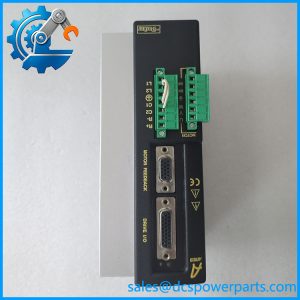
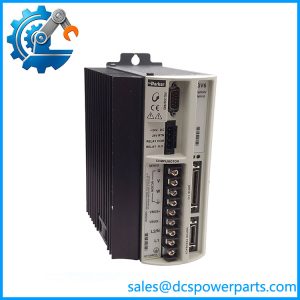
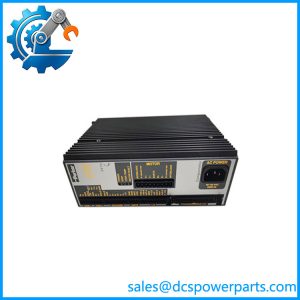
The Parker Compumotor ZETA4 is a 4 A microstepping drive for two-phase hybrid stepper motors used in automated positioning systems. Its current-controlled bipolar PWM amplifier regulates motor phase current, while selectable step resolution supports different motion requirements. Standard command options include step-and-direction and clockwise/counterclockwise pulse inputs.
The ZETA4 also incorporates Active Damping and Electronic Viscosity functions to reduce motor vibration, improve low-speed smoothness, and shorten settling time. Its protection circuitry monitors motor short circuits, undervoltage, overtemperature, and regenerative power conditions. The unit is a drive rather than a standalone programmable motion controller.
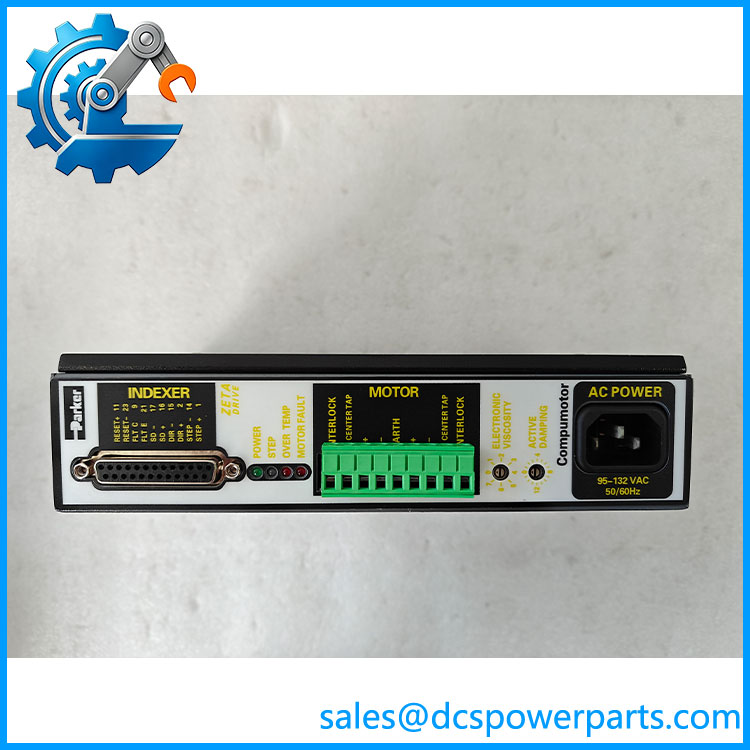
ZETA4
Application Scenarios & Field Pitfalls
The ZETA4 is used in positioning systems where a stepper motor must follow pulse commands from an external controller. Typical installations include indexing mechanisms, material-feed assemblies, and automated equipment requiring repeatable incremental movement. During replacement, the motor’s phase-current requirement, winding inductance, supply voltage, and pulse interface must all match the drive’s operating limits.
Typical application areas
- Packaging equipment: Stepper-driven indexing, feeding, and product positioning.
- Printing and labeling machinery: Controlled movement of rollers, feed mechanisms, and positioning axes.
- Material handling: Incremental movement of small conveyors, slides, and transfer mechanisms.
- Automated assembly: Repeatable positioning of fixtures, feeders, and mechanical adjustment systems.
Field pitfalls
1. Do not confuse peak current with RMS current. Parker specifies the ZETA4 motor current in peak amperes. Motor phase-current settings must be checked using the manufacturer’s specified current convention. An incorrect interpretation can cause motor overheating or inadequate torque.
2. Verify motor winding compatibility. The drive supports 4-, 6-, and 8-lead two-phase hybrid stepper motors. Check winding connections, phase polarity, inductance, and rated current before reconnecting the motor. A motor with unsuitable electrical characteristics can produce excessive heat or poor motion performance.
3. Check the input voltage carefully. The standard ZETA4 is designed for 95–132 VAC. Do not assume it accepts 240 VAC. The -240 is a separate variant that supports operation from 120 or 240 VAC with different DC bus conditions.
4. Inspect pulse timing and control logic. The step input requires a minimum 200 ns pulse width, with a maximum pulse rate of 2 MHz. Verify the controller’s output voltage, pulse polarity, direction logic, and shutdown/reset signals before enabling the motor.
5. Account for obsolescence during maintenance planning. Parker’s discontinuation notice lists as discontinued in 2024 and does not specify a direct replacement. A modern drive selection requires checking motor electrical data, control-signal requirements, mounting, and machine sequence behavior.
Related Products
- -240 — 4 A ZETA drive variant supporting 120 VAC or 240 VAC input. Its DC bus voltage changes with the input voltage, so it is not identical to the standard .
- ZETA8 — 8 A peak microstepping drive for higher-current stepper motor applications.
- ZETA12 — 12 A peak version for larger motor-current requirements.
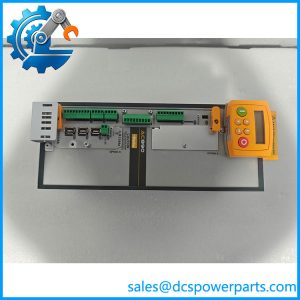
- ZETA6104 — Programmable single-axis stepper drive/controller with integrated motion-control functionality; not a direct replacement for the standalone .
- ZETA6108 — Higher-current programmable drive/controller in the ZETA6100 family.
- VM24 — 24 V input/output accessory used with compatible Compumotor drive/controller configurations.
- VM50 — 50-pin header-to-screw-terminal breakout accessory for compatible motion-control connections.
- RP240 — Operator interface accessory for compatible Compumotor systems.
These products belong to the broader Compumotor motion-control range, but their electrical ratings and control functions differ.
Procurement note: The is a discontinued drive. For replacement evaluation, record the complete drive label, motor model, phase-current setting, winding connection, AC supply rating, pulse interface, and existing DIP-switch configuration. Do not substitute a -240 or ZETA6104 solely because the product names are similar.