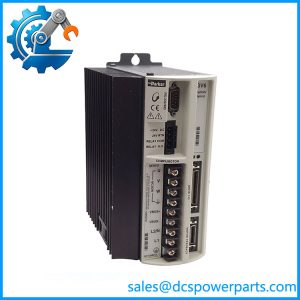
Description
Key Technical Specifications
| Parameter | Specification |
|---|---|
| Model | ZETA6104 |
| Manufacturer | Parker Compumotor / Parker |
| Product Family | 6000 Series / ZETA Series |
| Product Type | Microstepping Indexer / Drive |
| Drive Rating | 4 A |
| Input Voltage | 95–132 VAC |
| Input Frequency | 50/60 Hz |
| Motor Type | Stepper Motor |
| Control Function | Programmable Indexing + Stepper Drive |
| Communication | RS-232C / RS-422 / RS-485 |
| Software Family | Parker 6000 Series software |
| Programming Environment | Motion Architect |
| Motor Compatibility | Parker ZETA motor families and compatible stepper motors |
| Approx. Weight | 2.46 kg |
| Status | Legacy / discontinued |
Parker’s published documentation identifies the ZETA6104 as a 4 A drive/controller and lists it at approximately 2.46 kg. Parker’s replacement guidance also confirms that the ZETA6104 belongs to the earlier generation of stepper drive/controllers following the SX family.
Application Scenarios & Pain Points
The real problem with legacy stepper equipment is rarely the motor itself. More often, the original controller has failed and the machine’s application software, wiring, and mechanical setup were built around a specific controller family.
- Packaging machinery: Suitable for programmed indexing, positioning, and repeated motion sequences where a stepper motor is used instead of a closed-loop servo.
- Material handling: The integrated indexer/drive architecture can control repeated positioning movements without requiring a separate motion controller and stepper amplifier.
- Legacy production machinery: Particularly useful when maintaining equipment originally engineered around Parker Compumotor 6000 Series hardware.
- Multi-axis installations: ZETA6104 systems can be networked with other ZETA6000 units using the supported serial communication architecture. Parker documentation also identifies the ZETA6000 family as supporting daisy-chain and multidrop configurations.
Field note: Check the motor wiring before assuming the replacement is electrically identical. The installation guide documents different series and parallel motor-connection arrangements, with DIP-switch settings tied to the selected motor/current configuration.
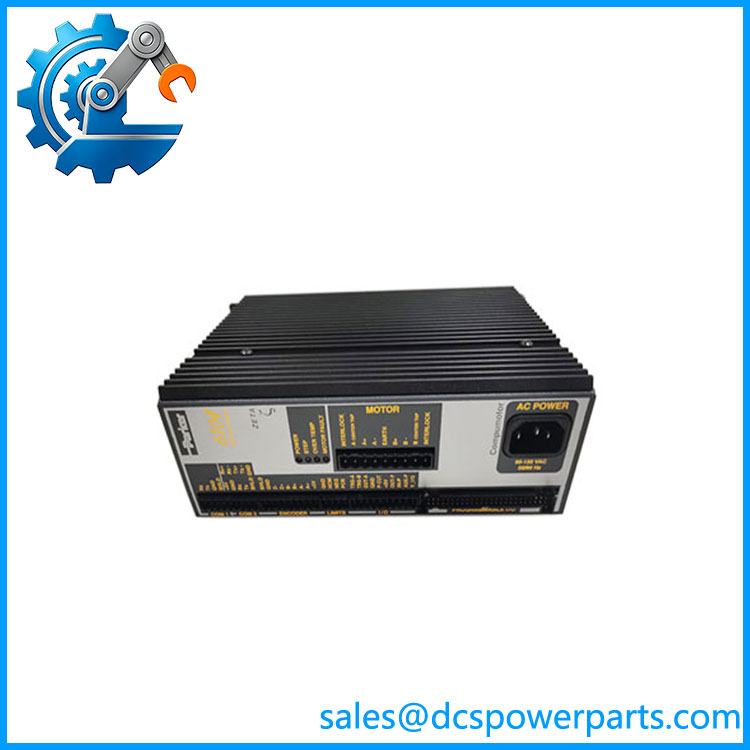
ZETA6104
Related Products
- Parker ZETA6108 — The higher-current member of the same ZETA6000 family. Parker identifies the ZETA6108 alongside the 6104 as a stepper drive/controller; selection depends on motor current requirements.
- Parker ZETA6112 — A higher-capacity ZETA6000 family unit. It is useful for applications exceeding the current capability of the ZETA6104. Parker lists it within the same 6000 Family documentation set.
- Parker ZETA6104-240 — A specific variant documented separately by Parker. Do not assume it has identical mains requirements to every configuration; verify the complete suffix.
- — A system ordering configuration associated with a and a particular ZETA motor combination. The suffix identifies the motor configuration rather than simply being a cosmetic variant.
- Parker ZETA6000 Series — The broader family containing the , ZETA6108, and ZETA6112. Useful when evaluating same-family replacement options.
- Parker SX / SXF Series — Earlier stepper-drive families. Parker’s replacement guidance identifies the as the generation following the SX family, making it relevant when tracing legacy machine designs.
- Parker IPA Drive/Controller — Parker currently recommends the IPA as one possible upgrade path for /ZETA6108 applications. It uses AcroBasic rather than the older ZETA programming environment and adds Ethernet TCP/IP capabilities.
The Engineer’s Guide: Field Pitfalls to Avoid
⚠️ Do not confuse with a modern servo drive.
The is fundamentally a microstepping stepper drive/indexer. It does not provide the same feedback architecture as a closed-loop servo system.
How to avoid it: Confirm whether the existing machine depends on open-loop stepper positioning before approving a replacement.
⚠️ Check the motor-current DIP-switch configuration.
The installation documentation provides specific current settings and motor wiring configurations. A wrong setting can produce overheating, poor torque, or abnormal motor operation.
How to avoid it: Photograph the original DIP-switch positions before removing the failed unit. Verify them against the motor’s rated current and the installation documentation.
⚠️ Do not assume modern software compatibility.
Parker states that the uses the older Motion Architect software environment, with compatibility limitations on newer Windows systems. Parker’s replacement guidance identifies the IPA as a possible modernization path.
How to avoid it: Preserve the original motion program and establish a workable legacy programming environment before the machine shutdown.
Frequently Asked Questions (FAQ)
What is Parker ?
The is a microstepping indexer/drive from Parker’s 6000 Series. It combines programmable motion-control functions with a stepper-motor drive, reducing the need for a separate indexer and amplifier.
What is the current rating of ?
Parker’s replacement documentation identifies the . The exact motor-current setting still has to be configured according to the motor and application.
What input voltage does the use?
The standard documentation identifies 95–132 VAC at 50/60 Hz for the unit. Do not apply this specification to variants such as -240 without checking the complete ordering code.
Can communicate with a PLC?
Yes. The supports serial communication architectures including RS-232C, RS-422, and RS-485. The actual PLC integration depends on the communication method and application program used in the machine.
Is discontinued?
Current Parker documentation treats the as a legacy product, and Parker provides a replacement discussion recommending newer controller/drive options such as the IPA.
For a plant buyer, this means condition and test evidence matter more than simply finding a unit with the correct label.
What should I verify before buying a replacement ?
Check:
- Complete model marking and suffix.
- Input-voltage version.
- Motor type and rated current.
- DIP-switch configuration.
- Existing motion program.
- Serial communication wiring.
- Motor series/parallel wiring.
- Firmware/software compatibility.
- Physical condition of terminals and connectors.
- Functional test results under a representative motor load.