Description
Product Introduction
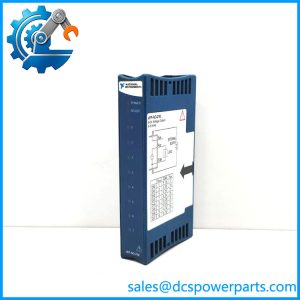
The National Instruments cFP-DO-403 is an 8-channel electromechanical relay output module for the Compact FieldPoint distributed I/O platform. Unlike the solid-state cFP-DO-400, the cFP-DO-403 uses mechanical relay contacts, making it suitable for applications where the field circuit requires contact switching rather than a transistor-based DC output.
Each channel provides an isolated relay contact that can switch AC or DC loads within the specified electrical limits. This makes the cFP-DO-403 useful for controlling contactors, solenoid valves, motor starters, indicator circuits, interposing relays, and other equipment where electrical isolation between the FieldPoint electronics and field circuit is desirable.
The relay architecture also changes how the module should be evaluated in a maintenance environment. Mechanical contacts have finite operating life and can develop contact resistance, welding, or intermittent operation after extensive switching. For that reason, a used cFP-DO-403 should be tested under an appropriate load rather than being accepted solely because all eight output LEDs operate correctly.
Technical Specifications
| Parameter | Specification |
|---|---|
| Manufacturer | National Instruments |
| Model | cFP-DO-403 |
| Part Number | 777318-403 |
| Platform | Compact FieldPoint |
| Product Type | Relay Digital Output Module |
| Number of Channels | 8 |
| Relay Configuration | SPST, normally open |
| Contact Type | Electromechanical relay |
| Maximum Switching Voltage | 250 VAC / 30 VDC |
| Maximum Switching Current | 5 A |
| Maximum Switching Power | 1,250 VA |
| Channel Isolation | Yes |
| Channel-to-Bus Isolation | Yes |
| Operating Temperature | -40 to 70 °C |
| Installation | Compact FieldPoint terminal base |
| Product Status | Discontinued / legacy |
Main Features and Engineering Considerations
Eight Isolated Relay Outputs
The primary feature of the cFP-DO-403 is its eight independent relay channels. The relay contacts provide electrical separation between the FieldPoint electronics and the switched field circuit, which can be useful when interfacing different voltage domains.
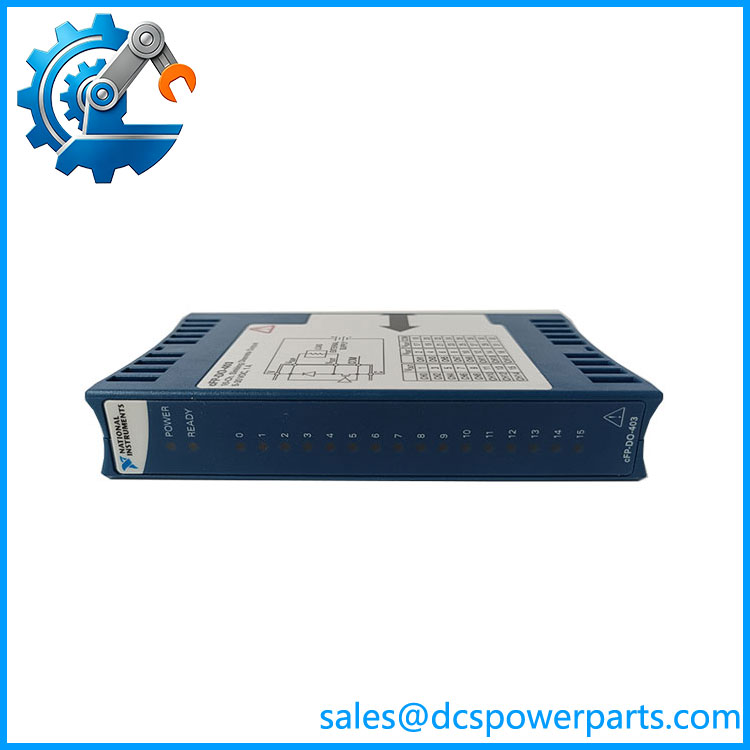
CFP-DO-403
AC and DC Switching
Unlike transistor-based DC output modules, relay contacts can be used for both AC and DC loads, provided the voltage, current, and switching-power ratings are respected.
The stated maximum of 5 A should not be interpreted as a universal rating for every load type. Inductive loads such as motors, contactors, and solenoids can produce substantially higher transient stress than resistive loads.
Mechanical Relay Considerations
Relay contacts eventually wear. High-frequency switching, inductive loads, inrush current, and inadequate suppression can shorten contact life.
For a replacement module, inspect:
- Relay operation
- Contact resistance
- Contact welding
- Output leakage
- Switching under load
- Terminal condition
- Channel-to-channel isolation
Compact FieldPoint Architecture
The cFP-DO-403 is designed for the Compact FieldPoint system and requires the appropriate terminal base and controller/network interface. It should not be considered a generic eight-channel relay board.
Application Scenarios
Typical applications include:
- Motor starter control
- Solenoid valve switching
- Contactor control
- Industrial machine control
- AC load switching
- DC actuator control
- Interposing relay applications
- Process-control outputs
- Distributed Compact FieldPoint I/O
- Legacy automation systems
Engineer’s Guide: Field Pitfalls
⚠️ Do not compare cFP-DO-403 directly with cFP-DO-400.
The DO-400 is a solid-state sourcing output module, while the DO-403 uses mechanical relay contacts. Their electrical behavior and application limits are different.
⚠️ Watch inductive loads.
Motors, contactors, and solenoids can produce high transient voltages. Appropriate suppression should be considered to protect relay contacts.
⚠️ Check AC versus DC switching requirements.
A relay’s switching capability is load-dependent. A rating valid for resistive AC loads should not automatically be applied to an inductive DC load.
⚠️ Relay life matters.
A used module can have perfectly functioning electronics but worn relay contacts.
⚠️ Test the actual load.
For refurbished hardware, cycle each relay under a representative load and verify both open and closed states.
Frequently Asked Questions
What is NI cFP-DO-403?
It is an 8-channel electromechanical relay output module for the National Instruments Compact FieldPoint platform.
What is the NI part number?
777318-403.
How many relay outputs does it have?
Eight.
What type of relay contacts are used?
The module uses SPST normally-open relay contacts.
Can it switch AC and DC?
Yes, within the specified voltage, current, switching-power, and load-type limitations.
What is the maximum switching current?
The commonly specified maximum is 5 A, but the allowable value depends on the load and switching conditions.
Is cFP-DO-403 still manufactured?
It is a legacy/discontinued Compact FieldPoint module.
What should be verified before purchasing?
- cFP-DO-403
- 777318-403
- Eight relay channels
- SPST-NO configuration
- AC/DC load voltage
- Load current
- Inductive versus resistive load
- Relay contact condition
- Compact FieldPoint terminal-base compatibility
- All-channel load-switching test
Procurement note: For a used cFP-DO-403, relay condition is the main hidden risk. I would request a channel-by-channel switching test under representative load, not just a photograph showing that the module powers up.