Description
Product Overview
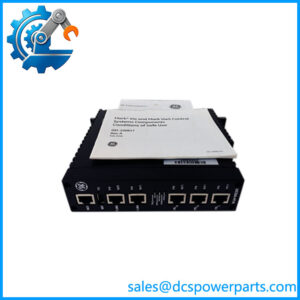
The N-Tron 517TX is a 17-port industrial Ethernet switch from the N-Tron 500 Series, intended for control cabinets and industrial networks requiring a relatively high copper-port count. The documented 517-family architecture provides 16 10/100BaseTX copper ports plus one 100BaseFX multimode fiber uplink, giving maintenance teams a practical way to aggregate local Ethernet devices while maintaining a fiber connection to another network segment. The copper interfaces use shielded RJ45 connectors, while the fiber interface uses an IEEE-compliant SC or ST duplex connector depending on the configuration.
Unlike a managed enterprise switch, the standard N-Tron 517TX is intended for straightforward plug-and-play industrial Ethernet operation. The 500 Series uses store-and-forward switching, a 2.6 Gb/s backplane, and supports up to 4,000 MAC addresses. The documented electrical input is 10–30 VDC with redundant inputs, while the enclosure is designed for 35 mm DIN-rail installation. For control-system engineers, this places the 517TX firmly at the industrial network-infrastructure layer rather than in the PLC, DCS controller, or remote-I/O layer.
From a replacement perspective, the N-Tron 517TX makes sense where an existing cabinet has a large number of 10/100 Ethernet drops and does not require advanced Layer 2 management functions. Its documented operating temperature is -40°C to +85°C, with 10–95% non-condensing humidity. The fiber uplink is specified for multimode 100 Mb communications up to approximately 2 km, so it should not be confused with the longer-distance singlemode 517FXE family.
Product Introduction
Sixteen copper ports in one DIN-rail switch is useful when a control cabinet has accumulated HMIs, PLCs, drives, gateways, instrumentation interfaces, and maintenance connections over several generations. The 517TX provides that density without introducing a managed-switch configuration layer into a legacy network.
For a legacy Ethernet replacement, verify the exact hardware designation and fiber requirement. If the installation actually uses the fiber-equipped 517FX, or the extended-range 517FXE, substituting a 517TX changes the network interface arrangement.
Key Technical Specifications
| Parameter | Value |
|---|---|
| Product Model | N-Tron 517TX |
| Manufacturer / Brand | N-Tron |
| Product Series | N-Tron 500 Series |
| Product Type | Unmanaged Industrial Ethernet Switch |
| Total Ports | 17 |
| Copper Ports | 16 × 10/100BaseTX |
| Copper Connector | Shielded RJ45 |
| Fiber Uplink | 1 × 100BaseFX multimode |
| Fiber Connector | SC or ST duplex, depending on configuration |
| Fiber Reach | Up to 2 km |
| Fiber Wavelength | 1310 nm |
| Switching Method | Store and Forward |
| Backplane Speed | 2.6 Gb/s |
| MAC Addresses | 4,000 |
| MAC Aging | Programmable |
| Minimum Latency | 2.2 µs |
| Input Voltage | 10–30 VDC redundant |
| Input Current | Approximately 440 mA at 24 VDC |
| Maximum Current | 1.0 A |
| Inrush Current | 8.5 A / 0.8 ms at 24 VDC |
| Operating Temperature | -40°C to +85°C |
| Storage Temperature | -40°C to +85°C |
| Humidity | 10–95%, non-condensing |
| DIN-Rail | 35 mm |
| Height | 2.3 in. |
| Width | 7.4 in. |
| Depth | 3.5 in. |
| Weight | Approximately 1.9 lb |
| Serial Port Parameters | 9600, N, 8, 1 |
The 500 Series documentation identifies the 517FX as the 17-port model with 16 copper ports plus one fiber uplink; the same 17-port copper architecture is associated with the 517 family. The published 517-family electrical and physical specifications should therefore be checked against the exact nameplate before using them for a particular 517TX procurement.
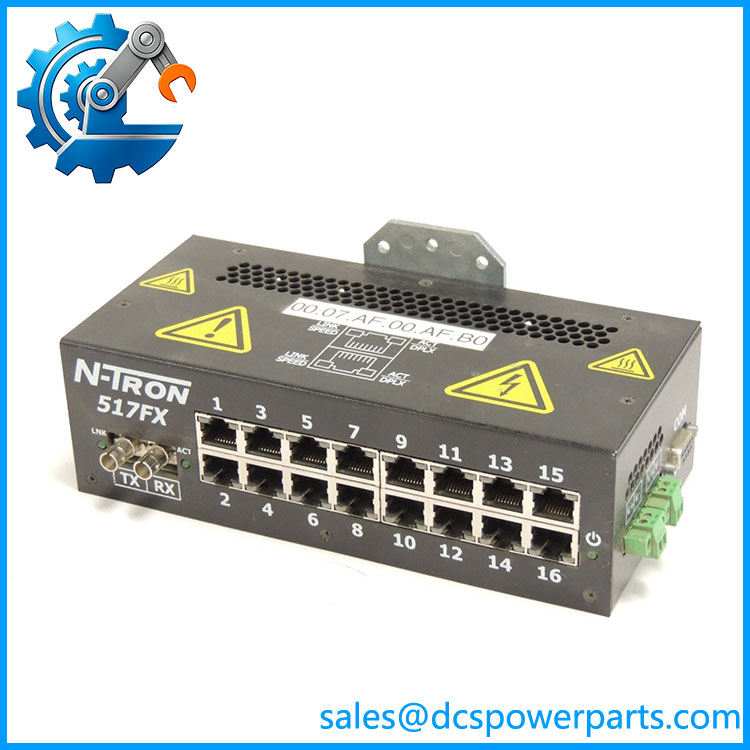
N-Tron 517TX
Related Products
- N-Tron 508TX — Smaller 8-port copper switch for cabinets with fewer Ethernet connections.
- N-Tron 516TX — 16-port copper industrial Ethernet switch; useful where a fiber uplink is not part of the required configuration.
- N-Tron 517FX — 17-port version with 16 × 10/100BaseTX copper ports and one 100BaseFX multimode fiber uplink.
- N-Tron 517FXE — Extended-range fiber version using singlemode fiber; intended for substantially longer links than the standard multimode 517FX architecture.
- N-Tron 524TX — Higher-density 24-port copper switch for larger industrial Ethernet cabinets.
- N-Tron 526FX2 — Higher-port-count model with two multimode fiber uplinks.
- N-Tron 508FX2 — Smaller 8-port model with six copper ports and two multimode fiber uplinks.
FAQ
What is the N-Tron 517TX used for?
The 517TX is an industrial Ethernet switch used to connect multiple 10/100 Ethernet devices within a control or industrial network. It operates at the network infrastructure level rather than functioning as PLC I/O or a DCS controller.
How many Ethernet ports does the 517TX have?
The 517 family provides 17 network ports. The documented 517 architecture consists of 16 × 10/100BaseTX copper connections plus one 100BaseFX multimode fiber uplink.
Is the N-Tron 517TX managed?
The standard 517TX is an unmanaged plug-and-play switch. N-Tron 500 Series documentation also identifies separate managed-feature variants within the broader family, so the exact suffix should be checked rather than assuming all 500 Series switches have identical management functions.
Can I replace a 517FX with a 517TX?
Not as a direct assumption. The 517FX includes a 100BaseFX multimode fiber uplink, while the 517TX designation refers to the copper-oriented version. If the existing network depends on that fiber connection, the replacement must preserve the required physical interface.
What fiber distance does the 517FX family support?
The standard multimode fiber link is specified for up to approximately 2 km at 100 Mb/s. Extended-range 517FXE versions use singlemode fiber and are specified for much longer distances.
Can I hot-swap the 517TX?
Do not assume hot-swapping is supported. Although the switch uses redundant DC inputs, removing the switch itself can interrupt every connected Ethernet device. Follow the plant’s approved network-maintenance procedure before replacement.
What should I verify before purchasing a replacement?
Check the complete model designation, number and type of ports, power-input arrangement, enclosure dimensions, temperature option, and whether the existing network requires a fiber uplink. For a legacy N-Tron installation, matching the port architecture is more important than simply matching the “517” family number.