Description
Product Overview
MTS30M4-38B belongs to the MT30 frame of SEM Limited’s permanent-magnet DC servo motor range, a British product line that has powered positioning axes since the era when machine tool builders specified analogue drives as standard. The model code is readable rather than arbitrary: the MT30 frame sets the mechanical envelope, the M4 designation selects the winding and magnetic build, and the trailing 38 is a voltage gradient — 38 volts of armature EMF per 1000 rpm. That single number explains the rest of the rating: with a 140 VDC terminal voltage, the arithmetic puts no-load speed at roughly 3700 rpm, which is exactly what the type is rated for.
What makes this motor worth keeping in circulation is not novelty but fit. A machine built around a 140 V armature supply, an integral tachogenerator for velocity feedback and a 5/8 inch keyed shaft cannot accept a modern brushless servo without a new drive, new feedback wiring and usually a new gearbox interface. Replacing the motor keeps the axis; replacing the technology replaces the machine. That economics is why MTS30M4-38B stays in demand among transfer line and machine tool maintainers even as the surrounding control systems age out.
The type circulates in the spares market under two labels — SEM as the manufacturer and Servo Dynamics as a long-standing US distribution and repair channel — which is worth knowing before cross-referencing a quotation, because catalogue pages from either side may describe the same casting, shaft and winding. Confusion in the other direction also exists: some listings assign this part number to a gearmotor or a PLC processor, descriptions that contradict a 6.8 kg frame with a keyed 5/8 inch shaft, and should be disregarded.
Technical Specifications
| Parameter | Value |
|---|---|
| Model | MTS30M4-38B, MT30 series frame, M4 winding |
| Manufacturer | SEM Limited, United Kingdom |
| Product type | Permanent-magnet brushed DC servo motor, tachogenerator feedback |
| Voltage gradient | 38 V per 1000 rpm |
| Maximum terminal voltage | 140 VDC |
| Maximum speed | Approximately 3700 rpm at rated terminal voltage |
| Continuous stall torque | 26 lb-in (approximately 2.9 N·m) |
| Feedback | Integral tachogenerator for velocity loop; standard encoder adaptor plate |
| Brushes | Silver-graphite, replaceable through the brush access covers |
| Shaft | 5/8 in diameter, 1.5 in key, 1.87 in extension |
| Mounting | Flange face mount with through-bolts; square flange option in the family |
| Insulation | Class F winding system, 40 °C ambient rating |
| Mass | Approximately 6.8 kg |
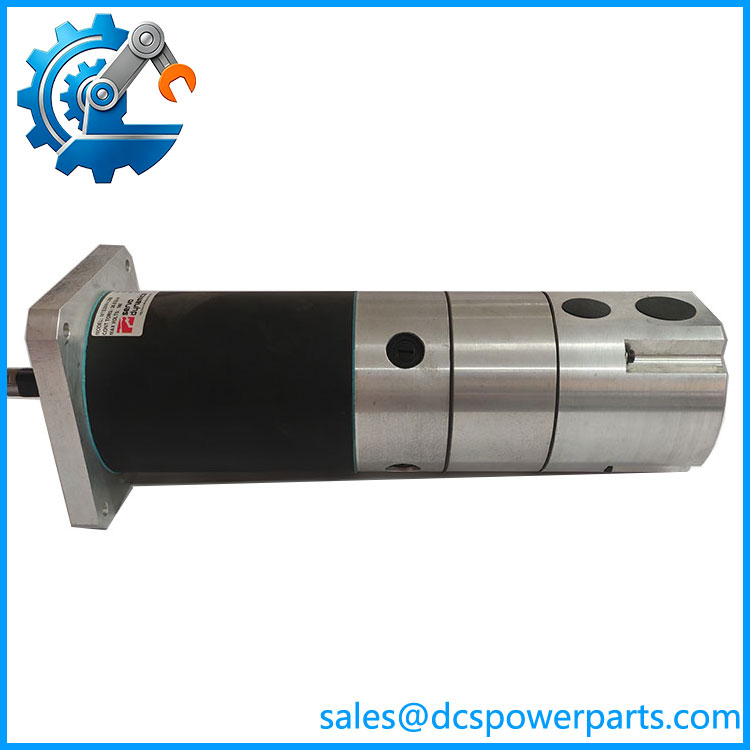
MTS30M4-38B
Key Features and Advantages
One wear part sets the service interval
Everything else on MTS30M4-38B is a long-life item — bearings, magnets, windings, tachogenerator — except the brushes. Silver-graphite brushes and their commutator define the inspection cycle, and they are accessible through covers rather than requiring a teardown, so a planned brush check costs minutes and a deferred one costs a commutator. Treating brush length as a scheduled measurement rather than a symptom turns an unpredictable failure into a maintenance task.
Tacho feedback that keeps an analogue drive honest
The integral tachogenerator closes the velocity loop at the source, so the drive sees a clean speed signal without an encoder, a counter card or a serial protocol. On a machine whose control cabinet predates fieldbus motion, that is the whole feedback architecture in one device — and it is also the most EMI-exposed wire on the axis. Shielded, separately routed tachometer leads grounded at the drive end prevent the oscillation that technicians often chase as a tuning problem.
The voltage gradient decides compatibility, not the frame size
Two motors of identical frame and torque can be unusable on the same drive if their voltage gradients differ. 38 V/1000 rpm fixes the armature voltage needed for a given speed, which is why substituting a -25 or -42 gradient build into a 140 V axis requires re-scaling the drive rather than bolting it on. Specifying MTS30M4-38B by gradient, torque and shaft — the three numbers a quotation rarely lists together — is what prevents a wrong-but-similar delivery.
Designed to be rebuilt rather than discarded
Commutator undercutting, brush spring tension, bearing replacement and tachogenerator service are all standard operations on this frame, and the housing is built to be opened. A worn MTS30M4-38B has a defined repair path with a known cost, which is a different proposition from a sealed modern servo where the practical answer is replacement.
Applications
Transfer lines and dial-index machines in automotive and appliance plants are the classic home of this frame: pallet transfer, lift-and-carry units, and station slides where a 140 V analogue axis has been running since the line was commissioned and where the mechanical interface, not the electronics, is the constraint on change.
Machine tool retrofits follow — knee and column positioning, quill feed, tool changer arms and turret indexing on milling and turning centres whose CNC retains an analogue velocity interface. When the control is upgraded but the mechanics are sound, a rebuilt is often the cheapest route to restoring position hold.
Web and filament handling equipment uses the type where the tachogenerator loop gives smooth tension control: winders and unwinders in film, foil, paper converting and wire drawing, plus coil winding for transformers and motors, where constant surface speed matters more than absolute positioning accuracy.
Packaging and printing machines with mechanical line shafts rely on it for registration and cut-off axes, and older robotics and pick-and-place gantries use it on the axis that never needed interpolation. Pump and fan damper actuators on legacy boiler and kiln installations use the same frame where a DC drive already exists in the cabinet and the actuator is a positioner rather than a process valve.
Related Products
MTS30M4-38 — the base build without the -B option suffix, electrically identical, the direct interchange for an axis already running this gradient. MTS30F4-25 — same frame with a 25 V/1000 rpm gradient, higher speed per volt but lower torque per amp; a drive re-scale is required. MTS30U4-42 — same frame at 42 V/1000 rpm, the higher-gradient variant for lower-voltage supplies. MT22D2-19 — smaller MT22 frame of the same family, lower torque, 19 V/1000 rpm gradient. MT22R2-24 — MT22 frame in the higher-torque winding, for compact axes needing more stall torque than the D2 build. MT40 series — the next frame size up, for axes beyond the MT30 torque ceiling. MT52 series — the largest metric frame in the range, high torque at low speed. A04 encoder adaptor — option that mounts an incremental encoder over the tachogenerator, allowing position feedback where the drive supports it. W01 shaft seal — option for oil mist, coolant and dusty environments where the standard shaft exit would ingest contamination. M00 lead set — standard 0.5 m flying leads, the reference termination for cabinet wiring.
Installation and Maintenance
Before installation: confirm the replacement carries the 38 V/1000 rpm gradient, the 5/8 inch keyed shaft and the correct flange, since frame-compatible motors with other gradients will physically fit and then behave wrongly. Verify the DC bus and field supply arrangement, check that the drive’s tachometer scaling matches the fitted generator, and inspect the coupling or gearbox input for runout before fitting — assembly misalignment beyond a few hundredths of a millimetre shortens bearing life more than load does. Route armature and tachometer cables separately from inverter and contactor wiring, land the tachometer shield at the drive end only, and record brush length plus tachometer output at zero and rated speed as the commissioning baseline for .
Maintenance practice: pull the brush covers at each scheduled outage, measure remaining length against the wear limit, inspect the commutator for arcing tracks and clean carbon dust before it migrates into the bearings. Trend tachometer output against the baseline, because a drifting signal indicates brush seating or generator wear long before the axis misbehaves. Store spare units dry and sealed, since silver-graphite brushes left in damp storage oxidise and a “new” motor can fail within weeks; run any long-stored unit on a bench check before fitting it to a production axis.
Warranty and Quality
is supplied as a complete motor with the shaft key, brush covers and termination hardware present, and with the voltage gradient, stall torque and shaft dimensions confirmed against the order rather than assumed from the frame size. Each unit is bench-run for bearing noise, commutator condition and tachometer output, with winding resistance and insulation resistance recorded on the test sheet that ships with it. A 12-month warranty applies under standard industrial spares practice, covering repair or replacement of quality-related failures. Support covers gradient and drive-scaling verification, brush and commutator assessment, encoder adaptor fitting and the rebuild-versus-replace decision for axes where the mechanical interface is the real constraint.