Description
Eaton MTL5582B Resistance Isolator
Key Technical Specifications
| Parameter | MTL5582B Specification |
|---|---|
| Manufacturer | Eaton Crouse-Hinds / MTL |
| Product Family | MTL5500 |
| Product Type | Resistance isolator |
| Channels | 1 |
| Input Type | RTD / resistance |
| RTD Wiring | 2-, 3-, or 4-wire |
| Typical RTD | Pt100 |
| Input/Output Resistance Range | 10–400 Ω |
| RTD Excitation Current | 200 µA |
| Supply Voltage | 20–35 VDC |
| Power Dissipation | 0.8 W at 24 V; 1.0 W at 35 V |
| Transfer Accuracy | <0.15 Ω at 1–5 mA excitation; <0.25 Ω at 0.5–1 mA |
| Temperature Drift | ±10 mΩ/°C |
| Response | Within 4% of final value within 1 s |
| Open-Circuit Response | Upscale to approximately 420 Ω nominal |
| Galvanic Isolation | 250 V RMS between safe-area circuits and power supply |
| Mounting | T-section 35 mm DIN rail |
| Operating Temperature | -20 to +60°C |
| Storage Temperature | -40 to +80°C |
| Humidity | 5–95% RH |
| Width | 15.8 mm |
| Height | 118.8 mm |
| Depth | 109.8 mm |
| Weight | Approx. 150 g |
| Hazardous Area Certification | IECEx / ATEX; Zone 0 application listed |
| EMC | EN 61326 |
Eaton specifies the MTL5582B as a one-channel temperature-input resistance isolator supporting 2-, 3-, and 4-wire RTDs to BS 1904/DIN 43760. The safe-area output is a resistance signal rather than a conventional 4–20 mA signal.
Product Introduction
The Eaton MTL5582B is an MTL5500-series intrinsically safe resistance isolator designed for RTD and other resistance measurements originating in hazardous areas. It provides galvanic isolation while reproducing the sensor resistance on the safe-area side for connection to a monitoring or control system. MTL documentation specifically identifies 2-, 3-, and 4-wire RTD operation, with Pt100 3-wire sensors being a typical application.
This is not a conventional analog-input transmitter. The output remains a resistance signal, with Eaton specifying a 10–400 Ω output range. That distinction matters when integrating the module with a DCS, PLC, temperature input card, or dedicated resistance measurement channel. The MTL5582B also replaced the earlier MTL5582, with the B version introduced to improve the response characteristics of the safe-area circuit.
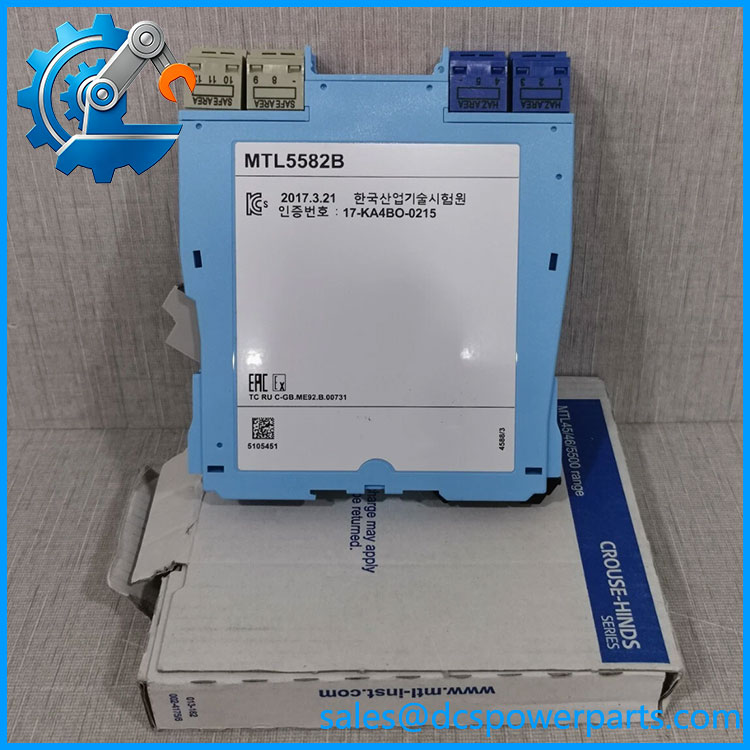
MTL5582B
Application Scenarios & Field Pitfalls — The Engineer’s Perspective
Engineering Pain Point
RTD circuits become complicated when the sensor is located inside a classified area but the receiving measurement system is installed in a safe control cabinet. The interface must preserve the resistance measurement while satisfying intrinsic-safety requirements. The MTL5582B addresses this by limiting hazardous-area energy and galvanically isolating the field circuit from the safe-area circuitry.
Typical Applications
- Hazardous-area Pt100 measurement: Repeats RTD resistance to a DCS or PLC resistance-input channel.
- Process temperature monitoring: Useful where the receiving system specifically requires a resistance input rather than 4–20 mA.
- Oil, gas and chemical process instrumentation: Provides an intrinsic-safety interface between classified-area RTDs and safe-area control equipment.
- Legacy DCS/PLC replacement work: Suitable where an existing installation must be matched without converting the signal architecture to 4–20 mA.
Technical Pitfalls to Avoid
- Do not treat it as a 4–20 mA temperature transmitter.
The safe-area output is a resistance signal. Replacing it with a conventional current-output temperature converter changes the receiving-channel requirements. - Verify the RTD wiring configuration.
The module supports 2-, 3-, and 4-wire arrangements, and the hazardous-area and safe-area wiring selections are independently configurable. Do not assume the existing terminal arrangement is automatically correct. - Check the DCS/PLC input card before replacement.
The receiving channel must be capable of measuring the repeated resistance. A standard voltage or 4–20 mA analog input is not automatically compatible. - Check the intrinsic-safety documentation for the actual installation.
Certification exists for the , but system approval depends on the complete entity/loop parameters, associated apparatus, wiring, enclosure, and installation method—not merely the isolator’s certificate. Eaton/MTL maintains current certification records for the product. - Do not confuse with MTL5575.
Both can be used with RTDs, but the signal architecture differs. MTL describes the as a non-configurable alternative to the MTL5575 where a resistance input is required instead of a 4–20 mA output. - Account for open-circuit behavior.
The module drives the signal upscale on sensor open circuit, with Eaton specifying approximately 420 Ω nominal. The receiving system’s alarm limits should be checked against this behavior.
Related Products
- MTL5582 — Earlier resistance-isolator version for repeating RTD signals; the replaced it in 2016 with improved safe-area response characteristics.
- MTL5575 — Single-channel configurable RTD/thermocouple temperature converter with a 4–20 mA safe-area output; fundamentally different signal architecture from the resistance-output .
- MTL5573 — Single-channel RTD/thermocouple temperature converter producing a 4–20 mA safe-area signal.
- MTL5576-RTD — Two-channel RTD temperature converter with 4–20 mA output; useful where channel density is more important than resistance-output architecture.
- MTL5581 — Single-channel mV/thermocouple isolator for low-level signals; it is not an RTD resistance repeater.
- MTL5541 — Single-channel 2/3-wire transmitter repeater for conventional transmitter signals rather than direct RTD resistance measurement.
- MTL5544 — Two-channel 2/3-wire transmitter repeater for applications based on transmitter current signals.
Procurement and Replacement Note
For an replacement, verify the complete catalog number, hazardous-area certification requirement, RTD type, 2/3/4-wire configuration, receiving resistance-input card, supply voltage, and existing terminal wiring before purchasing. The is a specialized intrinsic-safety interface, not a generic signal conditioner, so substituting another MTL5500 module solely because it accepts an RTD can create a signal-type or safety-architecture mismatch.
Eaton’s current product documentation identifies certification under multiple schemes, including current IECEx/ATEX-related records, while some older certificates have been superseded. For a live hazardous-area installation, use the certificate revision applicable to the plant’s jurisdiction and installation standard.