Description
Moore Industries HCS/HART/MB485/9-30DC — HART-to-MODBUS RTU Converter
Product Introduction
When a DCS or PLC can communicate through MODBUS but the field instruments still expose valuable HART information, the practical problem is usually not the 4–20 mA signal itself. The missing layer is the digital instrument data. The Moore Industries HCS/HART/MB485/9-30DC provides that bridge by accepting HART communication and presenting the retrieved information through a MODBUS RTU RS-485 interface. Moore Industries identifies the HCS specifically as a HART-to-MODBUS RTU converter.
The HCS/HART/MB485/9-30DC is useful where an existing control system needs access to transmitter diagnostics, secondary variables, configuration information, or other HART data without replacing the host DCS interface. The unit can communicate with a single HART instrument or a multidrop arrangement of up to 16 devices, while its 9–30 VDC supply and DIN-rail housing suit conventional control cabinets.
Key Technical Specifications
| Parameter | Specification |
|---|---|
| Product Model | HCS/HART/MB485/9-30DC |
| Manufacturer | Moore Industries |
| Product Family | HCS HART Concentrator System |
| Product Type | HART-to-MODBUS RTU converter |
| HART Interface | HART digital protocol |
| Output Interface | RS-485 |
| Communication Protocol | MODBUS RTU |
| Power Input | 9–30 VDC |
| Power Tolerance | ±10% |
| Power Configuration | 4-wire |
| HART Device Capacity | Single device or up to 16 devices in multidrop mode |
| Housing | Universal DIN-style enclosure |
| DIN Compatibility | 32 mm G-type / 35 mm Top Hat DIN rail |
| Integral Display | No |
| Configuration | PC-programmable |
| Hazardous-Area Classification | Non-Incendive / Division 2 and Zone 2, where applicable to the certified configuration |
| RoHS | Yes |
Moore’s current product information identifies the MB485 option as MODBUS RTU through RS-485 and the 9-30DC option as a four-wire 9–30 VDC supply. The manufacturer’s documentation also identifies the DIN housing and multidrop capability.
Application Scenarios & Pain Points
Adding HART Diagnostics to an Existing DCS
A common plant situation is an existing 4–20 mA loop connected to a DCS where the process value works normally, but maintenance personnel cannot easily retrieve HART device information from the control room. The HCS can operate alongside the existing control arrangement and make HART information available through MODBUS. Moore specifically documents this type of DCS integration.
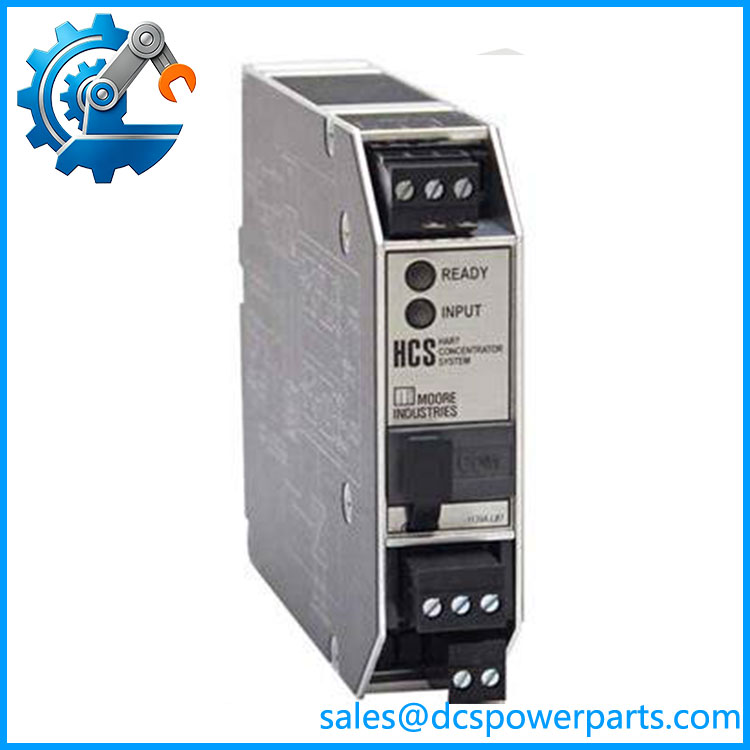
HCSHARTMB4859-30DC
HART-to-MODBUS Instrument Integration
The HCS can query HART instruments and store the resulting information in MODBUS registers for access by a MODBUS master. This makes it suitable for DCS, PLC, HMI, and supervisory applications that already have an RS-485 MODBUS interface.
Multidrop Instrument Networks
One HCS can interface with up to 16 HART devices in multidrop mode according to Moore Industries’ application documentation. That can be useful in instrument panels where adding a separate communication converter for every transmitter would create unnecessary hardware.
Tank Farm and Instrument Monitoring
Moore Industries documents the HCS in tank-gauging applications where existing HART transmitters remain connected to a DCS while a separate HMI needs access to their digital information. The HCS can provide the additional MODBUS communication path without replacing the existing instrumentation.
Related Products
- Moore Industries HCS/HART/MB232/9-30DC — HCS version using MODBUS RTU over RS-232 instead of the MB485 RS-485 interface.
- Moore Industries HCS/HART//9-30DC/-RF — Same basic HART-to-RS-485 architecture with enhanced RFI/EMI protection.
- Moore Industries HCS/HART//9-30DC [DIN] — DIN-rail housing designation for the HCS configuration.
- HCS Configuration Cable — Used for PC connection and configuration.
- HCS Configuration Software — PC software used to configure HART and MODBUS parameters.
- Moore Industries HCS HART Concentrator System — The broader product platform from which the specific /9-30DC configuration is ordered.
These are configuration variants and accessories rather than automatic substitutes. The interface selection, supply voltage, EMI option, and housing should be matched to the existing installation.
Engineer’s Guide — Field Pitfalls to Avoid
1. Do not confuse HART with the 4–20 mA process signal
The HCS is accessing the digital HART communication layer. It is not intended to replace the primary analog process-value path into the DCS. Moore specifically describes the HCS as connecting in parallel to the HART signal so the existing control signal can continue to serve the control system.
2. Confirm whether the application is single-drop or multidrop
The HCS supports both a single HART device and multidrop arrangements, but the addressing and instrument configuration must match the application. Do not assume that a collection of HART instruments can simply be connected together without reviewing their addressing and loop arrangement.
3. Check the MODBUS master configuration
The HCS is the MODBUS RTU interface side of the installation. The host PLC, DCS, or HMI must be configured with the correct MODBUS address, baud rate, parity, floating-point word order, and register grouping. These are configurable HCS parameters.
4. Do not overlook the -RF option
The base model and the -RF variant are not identical ordering codes. Moore identifies -RF as enhanced RFI/EMI protection. In cabinets located near variable-frequency drives, contactors, large motors, or other high-noise equipment, verify which option was originally installed rather than assuming the suffix is irrelevant.
5. Verify the power range
The 9-30DC portion of the model identifies the DC supply configuration. The documented nominal range is 9–30 VDC with ±10% tolerance. Do not substitute a 24 V-only interface without checking the actual supply and ordering configuration.
6. Check the DIN housing designation
The HCS ordering structure can include the DIN housing designation. Moore documents mounting on both G-type and Top Hat DIN rails. When replacing an older unit, compare the physical housing and terminal arrangement as well as the electronic model code.
7. Record the original configuration before replacement
This is particularly important when the HCS is used as a bridge between field instruments and a plant-wide MODBUS network. Record HART addresses, MODBUS settings, baud rate, parity, register mapping, and instrument assignments before removing the old unit. Replacing the hardware without restoring its configuration can leave the communications layer apparently healthy while the host receives the wrong instrument data.
FAQ
What is the Moore Industries HCS/HART//9-30DC?
It is a HART-to-MODBUS RTU converter from Moore Industries’ HCS HART Concentrator System. The specific configuration accepts HART communication and provides an RS-485 MODBUS RTU interface, with a 9–30 VDC supply.
Can it communicate with multiple HART transmitters?
Yes. Moore Industries documents operation with a single HART device as well as multidrop communication involving up to 16 HART devices.
Is HCS/HART//9-30DC an analog input module?
No. Its primary role is digital protocol conversion between HART and MODBUS RTU. It should not be specified as a conventional DCS analog input card.
Does the HCS output MODBUS TCP?
No. The configuration provides MODBUS RTU over RS-485. Moore also offers an MB232 configuration for MODBUS RTU over RS-232.
Can it be used with an existing DCS?
Yes, where the DCS has a suitable MODBUS RTU interface. Moore specifically documents using the HCS to expose HART information to a DCS through its MODBUS interface.
Can HCS provide power to a HART transmitter?
The manufacturer documents an HCS capability to provide 24 VDC loop power to one 2-wire transmitter in applicable configurations. This should be checked against the exact installation and wiring requirements before relying on the HCS as the transmitter’s power source.
What should I verify before purchasing a replacement?
Match the complete ordering code, including HCS / HART / / 9-30DC, housing designation, and any -RF option. Then verify the existing HART topology, MODBUS configuration, instrument addresses, register mapping, and physical DIN installation. For used or refurbished equipment, verify actual inventory condition and configuration rather than relying on a generic HCS description.