Description
Key Technical Specifications
| Parameter | Value |
|---|---|
| Manufacturer | Metso |
| Model | D201376 |
| Product Type | MB8 I/O Mounting Base / I/O Rack |
| System | MetsoACN / Metso DNA |
| I/O Capacity | 8 I/O modules |
| Field Connection | FCS / FCR field-connector arrangement |
| Associated FCS Part | S446105 |
| Module Connection | Ribbon-cable interface |
| Mounting Function | Mechanical mounting and field wiring interface |
| Architecture | Distributed I/O |
| Typical Application | MetsoACN M80 I/O groups |
| Expansion | Two D201376 units can form a 16-unit mounting arrangement |
| Associated Mounting Base | D201379 for larger I/O cabinet assemblies |
| Bus Terminator | D201381 |
| Lifecycle | Legacy / discontinued |
| Direct I/O Processing | None — this is an interface/mounting assembly |
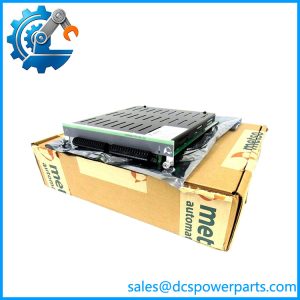
The most useful technical distinction is this: D201376 is not itself the AI8C, DI8P, or DO8P I/O electronics. It is the MB8 mounting/interface hardware that accommodates the I/O modules and their field connections. A Metso cabinet specification identifies the MB8 as an I/O mounting base for eight units, while another technical reference describes D201376 as providing ribbon-cable connections from the I/O units to the field connection hardware.
Product Introduction
Metso D201376
The Metso D201376 is an MB8 I/O mounting base used in MetsoACN distributed I/O installations. It provides the physical mounting and signal-connection path for up to eight I/O modules, with field wiring handled through associated FCR or FCS connector assemblies.
Its job is mostly architectural rather than computational. There is no reason to expect itself to perform analog conversion, digital logic, or process control. Its importance is mechanical and electrical: keeping the I/O modules, ribbon-cable interfaces, and field-termination hardware correctly organized within the Metso distributed-I/O cabinet.
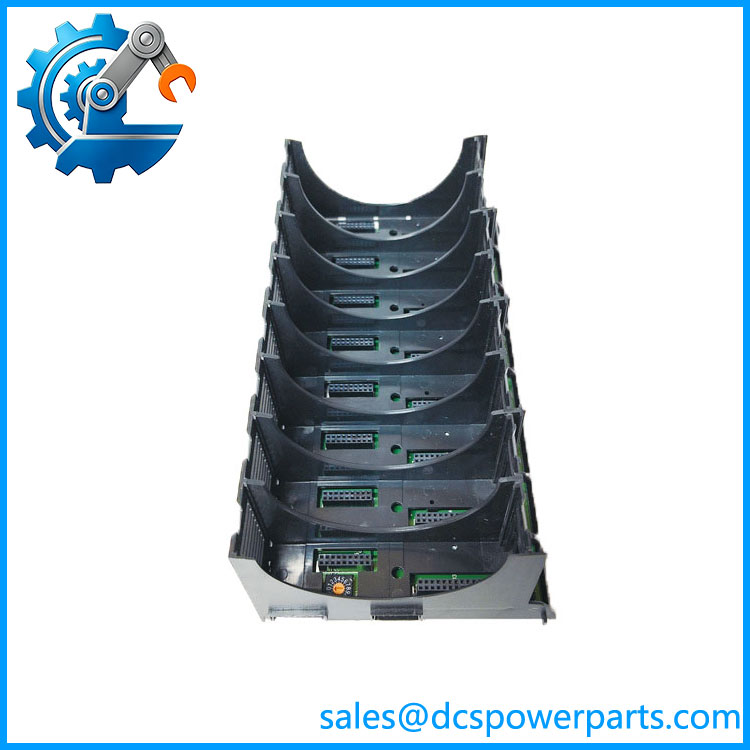
D201376
Application Scenarios & Field Pitfalls
Engineering Pain Point
A failed I/O mounting base is easy to misdiagnose because the individual I/O modules may still look healthy. If several channels from different modules disappear at once, check the /MB8 assembly, ribbon cables, field connectors, and common connection path before replacing multiple I/O cards. In a legacy Metso cabinet, a mechanical connection problem can look exactly like an electronics problem from the DCS screen.
Typical Applications
- Pulp & Paper — Distributed process I/O for paper machines, stock preparation, drives, pumps, and process instrumentation.
- Power Generation — Remote I/O cabinet interfaces for boiler, auxiliary, balance-of-plant, and process signals.
- Chemical Processing — Field termination and module mounting for distributed analog and digital process I/O.
- Mining & Minerals — Metso automation cabinets serving conveyors, pumps, material handling, and process equipment.
Technical Pitfalls to Avoid
- Do not buy as an analog input replacement.
This is the most important point. Some current listings call an “analog input module,” but the stronger Metso cabinet documentation identifies it as the MB8 I/O mounting base. The actual signal-processing modules are separate components such as AI8C, DI8P, and DO8P. - Check the FCS/FCR configuration.
The MB8 can use field-connector hardware. The FCS configuration uses spring terminals, while FCR provides a different field-termination arrangement. Verify the installed cabinet before ordering associated connection hardware. - Inspect ribbon cables carefully.
The architecture uses ribbon-cable connections between the I/O units and field-connection arrangement. A partially seated or damaged cable can create multiple-channel failures that initially appear to be I/O-card faults. - Verify module count.
One is an 8-unit MB8 mounting base. Metso documentation shows two units used for a 16-unit arrangement. Do not confuse the physical capacity of the base with the number of channels provided by the individual I/O cards. - Check the field connector before replacing the base.
If only one field circuit is affected, replacing the entire may be unnecessary. Check the terminal, cross-connection wiring, FCS/FCR connector, and cable first. - Inspect mechanical seating.
Legacy cabinet maintenance can disturb connector alignment. Confirm that the mounting base, module connectors, and field interface are fully seated before restoring power. - Do not assume all D201xxx parts are I/O cards.
The Metso D201xxx family contains controllers, I/O modules, mounting hardware, and other system components. The part-number prefix alone does not establish function. - Record the original slot arrangement.
Before removing modules, photograph the cabinet and record each I/O card position. The physical arrangement can matter for wiring and maintenance even when the DCS configuration remains unchanged. - Check the common connection path when several channels fail.
If multiple I/O modules show simultaneous field-signal problems, investigate the mounting base, field connector, common cabling, and I/O communication path before declaring several electronic modules defective. - Verify the complete cabinet architecture.
is only one part of the distributed-I/O assembly. Associated hardware includes the D201379 mounting base, S446105 FCS field connectors, and D201381 I/O bus terminator in documented MetsoACN cabinet arrangements.
Related Products
- Metso S446105 — FCS field connector with spring terminals. It is the field-termination component associated with the MB8 architecture and provides the practical interface between cabinet I/O and field wiring.
- Metso S446106 — FCR field connector using screw terminals. It serves the same general field-connection layer but uses a different terminal arrangement.
- Metso D201379 — MBB/IBC/IPS mounting base used in the broader MetsoACN I/O cabinet structure. It is complementary to and should not be confused with the eight-unit MB8 base.
- Metso D201381 — I/O bus terminator used with the MetsoACN distributed-I/O architecture. It is a bus-end component, not an I/O module.
- Metso D201134 / AI8C — Analog input module. This is the actual signal-processing hardware for analog inputs and therefore has a fundamentally different function from .
- Metso D201126 / DI8P — Digital input module used within the same distributed-I/O architecture. It provides digital signal acquisition, whereas provides the mounting/connection infrastructure.
- Metso D201129 / DO8P — Digital output module. It provides output-channel electronics and is installed within the MB8-type I/O arrangement rather than replacing the mounting base.
- Metso D201136 / AO4C — Analog output module for the MetsoACN I/O family. It is relevant when configuring an MB8 assembly with analog output functions.
- Metso D201463 / ACN C20 — ACN controller hardware used at a higher level of the Metso distributed-control architecture. It works with distributed I/O but is not mechanically or functionally interchangeable with .
- Metso D201505 / ACN C20 — Another ACN controller variant. It belongs to the control/network layer, while belongs to the physical distributed-I/O mounting and connection layer.