Description
Kongsberg Maritime RCU500
Product Overview
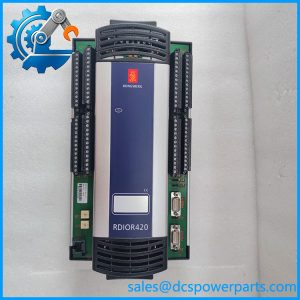
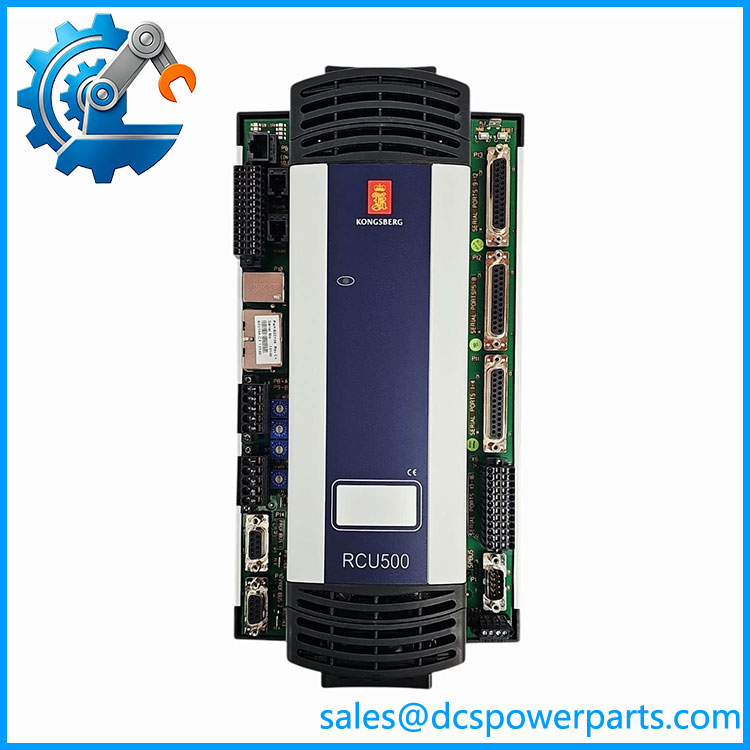
The Kongsberg Maritime RCU500 is a real-time Remote Controller Unit designed specifically for marine process-control applications. Kongsberg describes it as a single-board-computer-based controller intended for Dynamic Positioning systems, vessel control systems, process-control systems, and safety systems. Its core computing platform uses a PowerPC 8245 processor operating at 400 MHz, with 32 MB SDRAM and 16 MB Flash memory.
The Kongsberg RCU500 also integrates the remote-I/O communication function into the controller itself. Its SPBus interface connects the controller to Kongsberg RIO 400 remote I/O units through an RS-485 multidrop link with Manchester encoding. The controller provides two 10/100 Mbps Ethernet interfaces, dual CAN interfaces, dual PROFIBUS interfaces, twelve configurable serial lines, four isolated serial lines, four digital inputs, and four digital outputs.
That architecture is significant when maintaining older Kongsberg installations. The RCU500 is not a generic PLC CPU and not simply an I/O gateway. It combines processing, fieldbus management, local I/O, diagnostics, and redundancy functions in one DIN-rail-mounted unit. Kongsberg’s TÜV documentation confirms that the RCU500 was introduced into the AIM Safe architecture by combining the functionality previously provided by the SBC400 and SPBUS400 into one controller. The same documentation records its use in safety-related AIM applications up to SIL 3 at the system level under the specified architecture.
Product Introduction
Older Kongsberg automation cabinets can depend heavily on the RCU500 because the controller combines application processing with the SPBus interface to distributed RIO equipment. A failed unit therefore affects more than CPU execution; it can also interrupt the controller’s field-I/O communication path.
For a legacy replacement, the hardware label is only the starting point. The installed application, SPBus topology, controller redundancy, network configuration, and connected RIO equipment all need to match the vessel’s existing system.
Key Technical Specifications
| Parameter | Specification |
|---|---|
| Model | |
| Manufacturer | Kongsberg Maritime |
| Product Type | Remote Controller Unit |
| Article Number | 602265 |
| CPU | PowerPC 8245 |
| CPU Frequency | 400 MHz |
| SDRAM | 32 MB |
| Flash Memory | 16 MB |
| Supply Voltage | 24 VDC ±20% |
| Maximum Power Consumption | 20 W |
| Maximum Heat Dissipation | 20 W |
| Ethernet | 2 × 10/100 Mbps |
| CAN Bus | 2 × 1 Mbps |
| PROFIBUS | 2 × 12 Mbps |
| General Serial Interfaces | 12 × RS-232 / RS-422 / RS-485 |
| Isolated Serial Interfaces | 4 × RS-232 / RS-422 / RS-485 |
| Standard Serial Rate | Up to 115 kbps; higher rates documented for selected interfaces |
| SPBus Interfaces | 1 |
| SPBus Connector | 9-pin male D-sub |
| SPBus Voltage Range | 10–28.8 VDC |
| SPBus Isolation | 500 V via optocoupler |
| SPBus Type | RS-485 multidrop |
| SPBus Maximum Frequency | 2 MHz |
| SPBus Coding | Manchester |
| Digital Inputs | 4 |
| Digital Outputs | 4 |
| Watchdog | System-status watchdog output |
| Redundancy Interfaces | Redundancy input/output connections |
| Operating Temperature | 0°C to +70°C |
| Storage Temperature | -25°C to +70°C |
| Operating Humidity | Up to 98% RH |
| Protection | IP20 |
| Dimensions | 355 × 158 × 87 mm |
| Weight | 1.35 kg |
| Mounting | DIN rail |
| Connector Type | Screw terminals, 1.5 mm² |
The specifications above are taken from Kongsberg’s datasheet.
Major Features / Practical Advantages
Integrated controller and SPBus interface
The defining characteristic of the is the combination of a real-time computer and remote-I/O bus driver. Kongsberg’s TÜV documentation specifically states that the combined the functionality of the earlier SBC400 and SPBUS400 into a single DIN-rail-mounted unit.
This reduces the number of separate controller and bus-interface modules required in the process station, but it also makes the more important to the overall system than a conventional communication interface.
RCU500
PowerPC 8245 processing platform
The controller uses a 400 MHz PowerPC 8245 with 32 MB SDRAM and 16 MB Flash. Kongsberg’s datasheet states that this processor platform was capable of running AIM and DP applications.
For replacement work, do not confuse processor capability with application compatibility. The controller hardware can be correct while the installed application image is wrong or missing.
SPBus for RIO 400 remote I/O
The provides one dedicated SPBus interface for Kongsberg RIO 400 remote I/O equipment. The bus uses RS-485 multidrop signaling, Manchester encoding, and a maximum frequency of 2 MHz. The SPBus interface has documented 500 V isolation through an optocoupler.
This is the key difference between the and later RCU families using other remote-I/O bus architectures. is an SPBus controller.
Dual Ethernet
Two Ethernet LAN connections provide 10/100 Mbps network interfaces. The controller architecture was prepared for redundant RCU operation.
In a vessel installation, these ports should be treated according to the Kongsberg network design. Do not assume that both ports can be freely reassigned as ordinary Ethernet connections.
Dual CAN and PROFIBUS interfaces
The controller includes two CAN interfaces rated to 1 Mbps and two PROFIBUS interfaces rated to 12 Mbps.
This allows the to interface with a range of external control and automation equipment while retaining the SPBus connection for Kongsberg remote I/O.
Extensive serial connectivity
Twelve general-purpose serial interfaces support RS-232, RS-422, or RS-485, while four additional serial interfaces provide galvanic isolation. The documented maximum rates differ between these interface groups.
For older vessels with serial navigation, propulsion, instrumentation, or auxiliary control equipment, this interface capacity can be a major part of the original system design.
Local digital I/O
The provides four general-purpose digital inputs and four general-purpose digital outputs. Kongsberg’s hardware training documentation also identifies these onboard I/O points as opto-isolated.
These points are local controller I/O and should not be confused with the larger number of distributed signals handled through RIO 400 modules on SPBus.
Built-in diagnostics and watchdog
Kongsberg specifies built-in self-test facilities, error reporting through operator stations, a watchdog with system-status output, front-panel status indication, and high-temperature and cooling-fan alarms.
For field troubleshooting, these functions provide useful evidence when separating an RCU hardware fault from a remote-I/O or communications problem.
Redundant operation and hot replacement
The was designed for redundant RCU operation. Kongsberg’s product datasheet explicitly states that an can be hot-replaced in a redundant system.
That qualification matters. It should not be interpreted as permission to remove an from every single-controller installation while energized. The system must actually be operating in an approved redundant configuration, and the vessel’s maintenance procedure must permit the replacement.
Marine and functional-safety design
Kongsberg specifies conformity with IEC 61131-2, IEC 60945, IACS E10, and IEC 61508 for the product.
The TÜV report goes further for the AIM Safe application: it evaluated the as part of an AIM Safe release and concluded that the specified system architecture could meet requirements up to SIL 3 for low-demand safety applications. That SIL statement belongs to the specified AIM Safe system architecture, not to an installed by itself.
Related Products
- RCU400H — Earlier Kongsberg controller platform. was designed with software compatibility with the RCU400H controller unit.
- SBC500 — Kongsberg single-board-computer platform with which the is documented as software compatible.
- RCU501 — Later Kongsberg Remote Controller Unit using the RBus architecture rather than the ‘s SPBus architecture. It should not be treated as a direct bus-level substitute.
- RCU502 — Successor-generation Kongsberg Remote Controller Unit. It uses a revised controller architecture and should be evaluated against the existing system before substitution.
- RCU510 — Related Kongsberg Remote Controller Unit using SPBus and adding onboard I/O capability in the later RCU family.
- RIO400 — Kongsberg remote I/O family connected to the through SPBus.
- SPBus-HUB — SPBus distribution hardware used when multiple RIO units need to be connected within the controller architecture.
- SPBUS400 — Earlier separate SPBus controller/interface functionality that Kongsberg later combined with SBC400 functionality in the .
- SBC400 — Earlier Kongsberg process-control computer whose functionality was combined with SPBUS400 in the .
FAQ
What is the Kongsberg ?
The is a Kongsberg Maritime Remote Controller Unit based on a real-time single-board computer. It executes process-control applications and manages communication with RIO 400 remote I/O through SPBus.
Is an I/O module?
No. It contains four digital inputs and four digital outputs, but its primary role is controller processing and remote-I/O bus management. The distributed field I/O is handled by RIO 400 modules connected through SPBus.
What processor does the use?
Kongsberg specifies a PowerPC 8245 at 400 MHz, with 32 MB SDRAM and 16 MB Flash.
What is the difference between and RCU501?
The distinction is important for legacy-system procurement. The is an SPBus controller, while the RCU501 is associated with Kongsberg’s later RBus architecture. Kongsberg training documentation explicitly distinguishes as the SPBus controller and RCU501 as the RBus controller.
They should therefore not be treated as interchangeable simply because both are labeled Remote Controller Units.
Can I hot-swap the ?
Kongsberg explicitly documents hot replacement in a redundant system.
For a single-controller installation, do not assume the same procedure applies. Verify the actual redundancy configuration and vessel maintenance procedure first.
Does support firmware v3.1?
The part number does not establish firmware v3.1. Kongsberg documents the controller as a software-driven real-time computer capable of running AIM and DP applications, so the installed application/software revision must be verified on the actual unit or system documentation.
What is the Kongsberg article number for ?
Kongsberg’s official product datasheet identifies .
Some secondary listings show other identifiers, including 603108. Those should not override the official 602265 identification without checking the physical nameplate and revision. For procurement, photograph the complete label rather than relying on a shortened database description.
What remote I/O does use?
The uses SPBus to communicate with Kongsberg RIO 400 remote I/O units. The SPBus interface is RS-485 multidrop, optically isolated to 500 V, with Manchester signal coding and a maximum frequency of 2 MHz.
Can be used in a safety system?
Yes, Kongsberg’s was incorporated into the AIM Safe architecture. TÜV’s 2004 approval report evaluated the as part of the AIM Safe release 7.2 and stated that the specified system architecture could meet requirements up to SIL 3 for low-demand applications.
That does not mean an individual surplus automatically carries a SIL 3 rating independent of its system configuration, application software, redundancy, diagnostics, and safety lifecycle.
What should I verify before buying an ?
For a vessel-critical spare, verify:
- Exact model:
- Kongsberg article number: 602265
- Hardware revision
- CPU/memory version
- SPBus configuration
- Connected RIO 400 modules
- Ethernet A/B network configuration
- CAN and PROFIBUS assignments
- Serial interface assignments
- RCU redundancy arrangement
- Application software/image
- Existing controller address and mode settings
- Fan and temperature-alarm condition
- Functional-test evidence
Procurement Note
The Kongsberg Maritime is a legacy marine process controller built around a 400 MHz PowerPC 8245, 32 MB SDRAM, 16 MB Flash, SPBus, Ethernet, CAN, PROFIBUS, serial interfaces, and local digital I/O. Kongsberg’s own datasheet identifies 602265 as the article number and specifies 24 VDC ±20% input, 20 W maximum power consumption, IP20 protection, and DIN-rail mounting.
The most important compatibility issue is the SPBus architecture. was designed to communicate with RIO 400 remote I/O units over SPBus. It should not be substituted with an RCU501 merely because the two products have similar names; Kongsberg documentation identifies RCU501 as the RBus controller, representing a different remote-I/O bus architecture.
There is also a significant software consideration. Kongsberg describes the as software-compatible with the RCU400H and SBC500, while the AIM Safe approval documents the as a new controller combining SBC400 and SPBUS400 functionality.
For a used or surplus unit, powering up successfully is not enough to establish suitability. A proper spare should be checked for controller startup, Ethernet communication, SPBus communication, local DI/DO operation, serial interfaces relevant to the installation, and the correct application image.
The is particularly sensitive to system-generation matching. If the vessel was originally designed around /SPBus/RIO400, retaining that architecture may be substantially different from migrating to /RBus or RCU502 hardware.
One final procurement warning: the official Kongsberg datasheet gives 602265 as the article number. If a supplier offers an under a different number, do not reject it automatically, but require a clear photograph of the complete nameplate, hardware revision, and any Kongsberg assembly/serial identification before treating it as an equivalent unit.