Description
Key Technical Specifications
| Parameter | Specification |
|---|---|
| Manufacturer | Kongsberg |
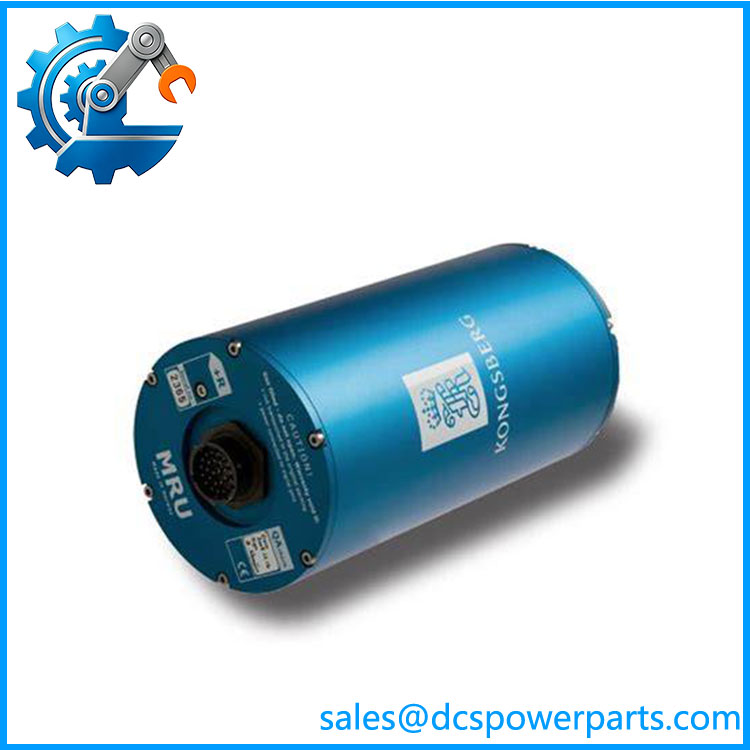
| Model | MRU-M-SU1 |
| Product Type | Motion Reference Unit |
| Sensor Technology | MEMS-based inertial sensing |
| Primary Measurements | Roll, pitch, heave |
| Extended Motion Data | Yaw, surge, sway depending on system configuration/input |
| Communication Interfaces | Ethernet, RS-232 / RS-422 |
| Data Protocols | Marine serial/network protocols; configuration dependent |
| Power Supply | Low-voltage DC; exact range should be verified from unit documentation |
| Typical Applications | Hydrographic survey, sonar motion compensation, marine navigation, offshore systems |
| Mounting | Fixed vessel/platform mounting |
| Environmental Design | Marine-rated enclosure |
| Configuration | Application and software dependent |
Available technical references describe the MRU-M-SU1 as a compact Kongsberg motion-reference sensor using solid-state MEMS sensing. Published secondary specifications differ on exact accuracy, update rate, power range, and environmental ratings, so those figures should not be treated as guaranteed specifications for every MRU-M-SU1 without checking the serial-number-specific documentation.
Application Scenarios & Pain Points
Marine motion data is deceptively important. A small error in vessel attitude can propagate into sonar positioning, depth measurements, crane compensation, or stabilization calculations, particularly when the vessel is operating in rough water.
Typical Applications
- Hydrographic Survey: Roll, pitch, and heave information can be supplied to multibeam or other survey equipment so measured data can be corrected for vessel movement.
- Marine Sonar: Motion-reference data helps compensate for vessel movement and maintain a stable spatial reference during acoustic measurements.
- Dynamic Positioning: The MRU can provide vessel-motion information to a larger navigation or control architecture. It should not, however, be mistaken for a complete DP controller.
- Offshore Equipment: Motion data can support stabilization and motion-compensation systems used around cranes, subsea equipment, and other marine machinery.
Field Case:
When replacing an MRU on a survey vessel, the physical mounting orientation deserves as much attention as the electrical connection. A unit installed with the wrong axis orientation can produce perfectly believable numbers that are neverth
MRU-M-SU1
Related Products
- Kongsberg MRU2 — A newer Kongsberg motion-reference product family used for marine roll and pitch measurement. It is a useful modernization reference, but it should not be assumed to be a drop-in replacement for MRU-M-SU1 without checking the host system.
- Kongsberg MRU-M-MB3 — Another MRU-M family model associated with marine motion measurement. The suffix is significant; application-specific configuration should be verified before substitution.
- Kongsberg RMP201-8 — Remote multi-purpose I/O hardware used in Kongsberg control architectures. It can complement an MRU installation by handling field I/O, but it does not perform the motion-measurement function.
- Kongsberg RCU502 — Remote Controller Unit used in Kongsberg marine control systems. It provides processing/control functions rather than acting as the vessel’s motion sensor.
- Kongsberg RSER200-4 — Serial-line interface hardware supporting RS-232/RS-422/RS-485 connections in compatible Kongsberg architectures. It can serve as a communications companion where the system architecture requires additional serial interfaces.
- Kongsberg RDIOR420 — Kongsberg remote I/O hardware used within marine automation architectures. It is complementary system hardware, not an MRU replacement.
- Kongsberg SPBUS-HUB — Bus/network infrastructure hardware used with compatible Kongsberg marine systems. It supports system connectivity rather than inertial measurement.
- Kongsberg Seapath family — GNSS/INS equipment providing a broader navigation reference solution. A Seapath-class system can incorporate motion-reference functions but serves a substantially wider navigation role than a standalone MRU.
The Engineer’s Guide: Field Pitfalls to Avoid
⚠️ Do Not Assume the MRU’s Physical Orientation Is Correct
An MRU can communicate normally while its X/Y/Z orientation is wrong.
How to avoid it: Record the original mounting direction, reference arrow, vessel heading relationship, and configured installation angles. After replacement, perform a static attitude check before accepting the data.
⚠️ Do Not Treat All MRU-M Variants as Interchangeable
MRU-M-SU1 and other MRU-M variants can look similar while serving different application configurations.
How to avoid it: Match the complete model suffix, firmware/configuration, connector arrangement, output protocol, and host-system requirements. Do not approve a substitute solely from the “MRU-M” family name.
⚠️ Do Not Trust Unverified Accuracy Numbers
Public secondary listings give different figures for MRU-M-SU1 accuracy, update rate, and supply voltage.
How to avoid it: For a procurement specification, use the original Kongsberg documentation associated with the actual serial number. This is especially important when the MRU is part of a calibrated survey system.
Frequently Asked Questions (FAQ)
What is the Kongsberg used for?
The is a marine Motion Reference Unit used to measure vessel motion and provide data to navigation, survey, sonar, stabilization, and other marine systems. Its primary measurements include roll, pitch, and heave, with broader motion information depending on system configuration.
Is an INS or a complete navigation system?
Not necessarily. An MRU is primarily a motion-reference sensor. A complete navigation solution may combine an MRU/IMU with GNSS, heading sensors, navigation processing, and other inputs.
That distinction matters when replacing equipment: matching an MRU with another inertial sensor does not automatically reproduce the functionality of an integrated GNSS/INS system.
Can be used for multibeam sonar?
Yes. Motion-reference information is particularly important for hydrographic survey and multibeam applications because roll, pitch, and heave must be accounted for when interpreting the measured seabed position. The is associated with this type of marine motion-compensation application.
What should I verify before replacing an ?
Check these items first:
- Exact model and suffix
- Serial number and firmware
- Physical mounting orientation
- Output protocol
- Connector/pinout
- Data rate
- Vessel reference coordinates
- Lever-arm configuration
- Host equipment compatibility
- Calibration status
For survey work, calibration and installation geometry are not secondary details. They directly affect measurement quality.
Can I replace with MRU2?
Do not assume a direct swap. MRU2 belongs to a newer Kongsberg product generation and may have different communication, configuration, mechanical, and software requirements.
For a modernization project, evaluate the MRU + navigation computer + sonar/DP interface as one system rather than comparing only the sensor dimensions.
What should I request when buying a refurbished ?
Ask for the actual unit’s:
- Model and serial-number photographs
- Firmware/configuration information
- Connector and housing condition
- Power-on self-test results
- Communication test
- Static roll/pitch verification
- Calibration history
- Previous application, if known
- Warranty terms
A generic “powers on” test is insufficient for a motion-reference sensor. A unit can boot correctly while having configuration or calibration problems that only appear after integration.
Is still practical for legacy Kongsberg systems?
Yes, particularly when maintaining an existing vessel or survey installation where the surrounding software and equipment were designed around the original MRU architecture. The key procurement question is not simply whether another MRU can measure roll and pitch; it is whether it produces the same data format, reference frame, timing behavior, and configured outputs expected by the host system.