Description
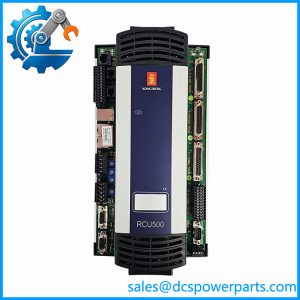
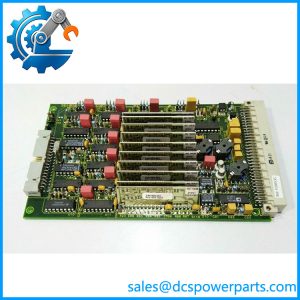
Kongsberg / ULSTEIN AIO1036.V2 Analog I/O Controller Module
Product Introduction
Marine propulsion controllers depend on clean analog feedback for parameters such as command position, actuator feedback, pressure-related signals, and other continuously varying process values. The AIO1036.V2 is an analog input/output interface card used within the ULSTEIN HELICON-X control architecture, providing the signal interface between the propulsion-control processor and external analog instrumentation. The HELICON-X hardware documentation identifies the AIO1036 family specifically as an Analogue In/Out Interface Card.
The documented AIO1036 architecture provides eight analog inputs and six analog outputs, with jumper-selectable voltage/current operation. Each analog input can be configured for a disconnected state, ±10 V, or 0–20 mA; the analog outputs provide corresponding selectable configurations. A current parts record identifies AIO1036 V2 as an analog I/O controller module with P/N 10405 Rev F, making the complete revision marking important when sourcing a replacement.
Key Technical Specifications
| Parameter | Specification |
|---|---|
| Manufacturer / System | ULSTEIN / Kongsberg Maritime |
| Model | AIO1036.V2 |
| Product Type | Analog Input/Output Interface Card |
| Related P/N | 10405 |
| Documented Revision | Rev F |
| System | HELICON-X |
| Primary Application | Marine propulsion remote control |
| Analog Inputs | 8 |
| Analog Outputs | 6 |
| Analog Input Range | ±10 V or 0–20 mA, jumper selectable |
| Analog Output Range | ±10 V or 0–20 mA, jumper selectable |
| Input Configuration | Individual channel jumper selection |
| Output Configuration | Individual channel jumper selection |
| Isolation | Galvanically isolated interface |
| Installation | HELICON-X electronic control unit |
| Signal Type | Analog process/control signals |
| Condition | Verify actual unit condition and revision |
The HELICON-X documentation gives individual jumper positions for AI00 through AI07 and AO0 through AO5. Each channel can be disconnected or configured for voltage/current operation through its associated jumper.
That configuration detail is important during replacement. A card can be electrically functional but still produce incorrect system behavior if a channel is left in 0–20 mA mode when the connected equipment expects ±10 V, or vice versa.
Application Scenarios & Pain Points
The .V2 is not a generic PLC analog card that should be swapped based only on channel count. It belongs to a dedicated marine propulsion-control architecture, where each analog signal has a defined role in the vessel’s control logic.
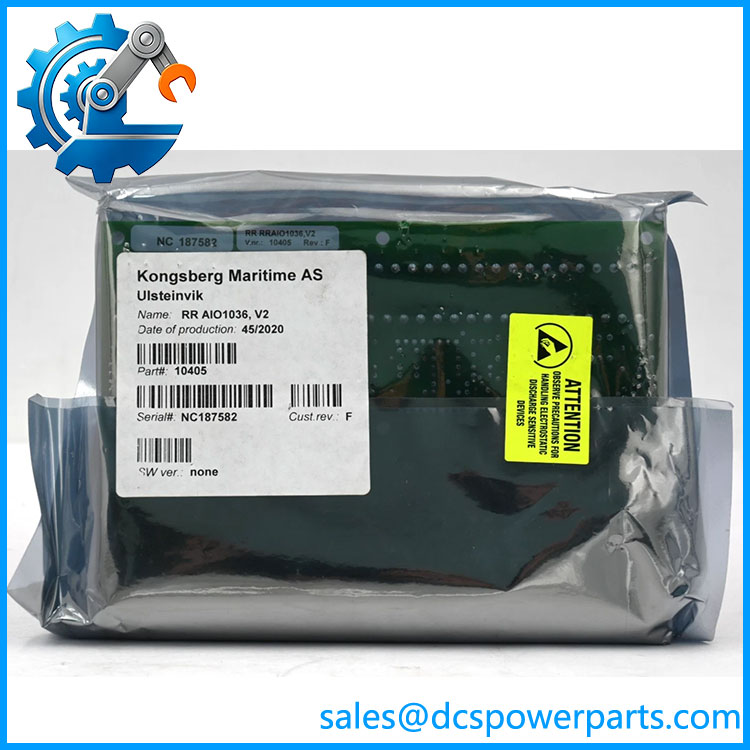
AIO1036.V2
Typical applications include:
- Marine propulsion control: Analog acquisition and command signals within HELICON-X propulsion systems.
- Propeller control: Processing continuously variable feedback and command signals associated with propulsion equipment.
- Actuator feedback: Interfacing analog position or process-feedback devices with the propulsion controller.
- Analog command generation: Providing configurable analog outputs to connected control equipment.
- Legacy HELICON-X maintenance: Replacement of an -family board in existing marine electronic units.
The HELICON-X documentation shows the alongside the IDA1035C Main Processor Card, DIO1037A Digital I/O Interface Card, PFI1038 Pulse/Frequency Interface Card, and PIB1039A Pitch Backup and Indication Card.
Field note: When troubleshooting an analog-control problem, check the jumper configuration before condemning the board. On this card, signal type is hardware-selected. A replacement with different jumper settings can create what looks like a calibration or sensor fault.
Related Products
- ULSTEIN / Kongsberg IDA1035C — Main Processor Card responsible for central processing and data acquisition in the HELICON-X architecture.
- ULSTEIN DIO1037A — Digital I/O Interface Card for discrete signals.
- ULSTEIN PFI1038 — Pulse/Frequency Interface Card for pulse and frequency-related signals.
- ULSTEIN PIB1039A — Pitch Backup and Indication Card for pitch indication and backup-control functions.
- ULSTEIN PDM1040 — Power Distribution and Monitor Card.
- ULSTEIN PCC1030C — Panel Processor Card used in HELICON-X control stations.
- ULSTEIN LSI1031B — Lamp and Switch Interface Card for operator-interface functions.
These boards belong to the same broader marine-control architecture but perform different functions. The .V2 should not be substituted with DIO1037A, for example, simply because both provide I/O functionality.
Engineer’s Guide — Field Pitfalls to Avoid
1. Verify the complete V2 / P/N 10405 identification
Current component records identify the V2 unit as P/N 10405 Rev F.
Avoidance: Record the model, P/N, revision, and PCB markings from the physical card before ordering.
2. Check every analog jumper
The architecture uses individual jumpers to select analog input and output modes.
Avoidance: Photograph the original jumper positions before removal. Replicate the approved configuration on the replacement only after checking the vessel wiring documentation.
3. Do not confuse ±10 V with 0–20 mA
Both signal types are supported, but they are not interchangeable.
Avoidance: Confirm the field transmitter/output device, receiving controller, and jumper setting for every channel.
4. Do not assume channel count alone proves compatibility
Eight inputs and six outputs identify the basic architecture, but hardware revision and system configuration still matter.
Avoidance: Match the complete part number and revision against the vessel’s approved spare-parts documentation.
5. Check the signal source before replacing the card
A failed analog channel can actually originate from a transmitter, broken cable, incorrect reference, connector problem, or configuration error.
Avoidance: Measure the field signal at the card terminals before removing the .V2.
6. Protect the board during handling
This is a populated electronic PCB connected to sensitive analog circuitry.
Avoidance: Use appropriate ESD precautions, isolate power before removal, and avoid handling connector pins or exposed circuitry unnecessarily.
FAQ
What is the .V2?
The is an Analog Input/Output Interface Card used in ULSTEIN HELICON-X marine propulsion-control equipment.
How many analog channels does .V2 have?
The documented architecture provides 8 analog inputs and 6 analog outputs.
What signal ranges does support?
The documented board allows analog channels to be configured for ±10 V or 0–20 mA, using individual jumper settings.
Is .V2 a PLC analog module?
Not in the conventional modular PLC sense. It is a dedicated marine analog interface card designed for the HELICON-X propulsion-control architecture.
What is the part number for .V2?
A current component listing identifies P/N 10405, Rev F for the V2 module.
What is the difference between and DIO1037A?
The handles analog inputs and outputs, while the DIO1037A is the corresponding digital I/O interface card within the HELICON-X architecture.
What should I verify before purchasing .V2?
Verify the .V2 designation, P/N 10405, revision, connector arrangement, jumper configuration, and vessel-specific HELICON-X system documentation. For an installed marine propulsion system, the jumper configuration is particularly important because it determines whether each analog channel operates as a voltage or current interface.