Description
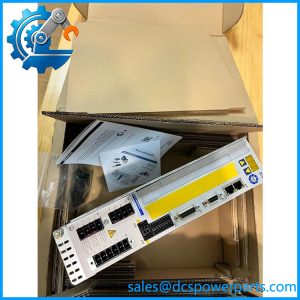
Kollmorgen S22460-SRS | S200 Servo Drive | 24/48 A SynqNet Motion Control
Key Technical Specifications
| Parameter | Specification |
|---|---|
| Manufacturer | Kollmorgen |
| Product Family | S200 |
| Model | S22460-SRS |
| Drive Type | AC brushless servo drive |
| Input Voltage | 240 VAC |
| Input Phase | 3-phase |
| Continuous Output Current | 24 A RMS |
| Peak Output Current | 48 A RMS |
| Peak Duration | Approximately 3 seconds minimum |
| Network Option | SynqNet |
| SynqNet Connector | RJ-45 |
| Cooling | Natural convection |
| Application | Single-axis servo motion |
| Feedback | S200-compatible feedback; configuration dependent |
Kollmorgen’s model-number documentation defines the S200 current classes as 02, 03, 06, 12 and 24, with the 24 class rated at 24 A RMS continuous and 48 A RMS peak. It also defines SRS as the SynqNet option with standard RJ-45 connectors.
Product Introduction
The Kollmorgen S22460-SRS is a high-current member of the S200 digital servo-drive family. Its 240 VAC three-phase power stage is rated for 24 A RMS continuous and 48 A RMS peak output, while the SRS suffix adds the SynqNet interface through standard RJ-45 connectors.
This combination makes the unit suitable for single-axis motion systems that require higher motor current and synchronized networked motion control. The drive should still be matched to the motor, feedback device, command architecture, and SynqNet controller rather than selected solely from the current rating.
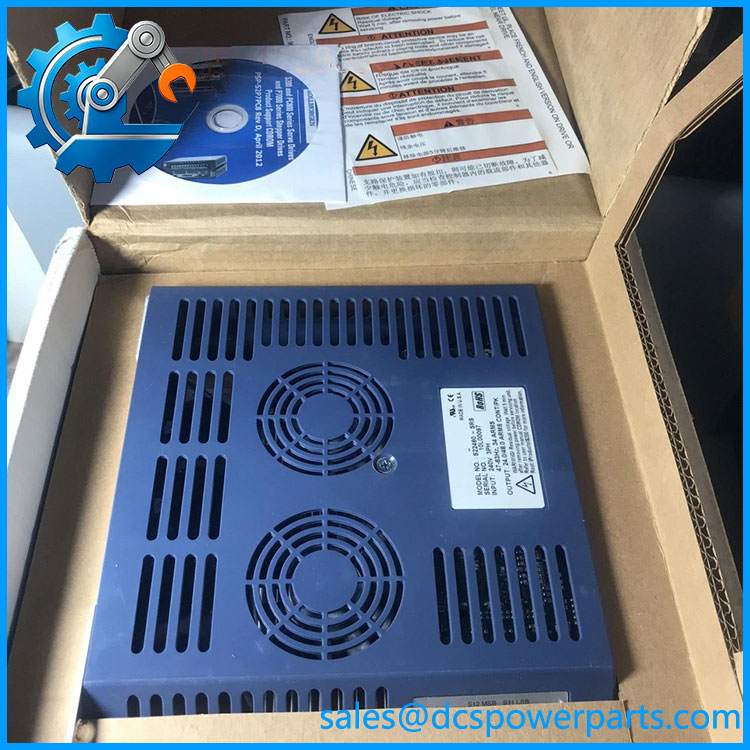
S22460-SRS
Application Scenarios & Field Pitfalls — Engineer’s Perspective
Engineering Pain Point
With an older S200 system, the main replacement risk is usually configuration mismatch, not simply insufficient motor current. A drive with the same family designation but a different suffix may have a different network interface or connector arrangement.
Typical Applications
- Industrial servo axes requiring up to 24 A RMS continuous output.
- Multi-axis motion systems using SynqNet synchronization.
- Semiconductor and precision manufacturing equipment, where the family has historically been used.
- Legacy automation machinery requiring replacement of an S22460-series amplifier.
The family documentation specifically identifies applications including semiconductor fabrication, packaging, medical equipment and other motion-control machinery.
Technical Pitfalls to Avoid
- Do not confuse SRS and SDS.
SRSspecifies SynqNet with RJ-45 connectors, whereasSDSuses the SynqNet option with Micro-D connectors. These are not interchangeable based on software configuration alone. - Verify the 240 VAC three-phase supply.
S22460 belongs to the 240 VAC three-phase / 24-48 A RMS class. Do not apply the lower-current S20260/S20360 specifications to this model. - Check the motor feedback before energizing.
The family supports different feedback arrangements depending on configuration. Confirm the existing motor, feedback device, cable and drive settings before commissioning. - Check SynqNet topology.
An S22460-SRS is not simply an analog servo amplifier with an RJ-45 connector. The SRS option is specifically the SynqNet interface, so the network controller and existing motion architecture need to be compatible. - Do not assume newer revisions are identical.
Kollmorgen notes hardware and regulatory revisions within the family. The S22460 has specific revision history, including a later Rev. C treatment that retained its earlier UL 508C status.
Related Products
- Kollmorgen -VTS — Same power class with the analog velocity/torque base configuration instead of the SRS SynqNet option.
- Kollmorgen -SDS — with SynqNet and Micro-D connectors rather than the RJ-45 interface used by SRS.
- Kollmorgen -CNS — configuration with CAN/Indexer option.
- Kollmorgen S21260-SRS — Lower-current SynqNet drive, 12 A RMS continuous / 30 A RMS peak.
- Kollmorgen S20660-SRS — 6 A RMS continuous / 18 A RMS peak SynqNet class.
- Kollmorgen S20360-SRS — 3 A RMS continuous / 9 A RMS peak AC SynqNet drive.
- Kollmorgen S20260-SRS — 1.5 A RMS continuous / 4.5 A RMS peak AC SynqNet class.
- Kollmorgen S20330-SRS — DC-input SynqNet drive; fundamentally different power-input architecture from -SRS.
Procurement Check
Before approving an S22460-SRS replacement, verify:
- Exact model:
- series
- 240 VAC, three-phase supply
- 24 A RMS continuous / 48 A RMS peak rating
- SynqNet option
- RJ-45 SynqNet connectors
- Motor voltage and current
- Feedback device and cable
- Existing SynqNet controller
- Network topology and node configuration
- Drive hardware revision
- Existing configuration parameters
- Motor tuning and application-specific settings
- Physical connector and mounting condition
Recommended procurement description:
Kgen Digital Servo Drive, 240 VAC 3-Phase, 24 A RMS Continuous / 48 A RMS Peak, SynqNet Interface with RJ-45 Connectors.
For a field replacement, the SRS suffix is critical. A nominally equivalent with VTS or SDS is a different configuration and should not be approved as a direct substitute without an engineering review.