Description
Product Overview
The HP 5517B is a two-frequency helium-neon laser head designed for laser-interferometer positioning and precision displacement measurement. The laser head contains the He-Ne laser, control circuitry, and a reference optical receiver, producing a coherent, collimated beam used with compatible interferometer optics and receivers. The published HP service documentation specifies a 632.991372 nm nominal vacuum wavelength for the 5517B, with lifetime wavelength accuracy of ±0.02 ppm under the stated calibration conditions.
For HP 5517B, the reference frequency is 1.9 to 2.4 MHz, with an H10 option extending the specified range to 2.2–2.4 MHz. The laser beam is typically 6 mm in diameter, with a maximum output of 1 mW. Keysight’s current documentation lists a 500 mm/s maximum velocity with linear optics, while its detailed specification table also identifies 538 mm/s under a specified receiver configuration. The distinction matters: maximum usable measurement velocity depends on the interferometer optics and receiver electronics, not the laser head in isolation.
The HP 5517B belongs to a measurement architecture rather than an industrial PLC/DCS platform. Its typical use is in VME- or PC-based laser-interferometer systems and the 5527A family, particularly where machine motion is comparatively slow. A 90-minute warm-up specification also deserves attention in maintenance planning. For replacement procurement, laser output, frequency stability, calibration history, power supply, beam height, and optical alignment should be checked together. A laser that produces visible light is not necessarily a serviceable interferometer source.
Product Introduction
Precision positioning equipment can appear mechanically accurate while its interferometer reference source has drifted outside acceptable limits. HP 5517B provides the two-frequency He-Ne reference used for displacement measurement, with a 1.9–2.4 MHz reference frequency and 6 mm beam diameter.
The unit requires approximately 90 minutes of warm-up and operates from regulated ±15 V supplies. For a laser interferometer replacement, calibration history and optical performance should be treated as acceptance criteria, not optional paperwork.
Key Technical Specifications
| Parameter | Value |
|---|---|
| Manufacturer | Hewlett-Packard (HP) |
| Model | 5517B |
| Product Type | Laser Interferometer Head |
| Laser Type | Helium-Neon, continuous-wave, two-frequency |
| Nominal Vacuum Wavelength | 632.991372 nm |
| Wavelength Accuracy | ±0.02 ppm, 3σ lifetime under specified calibration conditions |
| Typical 1-Hour Wavelength Stability | ±0.002 ppm |
| Reference Frequency | 1.9–2.4 MHz |
| Option H10 Frequency | 2.2–2.4 MHz |
| Beam Diameter | 6 mm typical |
| Maximum Beam Output | 1 mW |
| Minimum Output Power | 120 µW |
| Beam Height | 79.5 ± 1.0 mm |
| Maximum Linear Velocity | 500 mm/s with linear optics; higher specified value depends on receiver configuration |
| Input Power | +15 V ±0.3 V, 3.0 A max; −15 V ±0.3 V, 0.3 A max |
| Warm-Up Time | 90 minutes |
| Weight | Approx. 3.4 kg |
| Typical Applications | VME/PC laser interferometer systems, machine tools, precision positioning |
The wavelength and performance figures above come from the HP 5517B/C/D service manual and current Keysight product documentation.
Technical caution: The HP service manual identifies the 5517B’s nominal wavelength as 632.991372 nm, while some secondary product listings simplify the specification to “633 nm.” For metrology procurement, the more precise figure and calibration record should be retained.
Related Products
- HP 5517A — Earlier 5517-series two-frequency He-Ne laser head. The historical HP catalog states that the 5517B was electrically and optically compatible with the 5517A, although its beam height differs; a mounting bracket could compensate for the height difference.
- HP 5517C — Higher-frequency 5517-series laser head, using a 2.4–3.0 MHz reference-frequency range. It supports higher motion velocity than the 5517B and should not be substituted without checking the receiver and electronics.
- HP 5517D — Later high-frequency version with a 3.4–4.0 MHz reference range. It is intended for higher-speed measurement applications.
- Keysight 10884B — Dedicated power supply/equivalent supply arrangement referenced for the 5517 laser-head family. Correct ±15 V supply capability is essential for operation.
- Keysight 10702A — Linear interferometer optic used in precision displacement measurement systems. It works as part of the optical measurement path rather than replacing the laser head.
- Keysight 10703A — Linear retroreflector used with compatible interferometer configurations.
- Keysight 10706B — High-stability plane-mirror interferometer for applications requiring a different optical arrangement.
- Keysight 10715A — Differential interferometer for precision measurement applications where differential displacement measurement is required. The HP catalog identifies it among the optics compatible with the 5517 system.
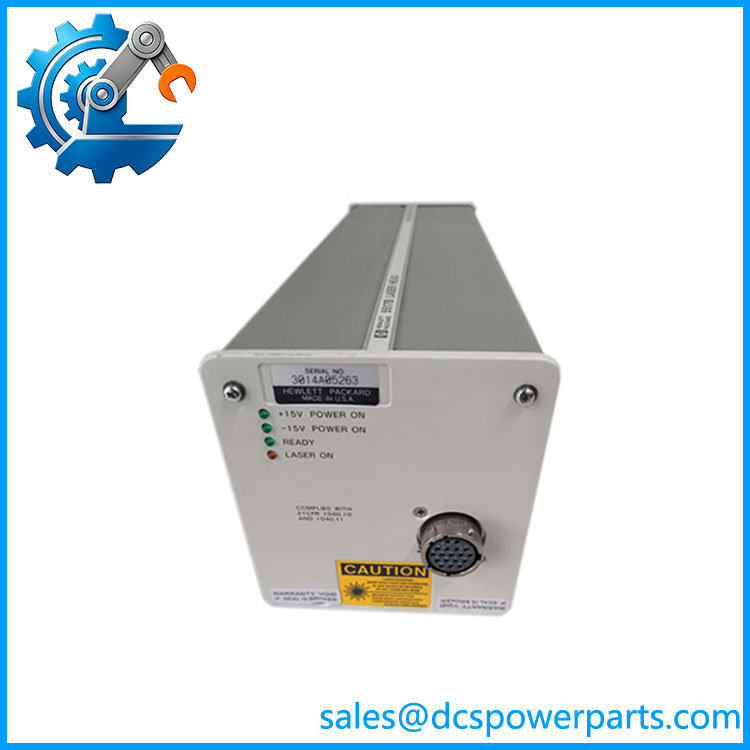
HP 5517B
Frequently Asked Questions
What is HP 5517B used for?
The HP 5517B is a laser interferometer head used as the optical reference source in precision displacement and positioning measurement systems.
Its typical applications include:
- Machine-tool positioning
- Precision stage measurement
- Coordinate measurement
- VME-based interferometer systems
- PC-based interferometer systems
- Precision calibration equipment
Keysight specifically identifies VME, PC, and the 5572A/5527A family as application environments for the 5517B.
What wavelength does the HP 5517B use?
The specified nominal vacuum wavelength is 632.991372 nm. The HP service documentation specifies ±0.02 ppm lifetime wavelength accuracy under the stated calibration conditions.
That is why calibration status matters considerably when purchasing an older 5517B.
Is HP 5517B the same as 5517A?
No, but they are closely related.
The historical HP catalog states that the 5517B is electrically and optically compatible with the 5517A, while noting a different beam height. A mounting bracket could be used to make the beam height compatible with the earlier installation.
For an actual replacement, verify the mechanical mounting and optical path rather than relying solely on the historical compatibility statement.
Can I hot-swap the HP 5517B?
No.
This is a laser source connected to regulated ±15 V power and precision optical equipment. It should be powered down and isolated before removal.
After installation, allow the specified warm-up period and verify the reference frequency, optical output, beam alignment, and interferometer measurement performance.
Does HP 5517B require a warm-up period?
Yes. The current specification lists approximately 90 minutes of warm-up time.
This is not a trivial detail for production maintenance. A replacement laser may appear functional immediately after startup while its frequency stability has not yet reached the expected operating condition.
Does HP 5517B support firmware v3.1?
Firmware version is not the primary compatibility criterion for this laser head.
The 5517B is an optical laser-head assembly containing its own laser-control electronics and reference receiver. System compatibility depends more heavily on the interferometer electronics, receiver, optics, power supply, frequency range, and calibration configuration.
For an existing system, verify the receiver and electronics model before treating another 5517-series head as a direct replacement.
How should I verify a New Surplus HP 5517B?
For this product, “powers on” is a very weak acceptance test.
I would request:
- Exact 5517B nameplate and serial number
- Manufacturing date, if available
- Calibration history
- Laser operating hours, if recorded
- Optical output measurement
- Reference-frequency measurement
- Beam diameter/beam-height verification
- Warm-up stability test
- ±15 V current measurements
- Optical alignment inspection
- Interferometer receiver compatibility
- Test report with measured values
The HP service documentation gives 120 µW minimum output and 1 mW maximum output, while current Keysight documentation confirms the same general output range and identifies the 90-minute warm-up requirement.
For a precision metrology application, I would favor a unit with traceable calibration and documented frequency/output testing over one described simply as “tested.”