Description
Product Overview
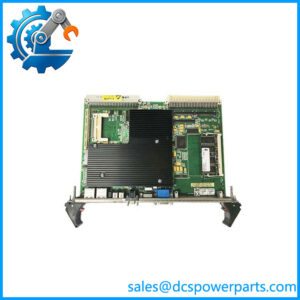
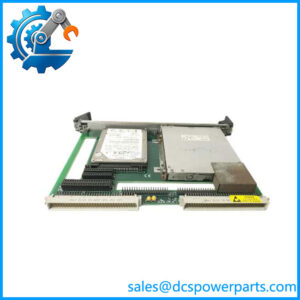
When a legacy computer system loses communication with a peripheral or serial-connected device, replacing the interface hardware requires confirming the original board type and host architecture. The GESPAC GESSIO-1E is identified in historical OS-9 hardware documentation as a serial-port board used alongside several GESPAC processor modules. This makes it relevant to maintenance of older embedded computing and control equipment where preserving the existing software and hardware configuration may be essential.
The GESPAC GESSIO-1E should be evaluated against the original equipment documentation rather than treated as a generic digital input/output module. Available listings do not establish its exact port configuration, electrical signaling standard, connector assignments, or supported transfer rates. Before ordering a replacement, compare the board markings and physical layout, confirm the host-board model, and check the operating-system driver and device configuration. These checks help reduce the risk of installing a board that fits physically but cannot communicate correctly with the existing system.
Key Technical Specifications
| Parameter | Specification |
|---|---|
| Product model | GESSIO-1E |
| Manufacturer | GESPAC |
| Product type | Serial-port interface board |
| System association | Legacy GESPAC board-level computer systems |
| Documented host associations | GESMPU-24, GESMPU-4B, GESMPU-14, GESMPU-20, GESSBS-6 |
| Operating system context | OS-9 hardware configurations |
| Serial port count | Not verified for this exact model |
| Communication standard | Not verified |
| Maximum baud rate | Not verified |
| Connector pinout | Requires the applicable board documentation |
| Supply voltage | Not verified |
| Operating temperature | Not verified |
| Installation | Confirm original backplane or host-board arrangement |
| Protection rating | Not verified |
| Lifecycle status | Listed as discontinued by parts suppliers |
The historical reference establishes the serial-port role and host-board associations, but it does not provide enough information to populate the remaining electrical specifications safely. Do not substitute the specifications of GESSIO-12 or GESCIO-1 for this model.
Major Features and Advantages
Serial communication for legacy systems
The GESSIO-1E was documented as part of GESPAC’s board-level computer configurations. Its relevance is therefore tied to maintaining a supported serial interface within the original host architecture, not to modern PLC I/O functions assumed from a generic product listing.
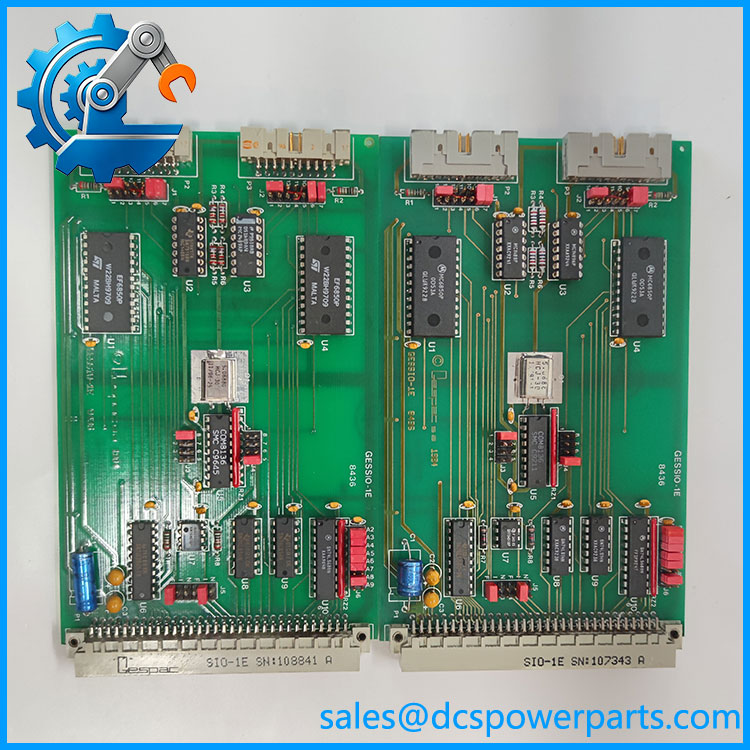
GESSIO-1E
Documented host-board relationships
The historical OS-9 reference lists several GESPAC processor boards alongside the GESSIO-1E. These associations provide a useful starting point when tracing the hardware in an existing machine, but they do not prove that every revision is interchangeable across all listed systems.
Legacy replacement planning
For equipment that cannot be upgraded immediately, a verified replacement board may help maintain the original hardware arrangement. Procurement should include the full model designation, revision details, connector photographs, and evidence of functional testing.
Configuration-aware maintenance
Serial interface boards depend on more than physical compatibility. Operating-system support, driver configuration, port assignment, signal levels, and cable wiring can all affect operation. These details should be confirmed from the original system manual before a replacement is commissioned.
Inspection and testing
For used or refurbished hardware, request a documented inspection and test report. Useful checks include connector condition, visible component damage, board revision, initialization on compatible hardware, and verified serial communication. Do not describe a board as fully tested unless the test scope and results are available.
Application Scenarios and Common Pain Points
- Legacy embedded computer maintenance: Retaining the original serial interface in a GESPAC-based system.
- OS-9 system restoration: Checking hardware and driver compatibility during restoration of an older computer configuration.
- Industrial equipment repair: Investigating serial communication failures without unnecessarily replacing a functioning processor board.
- Spare-parts inventory: Recording board revisions and host-system associations to improve future replacement decisions.
Common procurement risks include confusing GESSIO-1E with similarly named GESPAC boards, relying on incomplete supplier specifications, overlooking operating-system dependencies, and assuming identical connector layouts guarantee compatible signaling.
Related Products
These products are useful for identifying the surrounding GESPAC hardware family. They are not automatically interchangeable with .
| Model | General role | Relevance |
|---|---|---|
| GESMPU-24 | GESPAC processor board | Listed as a host association for |
| GESMPU-4B | GESPAC processor board | Listed as a host association |
| GESMPU-14 | GESPAC processor board | Listed as a host association |
| GESMPU-20 | GESPAC processor board | Listed as a host association |
| GESSBS-6 | GESPAC single-board computer | Listed in the same OS-9 hardware reference |
| GESMFI-1 | Multifunction interface board | Listed as an alternative interface component in one host configuration |
| GESHDC-1A | Hard-disk controller | Related storage subsystem board |
| GESFDC-3 | Floppy-disk controller | Related storage subsystem board |
| GESCNX-1B | GESPAC system component | Listed alongside the host and peripheral boards |
These relationships come from the historical OS-9 hardware reference. Confirm the full part number and system configuration before selecting related hardware for a repair.
Engineer’s Guide: Three Checks Before Replacement
1. Verify the exact board. Match the marking and revision against the installed unit. Do not confuse it with GESSIO-12 or GESCIO-1; their documented functions and configurations differ.
2. Confirm the serial interface and host configuration. Check the original manual for port assignments, signaling levels, connector pinout, and software driver requirements. Do not assume RS-232 or RS-422 support without model-specific evidence.
3. Test communication before production use. Where practical, test the board on compatible host hardware and verify data transmission and reception with the intended peripheral. Record the test conditions and any limitations.
Frequently Asked Questions
Q1. What is the GESPAC ?
It is a GESPAC serial-port interface board identified in historical OS-9 hardware documentation.
Q2. Which systems used it?
The reference lists the GESMPU-24, GESMPU-4B, GESMPU-14, GESMPU-20, and GESSBS-6 configurations. Verify the exact board revision and host documentation before treating a particular combination as compatible.
Q3. How many serial ports does it have?
The exact port count for was not confirmed by the available reference. Do not infer the count from GESSIO-12, which is a separate model.
Q4. Does it support RS-232 or RS-422?
The available model-specific evidence does not establish its supported electrical standards. Confirm the interface circuitry and pinout from the correct hardware documentation.
Q5. Can it be replaced by GESCIO-1?
No direct substitution should be assumed. GESCIO-1 is documented as a different interface board with opto-coupled digital inputs and outputs. Its specifications do not establish compatibility with .
Q6. What should I provide when requesting a quotation?
Provide the complete model number, PCB revision, photographs of both sides, the host-board model, and any available system or wiring documentation. Ask the supplier to state whether the unit is new old stock, used, or refurbished and what functional tests were performed.
Q7. What are the warranty and lead time?
These depend on the individual unit and supplier. Confirm stock status, dispatch timing, warranty duration, return conditions, and test evidence in writing.
Procurement recommendation: Identify as a legacy serial interface board, and use the original GESPAC host configuration as the starting point for qualification. Verify the connector pinout, electrical interface, and operating-system support before purchase or installation.