Description
Key Technical Specifications
| Parameter | Available information |
|---|---|
| Product model | GESOUT-3 OUT-3B |
| Assembly reference | GESOUT-3-9505 |
| Manufacturer | GESPAC |
| Product category | Industrial control PCB |
| I/O channel count | Not confirmed |
| Output signal type | Not confirmed |
| Analog output range | Not confirmed |
| Digital output rating | Not confirmed |
| Supply voltage | Not confirmed |
| Communication interface | Not confirmed |
| Isolation rating | Not confirmed |
| Operating temperature | Not confirmed |
| Installation method | System-specific PCB installation; details unconfirmed |
Technical note: A separate technical document describes a GESOUT-3A board with 32 optically isolated digital outputs, open-collector drivers rated up to 100 mA, and 1500 V isolation. That is a different suffix designation and must not be treated as proof of the OUT-3B specifications.
Product Introduction
The GESPAC GESOUT-3 OUT-3B is identified in available parts records as a legacy industrial control PCB assembly. The associated reference GESOUT-3-9505 provides a useful identification clue for procurement and replacement-part searches. However, publicly available information does not establish the board’s exact I/O architecture, electrical ratings, or host-system compatibility.
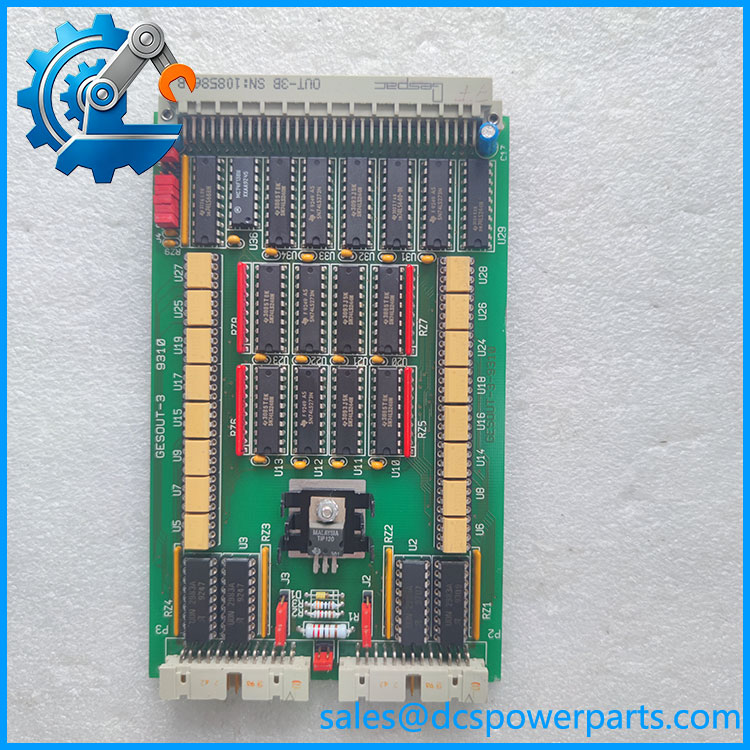
GESOUT-3 OUT-3B
For maintenance teams, the key issue is matching the original board configuration rather than relying on the general I/O description used in supplier listings. Board revision, connector arrangement, component population, and system-specific configuration should be checked before installing a replacement.
Major Features and Advantages
- Legacy equipment replacement: Provides a board-level replacement option when maintaining equipment that uses the GESOUT-3 assembly.
- Assembly-level identification: The GESOUT-3-9505 reference can help distinguish the required PCB from other GESPAC boards.
- Physical configuration matching: Connector positions, PCB dimensions, mounting points, and component layout should be compared with the installed board.
- Reduced replacement uncertainty: Confirming the full board designation and revision before ordering helps avoid receiving a visually similar but electrically different assembly.
- Maintenance planning: A verified spare can help reduce repair delays when the original control hardware is no longer readily available.
These are procurement and maintenance considerations, not verified manufacturer performance specifications.
Application Scenarios and Field Pitfalls
Potential use is within legacy industrial control equipment requiring a GESPAC board. The exact machine or control-system application has not been reliably established.
Before replacement, verify:
- The complete PCB marking, including ,
OUT-3B, and9505where present. - Connector type, pin count, and pin assignments.
- Board revision and component layout.
- Host rack, backplane, or controller compatibility.
- Field signal type, voltage, current, and isolation requirements.
- Whether the replacement has been electrically tested under an appropriate load.
Do not connect field wiring based solely on a supplier’s generic analog I/O description. Incorrect assumptions about output type or pin assignment can damage the board or connected equipment.
Related Products and Variants
- -9505: Associated assembly reference for the / OUT-3B board.
- GESOUT-3A: A separately documented digital-output board designation. Do not assume it is interchangeable with OUT-3B.
Procurement and Quality Control
For a used or surplus , request clear photographs of both PCB sides, the complete identification label, connector areas, and revision markings. Ask the supplier to confirm whether the board has undergone power-up and functional testing, and request the test scope and results.
My assessment: The GESPAC manufacturer association and legacy PCB identity are reasonably supported, but the electrical specification and system application remain unverified. A photograph of the actual board—especially its component side and identification label—would help establish a more precise identification.