Description
Key Technical Specifications
| Parameter | Value |
|---|---|
| Manufacturer | GE |
| Model | IS420ESWBH3AX |
| Product Family | Mark VIe |
| Functional Type | ESWB Ethernet Switch |
| Network Application | Mark VIe IONet |
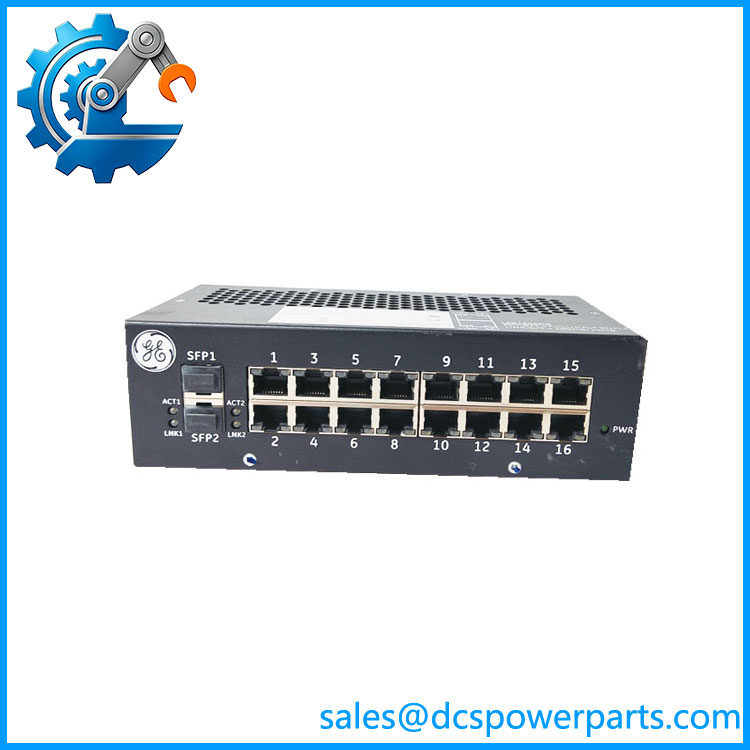
| Ethernet Ports | 16 |
| Port Connector | RJ45 |
| Physical Medium | Copper |
| Fiber Ports | None |
| Ethernet Speed | 10/100 Mbps |
| Switching Type | Industrial Ethernet switch |
| Typical Architecture | Mark VIe controller / distributed I/O network |
| Typical Installation | Turbine control cabinet |
| Cooling | Fanless / natural convection |
| Mounting | Cabinet / DIN-rail type installation, depending on system arrangement |
| Primary Use | IONet traffic distribution |
Available technical references consistently identify the IS420ESWBH3AX as an ESWB industrial Ethernet switch with 16 copper RJ45 ports operating at 10/100 Mbps.
Engineering caution: Published secondary specifications disagree on some electrical and mechanical details, particularly the exact DC input range and dimensions. I would not use those values for cabinet design without checking the applicable GE hardware manual and the actual nameplate revision.
Product Introduction
GE IS420ESWBH3AX
The GE IS420ESWBH3AX is an ESWB industrial Ethernet switch used within GE Mark VIe IONet architectures. Its primary job is to provide copper Ethernet connectivity between Mark VIe controllers, I/O packs, and associated network equipment. The unit provides 16 RJ45 10/100 Ethernet ports.
This is network infrastructure, not a conventional PLC I/O module. In a turbine control cabinet, the switch can be a single point affecting communication with multiple distributed I/O devices. That makes correct topology, power, port assignment, and network diagnostics more important than simply verifying that the switch powers up.
IS420ESWBH3AX
Application Scenarios & Field Pitfalls
Engineering Pain Point
A Mark VIe system can have perfectly healthy I/O packs and controllers while still showing widespread I/O communication faults because the Ethernet switch is not forwarding traffic correctly. When several unrelated I/O packs disappear simultaneously, look at the network path before replacing individual I/O packs. A failed ESWB or an incorrectly connected Ethernet cable can create a much larger apparent control-system failure.
Typical Applications
- Gas Turbine Control — IONet distribution between Mark VIe controllers and distributed turbine I/O packs.
- Steam Turbine Control — Ethernet connectivity for distributed Mark VIe I/O and controller networks.
- Combined-Cycle Plants — Local I/O network distribution within turbine and balance-of-plant control cabinets.
- Industrial Turbomachinery — Mark VIe network infrastructure for compressor and auxiliary control systems.
Technical Pitfalls to Avoid
- Do not treat ESWB as a general office Ethernet switch.
It is intended for the Mark VIe control architecture. The network topology and traffic characteristics are tied to the control system. - Do not assume every RJ45 port is interchangeable from a commissioning standpoint.
Record the original cable-to-port assignments before replacement. Port mapping matters when troubleshooting a distributed I/O network. - Check the entire network path.
If multiple I/O packs report communication faults at the same time, inspect the ESWB, upstream controller connection, power supply, and Ethernet cabling before replacing individual I/O packs. - Do not substitute a commercial Ethernet switch without engineering approval.
A generic 16-port switch may provide Ethernet connectivity but does not establish that the Mark VIe network architecture, timing behavior, diagnostics, or system certification requirements will be satisfied. - Watch for physical-layer problems.
Damaged RJ45 connectors, poor cable termination, excessive cable bending, and loose cabinet connections can cause intermittent IONet faults. - Check link LEDs systematically.
The ESWB family uses front-panel indicators to distinguish power, link, activity, and speed conditions. Use them to isolate the physical port before moving into controller diagnostics. - Do not assume a powered switch is a healthy switch.
Power indication only proves that the electronics are receiving power. Verify actual Ethernet link and communication with the affected I/O devices. - Maintain the original network topology.
Mark VIe systems may use simplex, dual, or redundant network arrangements. The ESWB should be installed according to the original engineered topology rather than improvised during replacement. - Verify environmental requirements.
ESWB equipment is intended for industrial control cabinets. Cabinet temperature, grounding, power quality, and physical installation all matter. - Be careful with the final suffix.
IS420ESWBH3AX should not be treated as identical to every ESWB variant. GE produced multiple ESWA/ESWB hardware configurations, including versions with different port counts and certification characteristics. GE’s Mark VIe/Mark VIeS HazLoc documentation specifically distinguishes different ESWx variants.
Related Products
- GE IS420ESWBH3A — Closely related ESWB Ethernet switch variant. It serves the same general Mark VIe IONet switching role, but the complete suffix and hardware revision should be checked before substitution.
- GE IS420ESWBH2A — Another ESWB Ethernet switch variant used within the Mark VIe network family. Do not substitute solely on the ESWB designation; port configuration and certification must match the application.
- GE IS420ESWAH3A — ESWA Ethernet switch family member. It is a related Mark VIe network switch, but ESWA and ESWB variants have different hardware configurations and should not be assumed interchangeable.
- GE IS420ESWAH4A — ESWA industrial Ethernet switch variant documented in the Mark VIe/Mark VIeS hazardous-location equipment documentation. It is relevant when the application requires a different ESWx hardware configuration or certification.
- GE IS420ESWAH5A — Another ESWA switch variant included in GE’s Mark VIe/Mark VIeS hazardous-location documentation. It is an alternative network hardware configuration rather than a blind replacement for H3AX.
- GE IS420UCSBH1A — Mark VIe UCSB controller module. It performs controller-level processing while the ESWB provides network switching. The two are complementary rather than interchangeable.
- GE IS420UCSBH3A — Related UCSB controller variant. It belongs to the Mark VIe controller hardware family and can operate as the control-system endpoint connected through the IONet architecture.
- GE IS220PSCAH1A — Mark VIe serial communication I/O pack. It connects serial field equipment to the Mark VIe system, while the ESWB provides Ethernet network infrastructure.
- GE IS220PDIAH1BE — Mark VIe discrete-input I/O pack. It acquires field contact states and relies on the Mark VIe network architecture for controller communications; it is therefore a downstream I/O device rather than a substitute for ESWB.
- GE IS220PRTDH1A — Mark VIe RTD input I/O pack. It handles temperature acquisition from RTDs and communicates through the Mark VIe I/O network. The ESWB provides the network infrastructure connecting such distributed I/O hardware.