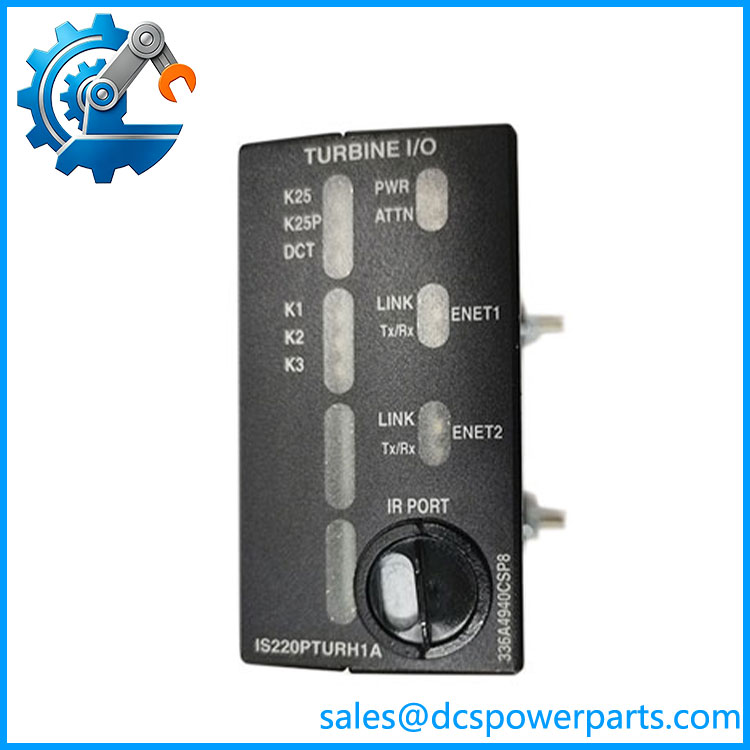
Description
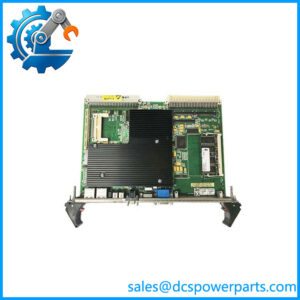
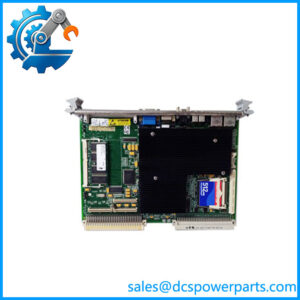
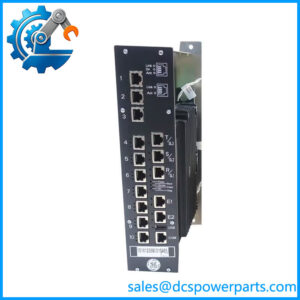
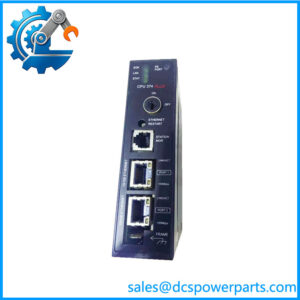
GE IS220PTURH1A — Mark VIe Turbine-Specific Primary Trip I/O Pack
Key Technical Specifications
| Parameter | Specification |
|---|---|
| Model | IS220PTURH1A |
| Manufacturer | General Electric |
| Platform | Mark VIe |
| Module designation | PTUR |
| Functional category | Turbine-specific primary trip I/O |
| Network | Two 10/100 Ethernet interfaces; IONet |
| Nominal supply | 28 VDC |
| Published supply range | 27.4–28.6 VDC |
| Maximum current | 0.41 A DC, according to the cited GE electrical characteristics |
| Terminal-board association | IS200TRPAH1A |
| Controller integration | Mark VIe architecture; controller and application configuration dependent |
| Operating temperature | Confirm against the applicable equipment guide and installation conditions |
| Firmware and configuration | Verify against the installed controller and site configuration |
The electrical values above are taken from the cited GE Mark VIe equipment guide. Do not substitute generic specifications from another I/O pack family.
Product Introduction
The GE IS220PTURH1A is a PTUR I/O Pack designed for turbine-specific primary trip applications in the Mark VIe control system. It provides the interface between a compatible turbine protection terminal board and the control system’s IONet network, supporting the acquisition and processing of application-specific protection signals. Its role is distinct from that of a general-purpose analog or discrete I/O module.
For maintenance teams, correct hardware pairing is essential. GE identifies the IS200TRPAH1A as the associated terminal board for this PTUR pack in its equipment documentation. Before installing a replacement, confirm the terminal-board label, controller configuration, wiring, and firmware requirements against the site’s approved drawings and configuration records.
Application Scenarios & Field Pitfalls — The Engineer’s Perspective
Engineering Pain Point
A turbine trip I/O pack is part of a protection path, so an apparently identical module is not automatically an acceptable substitute. Incorrect board pairing, mismatched wiring, or a configuration discrepancy can prevent expected signal processing or produce trip-system diagnostics. Replacement should follow the plant’s approved maintenance and functional-test procedure.
Typical Applications
- Turbine protection systems: Interfaces with the configured turbine-specific primary trip signal architecture.
- Speed-related protection: Supports speed-signal processing where specified by the approved PTUR application and terminal-board design.
- Emergency trip interfaces: Used within configured trip and shutdown signal paths associated with the compatible terminal board.
- Planned outages and fault recovery: Replaces a failed pack after the original part number, hardware revision, and system configuration have been confirmed.
Technical Pitfalls to Avoid
- Do not overlook the terminal board. Confirm that the installed board is the correct supported type. GE documentation identifies IS200TRPAH1A for the IS220PTURH1A combination. Do not assume a TTUR board or another similarly named board is interchangeable.
- Do not assume every IS220PTUR variant is equivalent. Verify the complete model and suffix. The Mark VIe PTUR family includes different hardware revisions; any substitution must be supported by the applicable GE documentation and site configuration.
- Check the power supply at the pack. Confirm the correct supply and wiring before commissioning. Investigate supply instability or connection problems rather than attributing every fault to the module.
- Verify IONet connectivity. Inspect Ethernet connections, link indications, network assignment, and controller-side diagnostics. A communication alarm does not by itself prove the I/O pack has failed.
- Review configuration and firmware. Confirm that the installed application supports the replacement hardware and that any required download or reconfiguration is carried out under the site’s approved procedure.
- Treat trip-path testing as mandatory. After replacement, perform the prescribed diagnostic checks and functional tests. Never bypass protection logic or force trip signals solely to clear alarms without the required authorization and risk controls.
- Check hazardous-area requirements where applicable. The equipment’s suitability depends on the specific installation, approved board combination, and applicable certification conditions.
Related Products
The following components are relevant to Mark VIe turbine control or protection maintenance. They are not all direct substitutes for the PTUR pack.
- IS200TRPAH1A — Associated terminal board identified in GE documentation for the PTUR application.
- IS220PTURH1B — Related PTUR hardware variant; verify revision compatibility before substitution.
- IS220YTURS1A — Mark VIeS turbine-specific primary trip pack; a different safety-system designation, not an automatic replacement.
- IS220PAICH1A — Mark VIe analog input pack for a different I/O function.
- IS220PDIOH1A — Mark VIe discrete I/O pack; function differs from PTUR.
- IS220PHRAH1A — HART-enabled I/O pack for a separate application.
- IS220PPDAH1A — Mark VIe power-distribution feedback module, not a trip I/O substitute.
Check the current hardware guide and approved bill of materials before ordering associated parts.
Procurement Note
When sourcing GE IS220PTURH1A, provide a clear photograph of the nameplate and connector side, plus the terminal-board part number and hardware revision. Confirm whether the existing installation uses simplex or redundant architecture, and retain the site’s controller configuration and firmware records for the replacement process.
Do not treat “fits the Mark VIe system” as sufficient compatibility evidence. For turbine protection hardware, acceptance should depend on the exact part number, supported terminal-board pairing, application configuration, inspection results, and completion of the plant’s approved functional tests. Product condition, test documentation, and warranty should be confirmed separately with the supplier; they cannot be inferred from the part number alone.