Description
Product Overview
The GE Fanuc IC693CPU363 is a CPU module for the Series 90-30 PLC platform, providing the processor and memory resources required to execute the user’s control program. The documented CPU363 uses a 25 MHz 80386EX processor, provides 240 KB of total configurable user memory, and occupies a single CPU slot in the Series 90-30 baseplate. Its published typical Boolean execution rate is 0.22 ms per 1K of logic. The module supports systems containing up to eight total baseplates, including the CPU baseplate and up to seven expansion or remote baseplates.
For GE Fanuc IC693CPU363, communication capability is a significant part of its value. The CPU provides one RS-232 and one RS-485 serial port, supporting the serial communication functions available to the Series 90-30 platform. The CPU also supports up to 2,048 discrete inputs and 2,048 discrete outputs, with configurable register, analog, internal-coil, and system-status memory areas. The module requires approximately 890 mA from the +5 VDC supply and is rated for an ambient operating temperature of 0 to 60°C.
The GE Fanuc IC693CPU363 is particularly relevant for maintaining established Series 90-30 installations where the existing application, baseplates, and I/O remain serviceable. It is not an Ethernet CPU by itself; Ethernet connectivity can be added through compatible Series 90-30 communication modules. When sourcing a replacement, hardware revision deserves attention because later CPU363 revisions incorporated hardware changes associated with firmware releases. A 2008 product-information notice, for example, documents CPU363-DK hardware and firmware release 10.74 changes.
Product Introduction
A CPU replacement in an older Series 90-30 rack is rarely just a matter of plugging in another processor. IC693CPU363 combines 240 KB of configurable user memory with a 25 MHz processor and a 0.22 ms/K typical Boolean execution rate.
For a Series 90-30 PLC CPU replacement, match the hardware revision, firmware requirements, memory configuration, serial communication setup, and application backup before placing the replacement into production.
Key Technical Specifications
| Parameter | Value |
|---|---|
| Manufacturer | GE Fanuc |
| Catalog Number | IC693CPU363 |
| Product Series | Series 90-30 |
| Product Type | CPU / Processor Module |
| CPU Model | CPU363 |
| CPU Architecture | 32-bit |
| Processor | 80386EX |
| Processor Speed | 25 MHz |
| User Memory | 240 KB / 245,760 bytes |
| Typical Scan Rate | 0.22 ms per 1K Boolean logic |
| CPU Width | Single slot |
| Maximum Baseplates | 8 total |
| Expansion/Remote Baseplates | Up to 7 |
| Discrete Inputs | 2,048 |
| Discrete Outputs | 2,048 |
| Discrete Global Memory | 1,280 bits |
| Internal Coils | 4,096 bits |
| Temporary Coils | 256 bits |
| System Status References | 128 bits |
| +5 VDC Load | 890 mA |
| CPU Serial Port 1 | RS-232 |
| CPU Serial Port 2 | RS-485 |
| Operating Temperature | 0 to 60°C |
| Storage Temperature | -40 to 85°C |
| Battery Backup | Yes |
| Floating-Point Math | Supported through firmware |
| Ethernet | Requires compatible communication module |
The core CPU specifications are documented in the Series 90-30 hardware manual.
Related Products
- IC693CPU350 — Series 90-30 25 MHz CPU with 240 KB-class configurable memory, but without the CPU363’s built-in serial-port arrangement. It can be relevant when comparing controller architectures rather than making a blind substitution.
- IC693CPU360 — 25 MHz Series 90-30 CPU with 240 KB configurable user memory. It is from the same CPU generation but has a different communication configuration from the CPU363.
- IC693CPU352 — 25 MHz CPU with a math coprocessor and additional serial communications. It can be considered where floating-point performance is important, but it is not a drop-in replacement without checking the application.
- IC693CPU364 — Series 90-30 CPU with an Ethernet interface. It is more appropriate when native Ethernet connectivity is required, subject to the installed system architecture.
- IC693CPU366 — Series 90-30 CPU with built-in PROFIBUS Master capability. It targets installations requiring integrated PROFIBUS master functionality rather than the serial configuration.
- IC693CPU367 — Series 90-30 CPU with built-in PROFIBUS Slave functionality. Its communication role differs substantially from the .
- IC693PWR321 — Series 90-30 power-supply family component supporting the CPU rack. The power supply must provide adequate +5 VDC capacity for the CPU and installed I/O.
- IC693ACC901 — Miniconverter and cable kit associated with firmware-update procedures for Series 90-30 CPU modules. GE documentation specifically identifies it for CPU firmware upgrades.
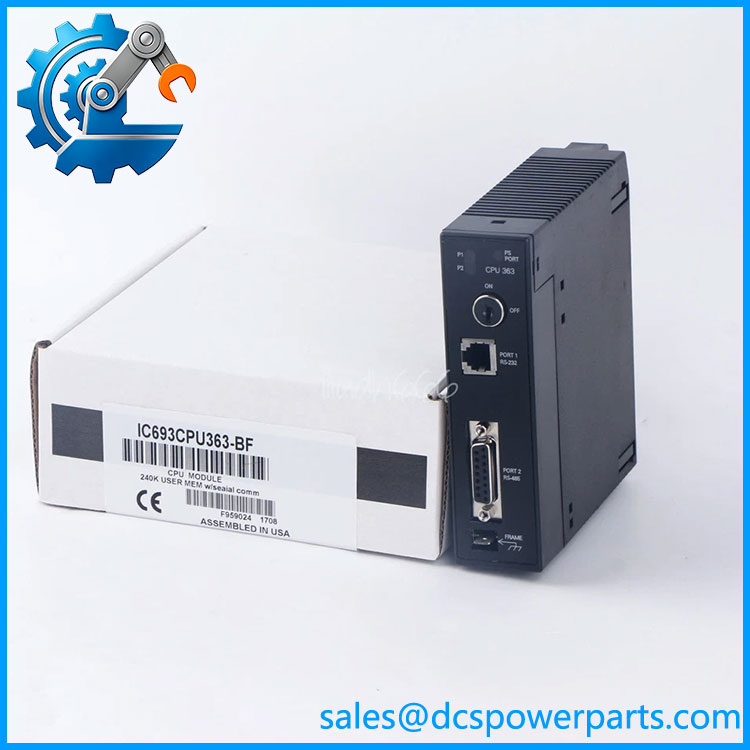
IC693CPU363
Frequently Asked Questions
What is GE Fanuc IC693CPU363 used for?
The is the main processor module for a Series 90-30 PLC rack.
It executes the stored application logic and coordinates:
- Discrete I/O processing
- Register and analog data
- Serial communications
- Internal PLC memory
- Timing and system status
- Expansion and remote baseplate communications
The CPU supports up to eight total baseplates, including its own CPU baseplate.
How much memory does have?
The provides 240 KB (245,760 bytes) of total user memory. The actual memory available for the user program depends on how configurable %R, %AI, and %AQ memory are allocated.
The Series 90-30 documentation specifies configurable register-memory ranges that depend on the programming software version being used.
Does have Ethernet?
No, Ethernet is not built directly into the .
The provides RS-232 and RS-485 serial interfaces. Ethernet-based communication can be implemented through compatible Series 90-30 communication modules.
This is an important distinction when replacing a CPU: an IC693CPU364, for example, belongs to the same general Series 90-30 CPU family but has an Ethernet interface.
Can I replace with IC693CPU360?
Possibly, but do not treat them as automatically interchangeable.
Both are 25 MHz Series 90-30 CPUs with 240 KB-class configurable memory, but the communication capabilities differ. The specifically provides two built-in CPU serial ports.
Before substitution, compare:
- CPU hardware revision.
- Firmware.
- Serial communication requirements.
- Programming software version.
- Memory allocation.
- Installed communication modules.
- PLC application functions.
If the existing application depends on the serial ports, moving to another CPU model may require configuration changes.
Will I lose my PLC program when replacing ?
The replacement CPU does not inherently preserve the application program from the removed CPU.
Before removing the original unit, create and verify a complete PLC program backup. Also record:
- CPU catalog number
- Hardware revision
- Firmware revision
- Memory configuration
- Serial-port settings
- Installed communication modules
- PLC fault/status information
For an old Series 90-30 system, I would not rely on a backup file that has never been restored or validated.
Does support firmware version 10.74?
Yes, specific later hardware revisions are documented with firmware release 10.74. GE’s 2008 product information specifically identifies among the CPU modules associated with firmware release 10.74.
That does not mean every historical hardware revision should be assumed to support the same firmware. Check the complete suffix/revision printed on the CPU before planning a firmware upgrade.
How should I test a New Surplus ?
For a production spare, I would perform a functional rack test rather than accepting a visual inspection.
Recommended test sequence:
- Verify the complete nameplate and hardware revision.
- Inspect the backplane connector and front-panel ports.
- Check battery condition.
- Install the CPU into a compatible Series 90-30 test rack.
- Confirm normal CPU startup.
- Verify firmware revision.
- Establish programming-software communication.
- Load a controlled test program.
- Exercise discrete I/O.
- Test RS-232 and RS-485 communications.
- Verify memory retention after controlled power cycling.
- Check CPU diagnostics and fault tables.
- Document the test results.
One procurement point matters here: “New Surplus” does not establish firmware compatibility. The family has multiple hardware revisions, and GE documented revision-specific firmware changes. A replacement should therefore be matched against the revision currently installed in the plant before commissioning.