Description
GE DS200TBCBG1AAA | Mark V TBCB Termination Analog Board
Key Technical Specifications
| Parameter | Specification |
|---|---|
| Manufacturer | General Electric |
| Series | Mark V Speedtronic |
| Model | DS200TBCBG1AAA |
| Functional Abbreviation | TBCB |
| Product Type | Analog Termination Board |
| Primary Function | Analog field-signal termination and conditioning |
| Excitation Input | Isolated 21 VDC |
| Current Inputs | 4–20 mA; selected channels can support 1 mA |
| Voltage / Current Selection | Jumper configurable |
| JHH | mA input signal path to TCCB |
| JII | RTD signal path to TCCB |
| TCQA Interface | Current-input circuitry can provide parallel voltage routing to TCQA in specified Mark V cores |
| Revision Quantity | 3 |
| Backward Compatibility | First two revisions documented as compatible |
| Assembly | Normal |
| PCB Group | G1 |
| Artwork / Revision Suffix | AAA |
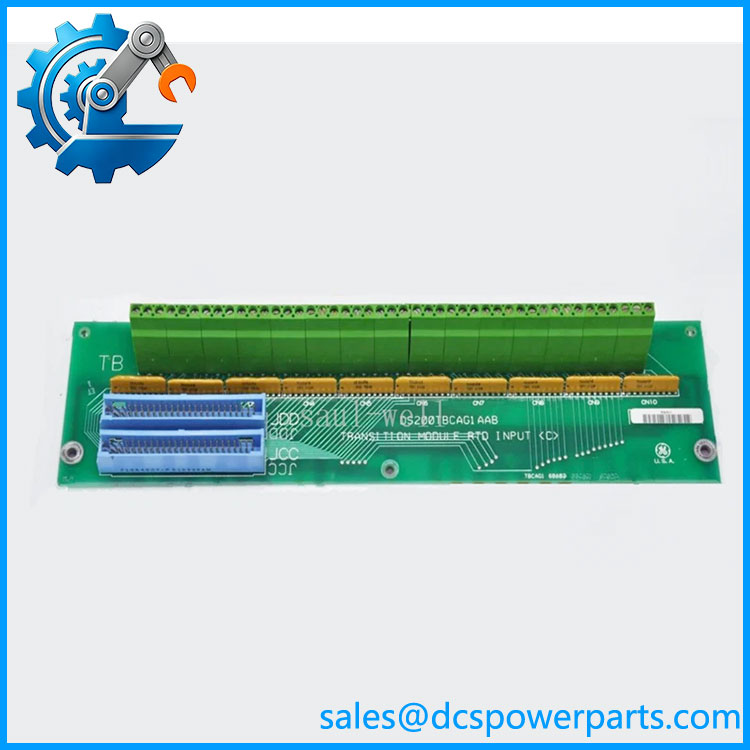
| Terminal Arrangement | Long terminal strip |
| Board Construction | Vertical pin connectors, jumper switches, resistor networks and discrete components |
| Operating Voltage | Verify against Mark V cabinet documentation |
| Operating Temperature | Verify against applicable GE system documentation |
| Mounting | Mark V cabinet / terminal-board installation |
| Firmware | Not applicable as a standalone programmable controller |
The DS200TBCBG1AAA is described as one of the Mark V terminal boards accepting isolated 21 VDC excitation. Its jumper configuration determines whether applicable inputs operate as voltage or current inputs. Documented current-input groups include 14 channels for 4–20 mA and another eight channels selectable between 4–20 mA and 1 mA.
The JHH connector is used for milliamp input signals routed toward the TCCB board, while JII carries RTD-related signals to TCCB. The board also contains terminal connections, vertical connectors, jumper switches, and resistor network arrays that form part of its signal-conditioning architecture.
DS200TBCBG1AAA
Product Introduction
The GE DS200TBCBG1AAA is a TBCB Termination Analog Board for the GE Mark V Speedtronic turbine control system. It provides the field-side termination and signal-conditioning layer between selected analog instruments and the Mark V control electronics. Its configurable input architecture allows designated channels to operate with voltage or current signals, making the board an important part of the Mark V analog signal path rather than a conventional standalone PLC analog input card.
The board is particularly important during replacement work because its jumpers and terminal wiring determine how incoming signals are presented to downstream Mark V boards. The full DS200TBCBG1AAA designation identifies the specific TBCB configuration, including its G1 group and A-rated revision/artwork positions. The first two of the three documented revisions are identified as backward-compatible, but that should not replace a direct comparison with the installed board.
Engineering Pain Point
A TBCB problem can easily be mistaken for a transmitter or sensor fault. If several analog channels change behavior together, the engineer should examine the common termination path, excitation supply, jumper configuration, terminal wiring, and downstream TCQA/TCCB connections before replacing individual field instruments. A board that has the correct functional abbreviation but different jumper or revision characteristics can also produce misleading commissioning results.
Typical Applications
- Mark V analog signal termination: Interfaces selected field analog signals with the Mark V control architecture.
- 4–20 mA instrumentation: Provides termination for documented 4–20 mA input groups.
- RTD-related signal routing: JII provides a documented RTD signal path toward TCCB.
- Voltage/current configurable inputs: Jumper settings determine the applicable input mode on supported channels.
Technical Pitfalls to Avoid
- Do not treat it as a generic PLC analog input module. The board is designed around the Mark V signal architecture and its associated terminal-board connections.
- Record jumper positions before removal. Input mode is determined by jumper configuration. Reproducing the installed configuration is more important than assuming a factory-default arrangement.
- Verify the excitation arrangement. The board is documented as accepting isolated 21 VDC excitation. Do not substitute a generic external transmitter supply without checking the Mark V wiring scheme.
- Check JHH and JII wiring carefully. These connectors have different signal functions. A wiring error can create faults downstream at TCCB even when the replacement board itself is functional.
- Do not confuse TBCB with TCQA or TCCB. TBCB is a termination/interface board; TCQA and TCCB perform different functions elsewhere in the Mark V signal-processing architecture.
- Match the complete revision. The three A positions in DS200TBCBG1AAA carry revision information. Although the first two revisions are documented as backward-compatible, verify the physical board and system documentation before substitution.
- Ignore unsupported generic ratings. Some secondary listings publish terminal current, voltage, temperature, and dielectric specifications that are not consistently supported by the available technical references. Use GE cabinet drawings and the applicable Mark V manual for final electrical limits.
Related Products
- DS200TCQAG1BHF — TCQA analog I/O board used downstream in the Mark V analog signal architecture; it is not a direct replacement for TBCB.
- DS200TCCBG1BED — TCCB Common Extended Analog I/O Board that receives signal information from associated terminal circuitry.
- DS200TCQCG1BHF — TCQC analog I/O board used for other Mark V analog signal functions; verify core and terminal-board architecture before substitution.
- DS200TBCAG1A — Related Mark V analog I/O termination board with a different TBC functional designation; not automatically interchangeable.
- DS200TBQAG1A — Mark V termination board from a related analog I/O family; application and wiring must be checked.
- DS200TBQBG1A — Related analog I/O termination board used elsewhere in the Mark V architecture.
- DS200TCEAG1BTF — TCEA Emergency Overspeed Board; protection function is substantially different from TBCB.
- DS200TCTGG1AFF — Mark V TCTG termination board associated with turbine control signal interfaces; verify exact system position before substitution.
Procurement and Replacement Note
For , the procurement specification should include the complete part number, physical revision markings, terminal arrangement, jumper configuration, and the Mark V core in which the board is installed. Photograph the terminal wiring and jumper positions before removal.
Most importantly, verify whether the existing board is being used for voltage inputs, 4–20 mA inputs, selectable 1 mA inputs, RTD routing, or a combination of these functions. The board’s terminal wiring and jumper configuration are part of the application, so a visually similar TBC-family board should not be approved solely from the first few characters of its part number.