Description
Key Technical Specifications
| Parameter | Value |
|---|---|
| Manufacturer | GE / N-Tron |
| Model | 516TX |
| GE Part Number | 336A4940DNP516TX |
| Product Type | Industrial Ethernet Switch |
| Ethernet Ports | 16 |
| Port Type | 10/100Base-TX |
| Connector | RJ45 |
| Backplane / Switching Capacity | 2.6 Gb/s |
| Switching Method | Store-and-forward |
| MAC Address Table | 4,000 addresses |
| MAC Aging Time | 300 seconds |
| Power Input | 10–30 VDC |
| Power Configuration | Redundant dual-input supply |
| Current Consumption | Approximately 400 mA at 24 VDC |
| Mounting | 35 mm DIN rail |
| Dimensions | Approx. 2.3 × 7.4 × 3.5 in |
| Weight | Approx. 2.2 lb / 1.0 kg |
| Operating Temperature | -40°C to +85°C |
| Operating Humidity | 10–95%, non-condensing |
| Operating Altitude | Up to 10,000 ft |
| Switching Architecture | Industrial Layer 2 Ethernet |
| Typical Application | Turbine control / industrial automation networking |
The documented 516TX specification identifies 16 10/100Base-TX ports, 2.6 Gb/s backplane capacity, 4,000 MAC addresses, store-and-forward switching, 10–30 VDC redundant power, and 35 mm DIN-rail mounting.
Important identification point: Some recent listings incorrectly describe 516TX as a controller or general-purpose I/O device. That is incorrect for 336A4940DNP516TX. The part is an industrial Ethernet switch.
Product Introduction
GE 516TX 336A4940DNP516TX
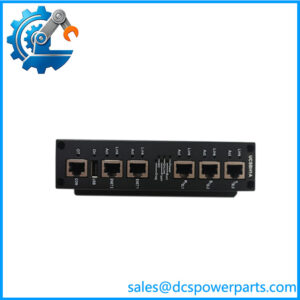
The GE 516TX 336A4940DNP516TX is a 16-port industrial Ethernet switch designed for industrial control networking. It provides sixteen 10/100Base-TX copper Ethernet connections and uses a 2.6 Gb/s switching backplane with store-and-forward operation.
The hardware is particularly useful in legacy GE turbine-control installations where multiple Ethernet devices must be concentrated in a cabinet. Its redundant DC power inputs and wide operating-temperature specification are practical features for control cabinets where loss of a single supply should not immediately remove network connectivity.
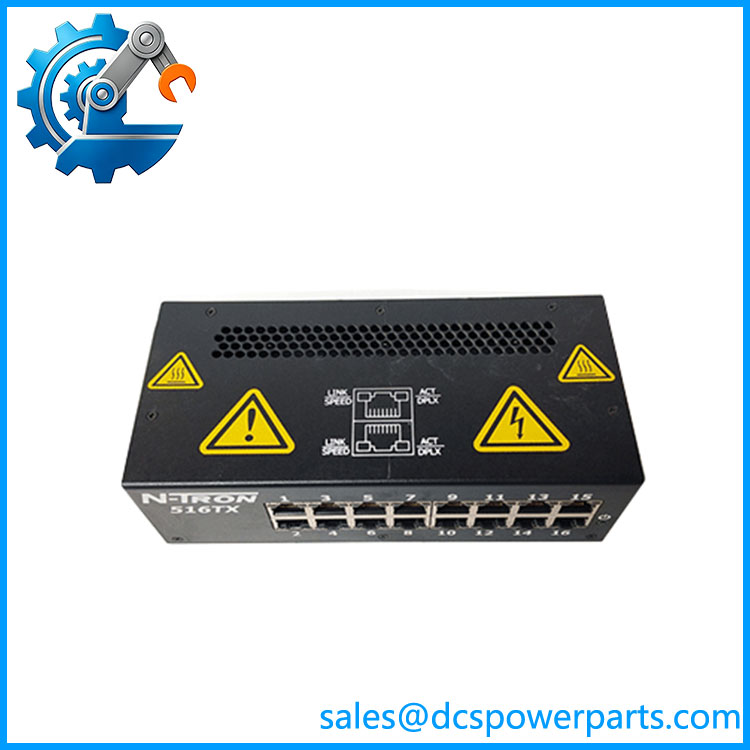
516TX 336A4940DNP516TX
Application Scenarios & Field Pitfalls
Engineering Pain Point
When several Mark VI or Mark VIe devices suddenly disappear from the control system at the same time, engineers often start replacing I/O packs. That is usually the wrong first move. If multiple unrelated devices lose communication simultaneously, inspect the Ethernet switch, its DC supplies, upstream connection, and common network cabling first. A failed 516TX can create a system-wide communication problem without any I/O hardware actually being defective.
Typical Applications
- Gas Turbine Control — Ethernet connectivity between turbine-control equipment, I/O networks, and associated control cabinets.
- Steam Turbine Systems — Industrial network distribution for distributed control hardware and auxiliary equipment.
- Power Generation — Cabinet-level Ethernet switching for turbine and balance-of-plant control systems.
- Industrial Automation — Connecting PLCs, remote I/O, HMIs, drives, instrumentation gateways, and other Ethernet devices.
Technical Pitfalls to Avoid
- Do not classify the 516TX as a Mark VIe I/O pack.
It is network infrastructure. It does not acquire RTD, analog, thermocouple, or discrete field signals. - Check both DC power inputs.
The switch supports redundant 10–30 VDC inputs. If one supply has failed, the switch may continue operating, potentially hiding an important power-system fault. - Do not replace it based only on port count.
A modern 16-port Ethernet switch may have completely different power, environmental, certification, timing, and network-management characteristics. - Check the physical layer first.
Inspect RJ45 connectors, cable continuity, shield/grounding arrangements, and link indicators before concluding that the switch electronics have failed. - Understand the difference between 10/100 Ethernet and Gigabit Ethernet.
The 516TX specification is based on 10/100Base-TX. Do not assume that every port supports 1000Base-T simply because newer industrial switches do. - Preserve the original port mapping.
Photograph and document every cable before removing the switch. Port identification is valuable during post-replacement commissioning. - Check for network loops.
An incorrectly patched Ethernet connection can create broadcast or switching problems. Do not add redundant connections casually to an existing turbine-control network. - Do not assume a communication fault is a switch fault.
If only one device is offline, troubleshoot that device, its cable, and its local connection first. A switch failure generally produces a wider pattern. - Check the switch’s environmental conditions.
The specified operating range is approximately -40°C to +85°C. Excessive cabinet temperature, condensation, contamination, or poor ventilation can still cause intermittent failures. - Verify the exact replacement history.
There are references indicating that 336A4940DNP516TX has been superseded by GE IS420ESWBH3A in certain GE applications. That does not mean the two should automatically be treated as plug-compatible. Confirm the engineered system documentation, network topology, power arrangement, and certification before substituting.
Related Products
- GE IS420ESWBH3A — A later GE Mark VIe ESWB Ethernet-switch family member referenced as a successor to 336A4940DNP516TX in certain applications. It is the first model to investigate for a legacy-system upgrade, but compatibility must be confirmed at the system level.
- GE IS420ESWBH3AX — Related ESWB industrial Ethernet switch used in Mark VIe architectures. It is a different hardware configuration from the original 516TX and should not be treated as an automatic drop-in replacement.
- GE IS420ESWBH2A — ESWB-series industrial Ethernet switch. It serves the same broad network-infrastructure role but has a different hardware designation and must be matched against the required system configuration.
- GE IS420ESWAH3A — ESWA-series Mark VIe Ethernet switch. It is relevant when upgrading or redesigning a Mark VIe network but is not automatically equivalent to the N-Tron 516TX.
- GE IS420ESWAH4A — Another ESWA network-switch variant used in Mark VIe/Mark VIeS installations. Verify port arrangement and certification before substitution.
- GE IS220PSCAH1A — Mark VIe serial communication I/O pack. It performs serial-device integration rather than Ethernet switching. It is complementary where serial instruments or controllers are connected to the Mark VIe system.
- GE IS220PDIAH1BE — Mark VIe discrete-input I/O pack. It acquires field contact signals and uses the control network for data transfer; it is a network endpoint rather than a switch.
- GE IS220PRTDH1A — Mark VIe RTD input I/O pack for temperature acquisition. It is another network-connected Mark VIe device that may communicate through the cabinet Ethernet infrastructure.
- GE IS420UCSBH1A — Mark VIe UCSB controller hardware. It provides controller-level processing and is normally an Ethernet-connected control-system device rather than a replacement for the 516TX.
- N-Tron 516TX — The underlying 516TX industrial Ethernet switch family associated with the GE 336A4940DNP516TX designation. The 16-port, 10/100Base-TX architecture is the key identification point.