Description
Foxboro FPS400-24 400 W Power Supply
Product Introduction
Foxboro FPS400-24 is a 400 W power supply designed specifically for the Foxboro DCS Standard 200 Series subsystem. Its primary function is to provide regulated 24 VDC power to 200 Series baseplates and associated fieldbus modules. Schneider Electric’s current specification identifies the FPS400-24 as the qualified power supply for 200 Series Fieldbus Modules, making it a system-specific power component rather than a generic 24 VDC DIN-rail supply.
Foxboro FPS400-24 is available in two electrically different versions. P0922YU accepts 85–265 VAC at 47–63 Hz or 108–145 VDC, with 125 VDC nominal input. P0922YC is designed for 24 VDC input and accepts 18–35 VDC. Both versions produce a factory-set 24.0 VDC output and have a maximum rated output of 16.7 A under the specified 25°C conditions. This distinction should be checked against the existing cabinet wiring before ordering; P0922YU and P0922YC are not interchangeable simply because they share the FPS400-24 model designation.
Foxboro FPS400-24 incorporates transformer-isolated 24 VDC output, power-factor correction on the AC-input version, dual-stage current limiting, overvoltage shutdown, internal fusing, LED output-status indication, and a Form C alarm relay. It is convection cooled and designed for horizontal or vertical DIN-rail installation. Schneider Electric also specifies Class I Division 2 and Zone 2 certifications under defined system and installation conditions.
Technical Specifications
| Parameter | Specification |
|---|---|
| Product Model | |
| Manufacturer | Foxboro / Schneider Electric |
| Product Type | Standard 200 Series DCS Power Supply |
| Rated Output Power | 400 W maximum at 25°C |
| Output Voltage | 24.0 VDC ±0.2 V nominal |
| Maximum Rated Output | 16.7 A |
| AC/DC Input Variant | P0922YU |
| P0922YU Input | 85–265 VAC, 47–63 Hz |
| P0922YU DC Input | 108–145 VDC, 125 VDC nominal |
| DC Input Variant | P0922YC |
| P0922YC Input | 18–35 VDC, 24 VDC nominal |
| Line Regulation | 2.0% of Vout |
| Load Regulation | 2.0% of Vout |
| Ripple / Noise | 100 mV peak-to-peak; 10 mV RMS maximum at 20 MHz |
| Temperature Coefficient | 0.025%/°C |
| Startup Time | 3 s typical; 5 s maximum |
| Overcurrent Protection | Current limiting at approximately 110% of maximum rated current |
| Overvoltage Protection | Factory set at 28.0 VDC for DIN-rail FBM/FCM/FCP applications |
| Internal Fuse | 10 A slow-blow, 250 VAC/VDC |
| Output-to-Chassis Isolation | 500 VAC |
| Input-to-Chassis Isolation | 1,500 VAC |
| Status Indication | Green normal-output LED; red undervoltage LED |
| Alarm Output | Form C / SPDT relay |
| Alarm Threshold | <22 VDC alarm; >23.5 VDC power OK |
| Alarm Contact Rating | 2 A at 30 VDC maximum; 2 A at 42.5 VAC maximum |
| Cooling | Convection, no fan |
| Mounting | Horizontal/vertical DIN rail; panel/wall mounting provisions |
| Operating Temperature | −30 to +71°C |
| Storage Temperature | −55 to +85°C |
| Relative Humidity | 5–95%, noncondensing |
| Operating Altitude | −300 to +3,000 m |
| Vibration | 0.75 g, 5–500 Hz |
| Hazardous Area | Class I Div. 2 / Zone 2 under specified conditions |
| Communication Protocol | None |
| Calibration | Not required |
| Net Weight | 2.67 kg |
Specifications are based primarily on Schneider Electric’s current PSS 41H-2FPS400 specification.
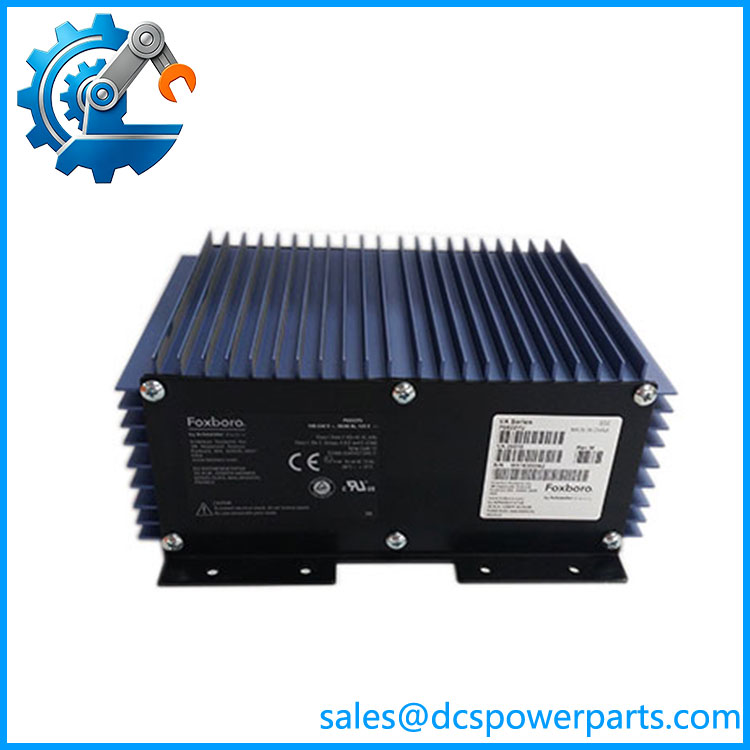
FPS400-24
Main Features and Engineering Considerations
System-Specific 200 Series Power
The most important characteristic of is that it was qualified specifically for Foxboro 200 Series FBM infrastructure. Schneider Electric states that these power supplies are the ones tested and qualified for 200 Series FBMs. That makes substitution with a generic 24 VDC industrial power supply a system-engineering decision, not simply a wattage comparison.
Two Different Input Architectures
P0922YU and P0922YC must be distinguished during procurement. is the high-voltage AC/DC version, while P0922YC accepts a low-voltage 24 VDC input. The physical model family is the same, but the input circuitry is different. Always inspect the installed part number and cabinet wiring before replacing the unit.
400 W Does Not Mean 400 W at Every Temperature
The nominal 400 W rating applies at 25°C under the specified conditions. Schneider Electric’s derating table shows lower maximum output power as static air temperature increases. For example, at 70°C the maximum listed power is 275 W for 220/240 VAC input and 250 W for 120 VAC or 24 VDC input.
This matters in crowded DCS cabinets. Calculate actual FBM, FCM, FCP, termination, and field-device demand rather than using 400 W as an unconditional design figure.
Current Limiting and Overvoltage Shutdown
The supply limits current when the load exceeds approximately 110% of its rated maximum. It also includes overvoltage shutdown; after an overvoltage event, input power must be interrupted before the shutdown circuit can reset.
During troubleshooting, this behavior can look different from a conventional breaker trip. A cabinet may show a low or collapsing 24 VDC output because the power supply is actively limiting current.
Independent Field Power Consideration
Foxboro documentation specifically notes that the can also power external field devices, but recommends that system-integrity field devices and DIN-rail baseplates should not be powered from the same .
For critical DCS installations, review the power-distribution architecture rather than simply adding field instruments to unused supply capacity.
Application Scenarios
- Foxboro DCS Standard 200 Series FBM baseplates
- Foxboro I/O subsystem power distribution
- Process automation cabinets
- DCS fieldbus module power
- DIN-rail mounted 200 Series subsystem installations
- External field-device power where the system design permits it
- Class I Division 2 or Zone 2 installations under approved configuration
- Legacy Foxboro/Invensys DCS replacement projects
Engineer’s Guide: Field Pitfalls
1. Verify versus .
This is the first check. accepts high-voltage AC/DC input; accepts 24 VDC input.
2. Do not calculate capacity as simply 400 W ÷ 24 V.
The 16.7 A rating is temperature and input-condition dependent. Review the derating table for the actual cabinet environment.
3. Check the baseplate cable.
The power supply uses specified Foxboro power-supply-to-baseplate cables. Existing installations may use different cable generations, so connector compatibility should be checked before assuming a direct replacement.
4. Do not confuse the alarm relay with a communication interface.
The Form C relay provides power-status indication; the does not function as an Ethernet, Modbus, or PROFIBUS communication module.
5. Account for cabinet temperature.
A supply operating near the upper ambient range can have substantially less available output power than its 400 W nominal rating.
6. Check the power architecture before substitution.
For safety-related or system-integrity loads, confirm whether the original design uses separate supplies, redundant supplies, dedicated field power, or baseplate power distribution.
Frequently Asked Questions
What is the output voltage of ?
The factory-set output is 24.0 VDC ±0.2 V nominal.
What is the maximum output current?
The maximum rated output is 16.7 A, corresponding to approximately 400 W at 24 V under the specified nominal conditions. Actual allowable output power is reduced at elevated temperature.
What is the difference between and ?
accepts 85–265 VAC or 108–145 VDC. accepts 18–35 VDC. They are different input variants of the family.
Does communicate with a DCS controller?
No conventional digital communication protocol is specified. The unit provides local LED status indication and a Form C relay output for power-status alarming.
Is fan cooled?
No. Schneider Electric specifies convection cooling with no fans.
Can be used with 200 Series FBMs?
Yes. Schneider Electric states that the power supplies are the supplies tested and qualified by Foxboro DCS for Standard 200 Series FBMs.
Does it require calibration?
No. The current specification states that calibration or voltage adjustment is not required.
Procurement Note
When sourcing , do not specify only “400 W, 24 VDC power supply.” The critical identification is the input variant and its relationship to the existing 200 Series architecture.
For an existing installation, verify the AC/DC input range, terminal block, input cable, baseplate cable, mounting arrangement, alarm connection, and actual load. For , verify the 24 VDC source can supply the required input current; Schneider Electric lists 19.5 A at 24 VDC input at maximum rated output.
For replacement projects, request the complete nameplate information and confirm the associated Foxboro baseplate and cable configuration. The power supply may be electrically healthy while the real compatibility problem is the input terminal arrangement, baseplate cable generation, or available thermal capacity.