Description
Foxboro FDC280 / RH100HZ Field Device Controller and Termination Cable
Key Technical Specifications
| Parameter | FDC280 | RH100HZ |
|---|---|---|
| Manufacturer | Foxboro / Schneider Electric | Foxboro / Schneider Electric |
| Product Type | Field Device Controller | Type 5 termination cable |
| System | Foxboro DCS | Foxboro DCS FDC280 |
| Primary Function | Control and field-device integration | Serial termination connection |
| Supply | 24 VDC redundant architecture | Passive cable assembly |
| Serial Interface | Via compatible termination assembly | FDC280-to-termination assembly |
| Ethernet | 100 Mbps control-network connection; hardware configuration dependent | Not applicable |
| RH100HZ Length | Not applicable | 5.0 m / 16.4 ft |
| Operating Temperature | -20 to +60°C | Installation-dependent |
| Storage Temperature | -40 to +70°C | Installation-dependent |
| Humidity | 5–95% RH, non-condensing | Installation-dependent |
| FDC280 Dimensions | 51.8 mm W × 105/116 mm H × 147 mm D | Cable assembly |
| FDC280 Weight | Approx. 0.8 kg, single module | Not established in the cited specification |
The documentation specifies 24 VDC operation, -20 to +60°C operating temperature, 5–95% non-condensing relative humidity, and approximately 0.8 kg for a single non-fault-tolerant module.
For serial field-device connections, the documentation specifies Type 5 cables between the controller baseplate and serial termination assemblies. RH100HZ is specifically the 5.0 m version.
Product Introduction
The is a field-mounted controller designed to combine process control with direct intelligent-field-device integration. Unlike a conventional FBM-only architecture, the can communicate directly with supported Ethernet and serial devices and execute regulatory, logic, timing, sequential-control, and alarm functions. Schneider Electric documentation lists drivers for PROFINET, Modbus TCP, Modbus RTU, Triconex System Access, OPC UA, and EtherNet/IP, subject to the applicable software and configuration.
The RH100HZ belongs to the serial termination hardware rather than the controller electronics. At 5.0 m long, it is used between the baseplate and compatible serial termination assemblies. This distinction matters during procurement: ordering an controller does not automatically mean the required termination cable is included, and selecting RH100HZ requires confirmation that the installed termination architecture is Type 5.
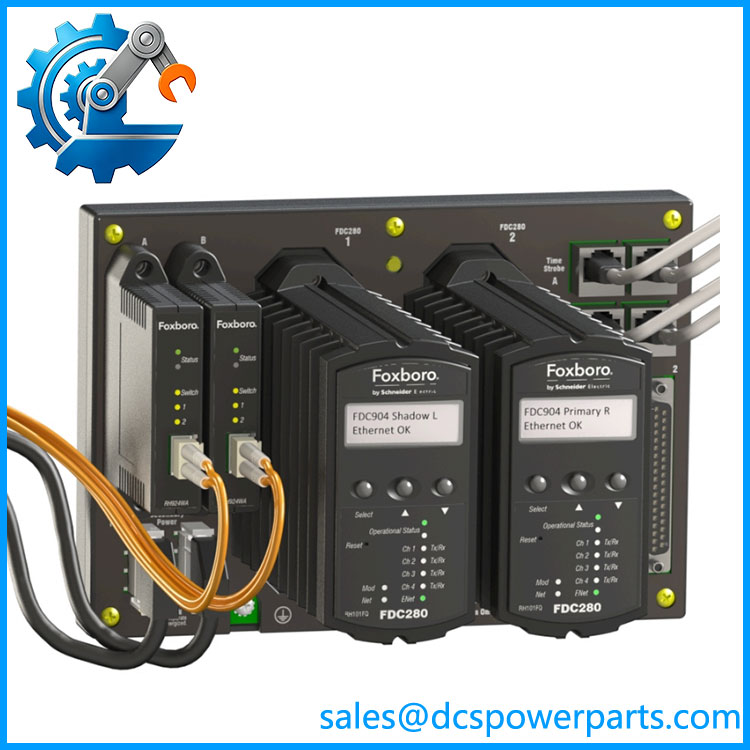
FDC280
Engineering Pain Point
The difficult part of an replacement is usually not the physical controller. It is maintaining the relationship between the controller, baseplate, network adapter, termination assembly, cable, device protocol, and DCS software image. A controller can be electrically correct but still fail commissioning if the image revision, driver, termination hardware, or serial wiring does not match the existing Foxboro configuration. Schneider documentation also identifies separate simplex and fault-tolerant serial arrangements, so the cable topology must be checked before replacement.
Typical Applications
- Foxboro DCS field-device integration
- Direct Modbus RTU/TCP device communication
- Serial RS-232, RS-422, and RS-485 field-device interfaces
- Process control and alarming performed at field-mounted controller locations
- Fault-tolerant installations using paired controller modules
Technical Pitfalls to Avoid
- Do not quote “ ” as one component. is the controller; is a 5 m termination cable.
- Verify the termination assembly. is intended for the Type 5 serial termination architecture; it is not a generic RS-232/422/485 extension cable.
- Check cable length before replacement. is 5.0 m. Shorter Type 5 options include RH100HV, RH100HW, RH100HX, and RH100HY.
- Check simplex versus fault-tolerant architecture. Schneider documents different serial termination arrangements for single-port simplex and two-termination fault-tolerant installations.
- Verify the software image. Foxboro documentation identifies image revisions that correspond to different Control Core Services releases. An image mismatch can become a commissioning issue even when the hardware is correct.
- Do not treat the as a generic PLC CPU. Its integration depends on Foxboro DCS Control Core Services, supported device drivers, baseplate/network hardware, and the configured field-device architecture.
Related Products
- — Field Device Controller 280; performs control and direct field-device integration.
- RH101KF — baseplate associated with the controller hardware; supports the controller installation architecture.
- RH100HV — 1.0 m Type 5 serial termination cable.
- RH100HW — 1.5 m Type 5 termination cable.
- RH100HX — 2.0 m Type 5 termination cable.
- RH100HY — 3.0 m Type 5 termination cable.
- — 5.0 m Type 5 termination cable.
- RH100MM — 6 m RS-232 Y-cable used in the documented fault-tolerant serial arrangement.
- RH100MN — 12 m RS-232 Y-cable for the corresponding fault-tolerant arrangement.
- RH924UQ / RH924WA — network-adapter hardware for copper or fiber Ethernet architectures; exact revision must be checked against the installed system.
Procurement Note
For an replacement, obtain the complete controller part number, baseplate type, network adapter, software/image revision, fault-tolerance arrangement, and installed protocol drivers.
For , verify that the existing installation uses the Type 5 serial termination architecture and that a 5.0 m cable is required. Do not substitute a generic serial cable based only on connector appearance.
The critical procurement distinction is simple: is the controller; is the 5 m controller-to-termination cable. Keeping those two identities separate prevents a common ordering and compatibility error.