Description
Foxboro E69F-TI2-JRS Current-to-Pneumatic Converter
Product Introduction
The Foxboro E69F-TI2-JRS is a field-mounted current-to-pneumatic converter designed to translate an electrical control signal into a proportional pneumatic signal for industrial process-control applications. The E69F family is specified as a current-to-pneumatic converter, with the I configuration accepting 4–20 mA DC, 4–12 mA, or 12–20 mA signals through a 170 Ω input circuit. The 2 output configuration corresponds to 20–100 kPa, 3–15 psi, or 0.2–1.0 bar/kg/cm² pneumatic output. Direct or reverse action must be specified for the actual unit.
The Foxboro E69F-TI2-JRS is particularly useful where a DCS or PLC produces an electronic control signal but the final control element requires pneumatic pressure. The converter sits between the electronic control system and the pneumatic actuator, allowing a 4–20 mA command to be represented as a proportional 3–15 psi pneumatic output. It is therefore not a DCS I/O card, positioner, or PLC module; it is a dedicated field signal-conversion device. The unit’s configuration includes an explosionproof threaded cover, integral explosionproof junction box, adjustable filter regulator, and supply/output gauges.
The Foxboro E69F-TI2-JRS should be evaluated as a complete pneumatic instrument when used as a replacement. Electrical signal range alone does not establish compatibility. Instrument-air pressure, direct/reverse action, output range, hazardous-area requirements, mounting, tubing, and the downstream actuator or valve must all match the original installation. Current secondary records identify the E69F-TI2-JRS as discontinued, so preserving an existing installation may require careful sourcing of an exact unit or a documented engineering replacement rather than an assumed drop-in substitute.
Technical Specifications
| Specification | Details |
|---|---|
| Manufacturer | Foxboro |
| Product Series | E69F |
| Model | E69F-TI2-JRS |
| Product Type | Field-Mounted Current-to-Pneumatic Converter |
| Input Signal | 4–20 mA DC |
| Other Input Ranges | 4–12 mA or 12–20 mA, configuration dependent |
| Input Impedance | 170 Ω |
| Output Signal | 3–15 psi |
| Equivalent Output | 20–100 kPa / 0.2–1.0 bar |
| Action | Direct or reverse, specified during configuration |
| Enclosure | Threaded-cover explosionproof |
| J Option | Integral explosionproof junction box |
| R Option | Adjustable filter regulator without gauge |
| S Option | Supply/output gauges |
| Installation | Field mounted |
| Approx. Weight | 2.3 kg |
| Product Status | Discontinued according to secondary product records |
The manufacturer-style ordering information is more reliable for defining the TI2-JRS configuration than generic reseller specifications. In particular, supply-air pressure and environmental ratings should be checked against the original Foxboro documentation for the installation rather than copied from inconsistent current listings.
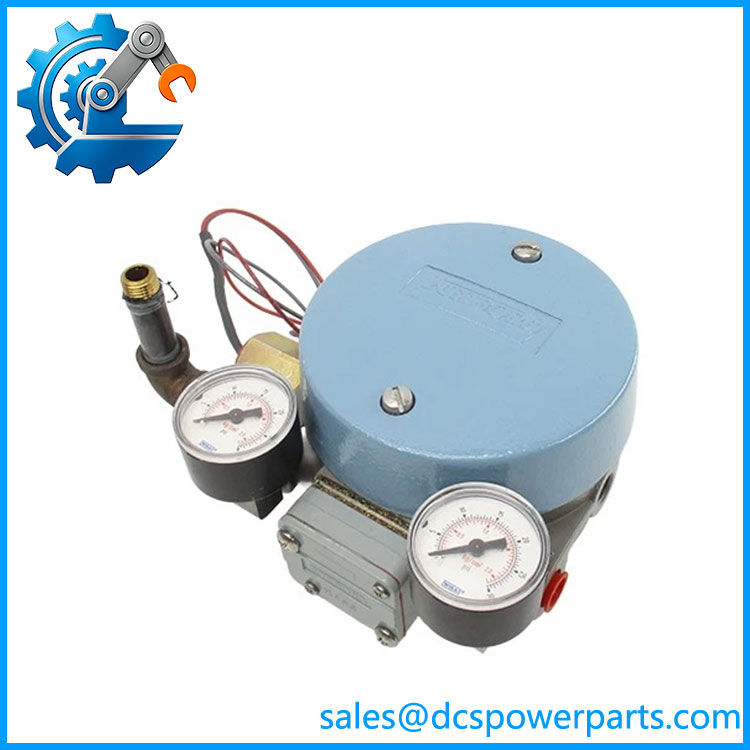
E69F-TI2-JRS
Main Features and Engineering Considerations
Direct Electrical-to-Pneumatic Conversion
The primary function is straightforward but important: the converter accepts an electrical current command from a control system and produces a proportional pneumatic output. In a typical control loop, the DCS output might be 4 mA at the low end and 20 mA at the high end, while the pneumatic output correspondingly spans 3 to 15 psi.
Explosionproof Field Construction
The T enclosure designation specifies a threaded-cover explosionproof enclosure intended for applicable hazardous-area installations. This should not be confused with simply having an IP-rated enclosure. Hazardous-area certification, installation method, cable entry and local electrical regulations must all be considered together.
Integrated J-R-S Configuration
The JRS portion is particularly important during procurement. The J option provides an integral explosionproof junction box. The R option adds an adjustable filter regulator without a gauge, while S specifies supply/output gauges. These features make the unit a more complete field installation than a basic converter body.
Direct or Reverse Action
The E69F ordering information explicitly allows direct or reverse action. This matters when the converter controls an air-to-open or air-to-close valve. A replacement with the wrong action can produce exactly the opposite valve response from what the control strategy requires. The action should therefore be confirmed from the nameplate, original datasheet, loop drawing, or functional test before installation.
Instrument-Air Quality
An I/P converter depends on clean, dry instrument air. Contamination, moisture, pressure instability, or blocked filtration can produce slow response, output drift, or failure to achieve the expected pneumatic range. The integrated regulator does not eliminate the need for correctly specified plant instrument air.
Application Scenarios
DCS-Controlled Pneumatic Valves
The can convert a DCS analog output into the pneumatic signal required by a control valve actuator.
Process-Control Loops
Typical loops include flow, pressure, temperature, and level control where the final control element remains pneumatically actuated.
Hazardous Process Areas
The explosionproof enclosure configuration makes the family suitable for appropriately certified hazardous-area installations when the complete installation meets the applicable requirements.
Oil and Gas Facilities
The electrical-to-pneumatic conversion principle is useful on process equipment where electronic control systems interface with pneumatic field equipment.
Legacy Foxboro Control Systems
The family is particularly relevant when maintaining older Foxboro installations where the existing control architecture and field instruments were designed around conventional pneumatic actuators.
Engineer’s Guide: Field Pitfalls
1. Do not confuse the with a valve positioner.
The converts current to pneumatic pressure. A valve positioner performs additional valve-position feedback and positioning functions. They are not interchangeable simply because both can be associated with pneumatic valves.
2. Verify direct versus reverse action.
This is one of the easiest replacement errors to miss. Confirm whether increasing current should increase or decrease pneumatic output.
3. Match the output range.
The 2 configuration is associated with the 3–15 psi / 20–100 kPa output range. Do not substitute a different output configuration without checking the actuator requirements.
4. Check the JRS accessories.
A ba and an are not necessarily mechanically equivalent from an installation standpoint. The J, R, and S options affect junction-box and pneumatic-accessory configuration.
5. Verify instrument-air pressure and cleanliness.
An I/P converter cannot compensate for unstable or contaminated air. Check the upstream regulator, filter, tubing and supply pressure before condemning the converter.
6. Check hazardous-area certification.
Explosionproof construction does not mean every installation condition is automatically acceptable. Verify the original area classification, certification markings, cable entries and installation requirements.
7. Do not calibrate only the electrical side.
A proper replacement test should confirm the complete conversion chain: DCS current → converter pneumatic output → actuator response → valve travel → process response.
8. Treat discontinued status seriously.
Secondary recordentify as discontinued with no direct replacement listed. If the plant depends on this model, keeping a verified spare can be more practical than assuming a modern I/P converter will be mechanically and functionally interchangeable.
Frequently Asked Questions
WhatFoxboro ?
It is a field-mounted Foxboro current-to-pneumatic signal converter used to convert an electrical current command into a pneumatic control signal.
What is the input signal?
The I configuration supports 4–20 mA DC, with 4–12 mA and 12–20 mA ranges also available depending on configuration. The specified input impedance is 170 Ω.
What is the pneumatic output?
The 2 configuration corresponds to 20–100 kPa, 3–15 psi, or 0.2–1.0 bar/kg/cm².
What does JRS mean?
For the documented ordering structure, J denotes an integral explosionproof junction box, R an adjustable filter regulator without gauge, and S supply/output gauges.
Is a DCS module?
No. It is a field-mounted pneumatic signal converter. It may be connected to a DCS analog output, but it is not part of the DCS I/O hardware.
Is discontinued?
Secondary product records identify the exact model as discontinued. This makes exact-part-number verification especially important for legacy-system maintenance.
Can another Foxboro replace it?
Not automatically. The enclosure, input range, output range, direct/reverse action, junction-box configuration, regulator/gauge options and hazardous-area requirements should all be compared before substitution.
Procurement Note
For , the safest procurement description is:
Foxboro Series Field-Mounted Current-to-Pneumatic Converter, 4–20 mA DC input, 3–15 psi output, explosionproof threaded enclosure, integral explosionproof junction box, adjustable filter regulator, supply/output gauges.
Before accepting a substitute, verify the complete nameplate and the existing loop drawing. The most important parameters are input range, direct/reverse action, 3–15 psi output range, instrument-air supply, hazardous-area certification, pneumatic connections, and J/R/S configuration. Those details determine whether the replacement will actually control the existing actuator correctly.