Description
Key Technical Specifications
| Parameter | Specification |
|---|---|
| Manufacturer | Eaton / Moeller |
| Product Model | RAMO-D02AI1S-C320S1 |
| Catalog Number | 150152 |
| Product Type | Direct-On-Line Motor Starter |
| Product Family | Rapid Link 4.0 RAMO |
| Motor Starter Type | DOL / Direct Starter |
| Rated Operational Voltage | 400 VAC, 3-phase |
| Mains Voltage | 380–480 VAC, 50/60 Hz |
| Rated Operational Current | 6.6 A |
| Adjustable Current Range | 0.3–6.6 A |
| Motor Rating at 400 V / 50 Hz | 0.09–3 kW |
| Motor Rating at 440–480 V / 60 Hz | 0.125–3 HP |
| Communication | AS-Interface |
| AS-i Profile | S-7.4 |
| AS-i Network Capacity | Up to 31 modules |
| Brake Control | 230 VAC external motor brake |
| Power Connection | C32 — plug-in connections at bottom |
| Ambient Operating Temperature | -10 to +55 °C |
| Motor Protection | Integrated thermistor monitoring / PTC and thermo-click |
| Standards | IEC/EN 60947-4-2; IEC/EN 60947-5-1 |
| Protection Class | IP65 |
| Article Number | 150152 |
The Eaton/Rapid Link documentation identifies RAMO-D02AI1S-C320S1 as a 6.6 A DOL starter with AS-Interface Profile S-7.4, rated for 400 V three-phase operation. The published selection table gives a 380–480 V mains range and 0.09–3 kW motor range under the stated operating conditions.
The part-number structure is useful when checking a replacement. D indicates a DOL starter, 02 specifies the 230 VAC external brake-control option, AI1 identifies AS-Interface Profile 7.4, C32 indicates bottom power connections, and S1 is the standard version.
Application Scenarios & Pain Points
Distributed conveyor systems expose a familiar maintenance problem: the motor is physically remote from the PLC cabinet, yet the plant still needs local motor switching, protection, diagnostics, and network control. Rapid Link was designed around that architecture.
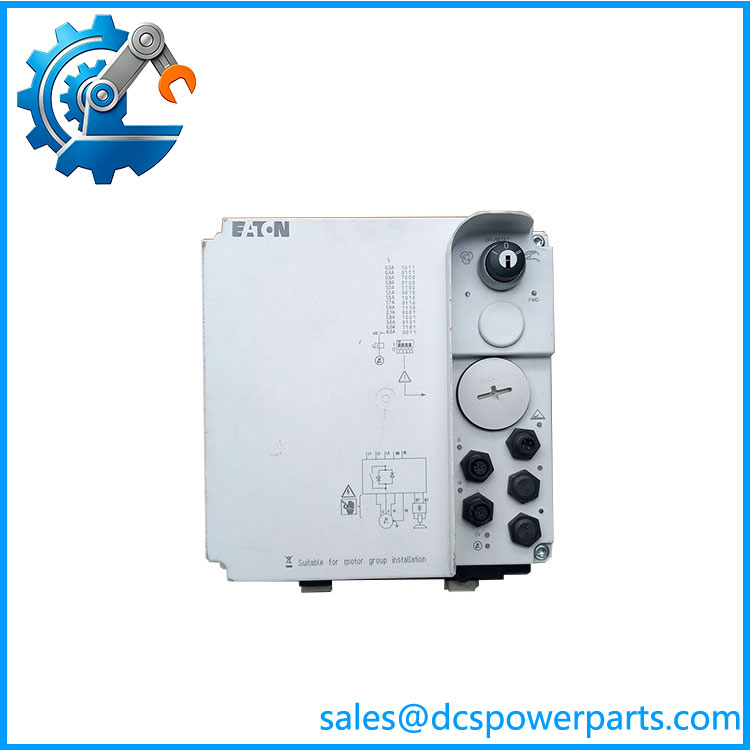
RAMO-D02AI1S-C320S1
Typical Applications
- Conveyor Systems: Particularly suitable for distributed conveyor motor control where individual motors are positioned along a production or material-handling line.
- AS-Interface Motor Networks: The RAMO communicates through AS-i, reducing the amount of traditional point-to-point control wiring required between the controller and distributed motor starters.
- DOL Motor Starting: The starter directly switches compatible three-phase asynchronous motors rather than providing variable-frequency speed control.
- Brake Motor Applications: The D02 configuration is significant where an external motor brake requires 230 VAC control. Do not substitute a D00 version without checking the motor-brake arrangement.
Field Case:
On a conveyor line, a failed RAMO can stop only one motor section while the rest of the network remains healthy. Before replacing the unit, check the AS-i connection, motor thermistor circuit, supply voltage, and local starter status. A communication fault and a genuine power-stage failure can look surprisingly similar from the supervisory system.
Related Products
- Eaton RAMO-D00AI1S-C320S1 — 6.6 A DOL starter with AS-i Profile S-7.4 and bottom connections, but without the D02 230 VAC external-brake option. It is relevant for motors without the brake-control requirement.
- Eaton RAMO-D02AI2S-C320S1 — Related DOL starter using a different AS-i profile configuration. It should not be treated as a drop-in replacement for the AI1 version without checking the network architecture.
- Eaton RAMO-DA2AI1S-C320S1 — 6.6 A DOL starter with an actuator output and 230 VAC brake-control arrangement. The additional actuator function distinguishes it from the standard D02 configuration.
- Eaton RAMO-W02AI1S-C320S1 — Reversing starter with selector functionality. It adds forward/reverse motor control rather than the single-direction operation of the D02 model.
- Eaton RAMO-D02AI1S-C32RS1 — Related D02 starter with a manual override switch. Useful where local manual operation is required, but the added switch makes it a different hardware configuration.
- Eaton RASP-212AI1S0-C320S1 — Rapid Link speed controller rather than a DOL starter. It is the relevant alternative when the motor application requires variable-speed operation instead of simple start/stop control.
- Eaton RAMO-D04AI1S-C320S1 — Higher brake-control configuration in the same RAMO family, using a 400 VAC brake-control option. It may suit a different brake arrangement but should not be substituted for D02 without verification.
- Eaton RAMO-W02AI1S-C320S1 — Reversing variant for applications requiring forward/reverse control. It shares the broader RAMO/AS-i architecture but has materially different motor-control behavior.
The Engineer’s Guide: Field Pitfalls to Avoid
⚠️ Do Not Confuse D02 With D00
The D02 suffix is not cosmetic. It identifies the configuration with 230 VAC control voltage for an external motor brake.
How to avoid it: Check whether the existing motor has a brake and confirm the brake-control wiring before accepting a D00 substitution.
⚠️ Verify the AS-i Profile
The AI1 portion identifies the AS-Interface Profile 7.4 configuration. Replacing it with another AS-i profile version can create a network-configuration problem even if the power wiring physically fits.
How to avoid it: Record the AS-i master configuration, slave profile, address, and installed RAMO part number before replacement.
⚠️ Check the Current Setting Before Energizing the Motor
The rated current is 6.6 A, with an adjustable range of 0.3–6.6 A. A wrong setting can cause nuisance trips or inadequate motor protection.
How to avoid it: Record the existing motor nameplate current and RAMO setting. Verify the setting against the actual motor rather than simply copying a generic factory value.
Frequently Asked Questions (FAQ)
What is Eaton RAMO-D02AI1S-C320S1?
It is a Rapid Link 4.0 RAMO direct-on-line motor starter, catalog 150152, designed for three-phase asynchronous motor control through AS-Interface Profile S-7.4.
What motor size can RAMO-D02AI1S-C320S1 control?
The published rating is approximately 0.09–3 kW at 400 V / 50 Hz, with a stated range of 0.125–3 HP at 440–480 V / 60 Hz, based on the specified four-pole three-phase asynchronous motor conditions.
The rated operational current is 6.6 A, adjustable from 0.3 to 6.6 A.
Does RAMO-D02AI1S-C320S1 support a motor brake?
Yes. The D02 configuration includes a 230 VAC control voltage for an external motor brake. This is one of the most important differences from the D00 configuration.
Is RAMO-D02AI1S-C320S1 a variable-frequency drive?
No. It is a DOL starter, not a VFD. The starter provides motor start/stop control and protection; it does not provide the continuously variable output-frequency control expected from a speed controller.
If variable speed is required, a Rapid Link speed-controller model such as the RASP family is the appropriate class to investigate.
What communication system does this RAMO use?
The AI1 configuration uses AS-Interface Profile S-7.4. The published Rapid Link documentation lists this version for systems supporting up to 31 modules.
During replacement, verify the AS-i master configuration and slave address rather than assuming the replacement will automatically inherit the previous network settings.
Is this model discontinued?
Published product documentation states that was scheduled to become unavailable after June 30, 2020, with Y7-198519 / RAMO5-D202A31-5120S1 identified as the replacement product.
That makes exact legacy replacement stock particularly relevant for plants retaining an existing Rapid Link 4.0 installation.
What should I request when buying a refurbished ?
Request:
- Actual nameplate photograph
- marking
- Article No. 150152
- AS-i communication test
- Motor-start simulation or functional test
- Current-protection verification
- Brake-control output verification
- Thermistor/PTC input test
- Bottom connector inspection
- Housing/IP-condition inspection
- Manufacturing/revision information
- Warranty terms
A unit that simply powers up is not adequately tested. For this starter, the meaningful test should cover AS-i communication, motor-control operation, protection functions, and the 230 VAC brake-control circuit.