Description
DEIF HAS-111DG Synchronizer — Product Page
Product Overview
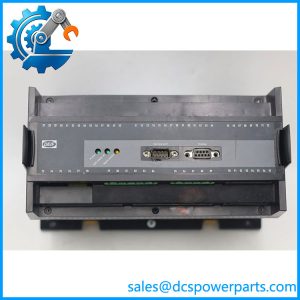
The is part of DEIF’s Uni-line range of generator synchronization instruments. Its primary task is to assess whether a generator’s electrical conditions are sufficiently close to those of a busbar or another voltage system for synchronization. When the configured phase-angle, frequency, and voltage-difference criteria are satisfied, the unit issues a synchronization pulse for the generator circuit breaker. This function is relevant to generator switchboards, standby power installations, and industrial power systems where an operator or external control system manages the synchronization sequence.
Unlike automatic synchronizers that independently regulate generator frequency and voltage and compensate for breaker closing time, the is designed for manual or semi-automatic operation and synchronization checking. The operator or associated control equipment remains responsible for bringing the generator into the acceptable synchronization window. Adjustable limits help the commissioning engineer align the permissive conditions with the generator, breaker, and operating procedure. These settings should be validated against the actual generator and switchgear requirements rather than copied blindly from another installation.
The can also work with compatible DEIF load-sharing units through two analog outputs used for regulation-related purposes. That capability can be useful where synchronization supervision and generator control are divided among separate instruments. Before replacement or procurement, verify the exact ordering configuration, auxiliary supply, generator measuring-voltage range, rated frequency, and terminal arrangement against the installed unit and its wiring diagrams. DEIF documentation lists ordering configurations with different measuring and supply-voltage selections, so the model name alone may not establish every electrical detail of a particular unit. For field maintenance, matching the nameplate and ordering code is more reliable than assuming all units have the same power and measurement ratings.
Product Introduction — Practical Field Focus
For commissioning, confirm the voltage sensing connections and phase sequence before enabling the breaker-close circuit. Incorrect phase mapping or unsuitable synchronization thresholds can prevent an otherwise healthy generator from synchronizing, or allow an unsafe close if the surrounding circuit is incorrectly designed.
During replacement, record the complete ordering code and supply rating, then compare terminal assignments and output behavior with the existing installation drawings. Do not assume that a can be replaced directly by an automatic FAS-series synchronizer; their control functions and commissioning requirements differ.
Key Technical Specifications
| Specification | Details |
|---|---|
| Product Model | |
| Manufacturer / Brand | DEIF |
| Product Type | Generator synchronizing relay / synchronization-check instrument |
| Product Family | Uni-line |
| Primary Function | Synchronization supervision and breaker-close pulse |
| Synchronization Mode | Manual or semi-automatic |
| Main Measured Conditions | Phase-angle difference, frequency difference, voltage difference |
| Measuring Voltage | Ordering-dependent; verify nameplate and datasheet |
| Auxiliary Supply | Ordering-dependent; verify the exact configured variant |
| Frequency Range | Confirm against the unit’s datasheet and ordering configuration |
| Outputs | Synchronization relay output; two analog outputs for compatible DEIF load-sharing/regulation applications |
| Communication Protocol | No digital communication protocol specified in the cited product overview |
| Installation Method | 35 mm DIN-rail or base mounting, per DEIF application documentation |
| Protection Rating | Confirm from the installation instructions for the specific version |
| Operating Accuracy | Not stated here; use the applicable DEIF datasheet |
| Typical Application | Generator-to-busbar synchronization, tie-breaker synchronization checks, switchboard control |
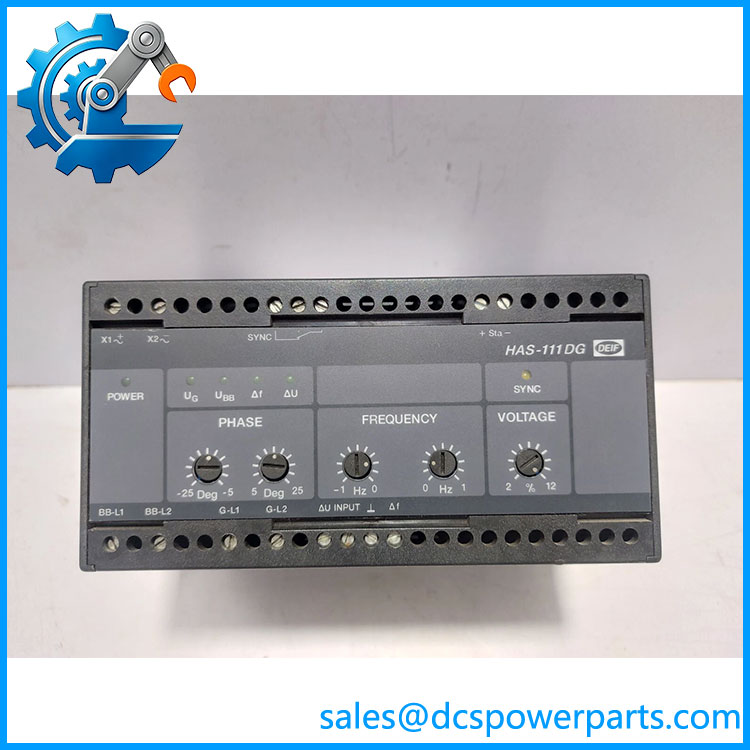
DEIF HAS-111DG
Related Products
These DEIF products serve related power-generation and switchboard functions; they are not automatically interchangeable with the .
- FAS-113DG — Automatic synchronizer with voltage regulation and breaker-time compensation.
- FAS-115DG — Automatic synchronizer with voltage regulation and breaker-time compensation.
- LSU-112DG — Load-sharing unit for frequency and power control.
- LSU-113DG — Load-sharing unit with frequency and power control plus an additional power-related function.
- LSU-114DG — Load-sharing unit with frequency and power control and start/stop functionality.
- LSU-122DG — Load-sharing unit for reactive power and voltage-related control.
- EPQ96-2 — Electronic potentiometer for controlling compatible electronic speed governors.
- EPN-110DN — Electronic potentiometer used in generator speed-governor control applications.
- RSQ-3 — Synchronoscope for visual monitoring during manual synchronization.
Frequently Asked Questions
What does the DEIF do?
It checks synchronization conditions and issues a breaker-close synchronization pulse when the measured phase-angle, frequency, and voltage differences are within the configured limits.
Is the a fully automatic synchronizer?
No. DEIF identifies it for manual or semi-automatic synchronization. Automatic synchronization with voltage regulation and breaker-time compensation is associated with models such as the FAS-113DG and FAS-115DG.
Can it be used for generator paralleling?
Yes, as part of a correctly engineered synchronization system. The surrounding installation must provide the required generator regulation, breaker control, interlocks, and electrical protection.
Can the be used with a DEIF load-sharing unit?
DEIF documents two analog outputs for regulation-related connection to compatible DEIF load-sharing units. Confirm signal requirements and wiring against the specific equipment manuals.
Is the hot-swappable?
Do not assume so. Isolate the relevant auxiliary supply and measuring circuits and follow the site’s electrical safety and switchboard procedures before removal or replacement.
What should be checked before ordering a replacement?
Compare the complete ordering code, auxiliary supply, measuring-voltage rating, frequency configuration, terminal layout, mounting arrangement, and existing wiring diagram. Confirm that the replacement supports the original system’s synchronization logic.
What testing should be completed after installation?
Verify the measuring inputs and phase sequence, check the configured synchronization limits, test the synchronization output under controlled conditions, and confirm the breaker-close interlocks independently. Perform the site’s approved commissioning and protection checks before returning the generator to service.
What warranty or test documentation should accompany a supplied unit?
Request the supplier’s applicable warranty terms, traceable model and ordering-code photographs, condition disclosure, and available functional-test records. For used or refurbished equipment, confirm exactly which tests were performed; a visual inspection alone does not establish synchronization performance.