Description
Product introduction
In automated machinery, a stepper motor must match the required movement profile, drive settings, and mechanical interface. The Danaher Motion VDE0530-S1 is listed as an industrial step motor used in motion-control equipment. It may be relevant when maintaining older positioning systems where replacing the motor with a different frame or winding configuration could require mechanical changes or drive retuning.
Before ordering the Danaher Motion VDE0530-S1, compare the original motor’s full type designation, terminal or connector arrangement, shaft dimensions, mounting pattern, and electrical ratings. Listings associate this model designation with PowerMax II motors, but the full motor code is needed to establish the exact configuration.
Key technical specifications
| Parameter | Details |
|---|---|
| Product model | VDE0530-S1 |
| Manufacturer / brand | Danaher Motion; Pacific Scientific association appears in other references |
| Product type | Stepper motor |
| Motor series | PowerMax II is referenced by some listings; verify nameplate |
| Rated voltage | Not verified for this exact designation |
| Rated current | Not verified |
| Holding torque | Not verified |
| Step angle | Confirm from the complete motor model or datasheet |
| Shaft and mounting dimensions | Confirm from the physical unit drawing |
| Feedback interface | Not established from the model string alone |
| Connector / wiring | Verify against the original unit |
| Operating temperature | Check the applicable motor datasheet |
| Protection rating | Not verified |
| Installation method | Mechanical mounting; exact mounting arrangement requires confirmation |
The model-specific details above are intentionally limited to information that can be supported. Do not use generic specifications from another stepper motor in this family as confirmed ratings for the VDE0530-S1.
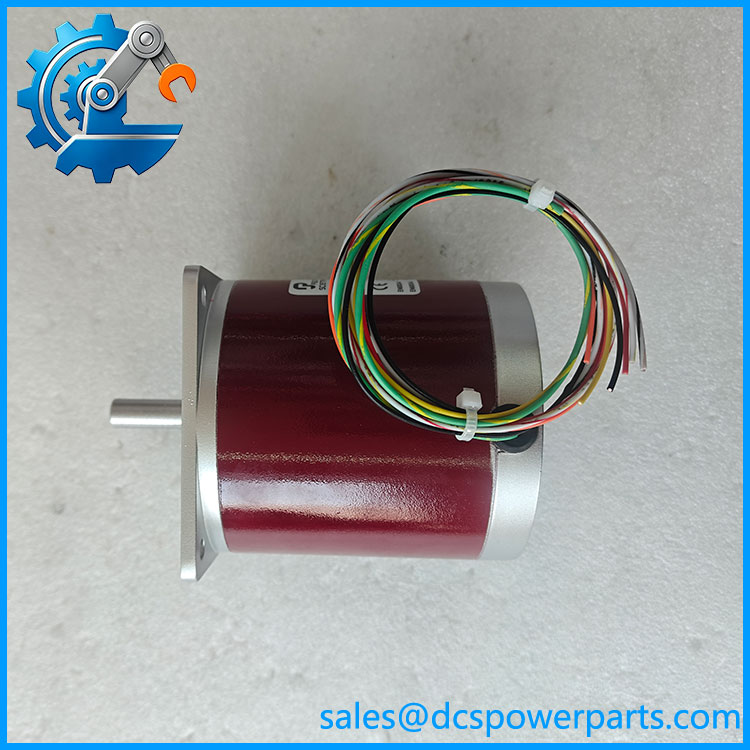
VDE0530-S1
Application scenarios and replacement considerations
- Positioning equipment: Stepper motors can provide incremental movement in indexing and positioning mechanisms. Confirm torque demand and required positioning resolution.
- Packaging and assembly machinery: Check acceleration, stopping frequency, load inertia, and the required motion cycle before selecting a replacement.
- Legacy automation equipment: Preserve the original mounting dimensions, shaft geometry, and wiring arrangement where possible.
- Maintenance and spare-parts planning: Compare the nameplate and connector details before purchase, especially if the installed motor has been in service for many years.
Field note: A motor that fits mechanically may still be unsuitable electrically. Incorrect phase wiring, current settings, or drive compatibility can cause missed steps, excess heating, or poor positioning performance.
Related model identification
Some listings associate the VDE0530-S1 designation with full PowerMax II motor codes such as P21NRLA-LNN-NS-00 and P21NRXC-… variants. These are useful examples of the longer codes to look for, not confirmed drop-in replacements.
When comparing alternatives, match the complete motor code rather than relying on the shared VDE0530-S1 designation.
Engineer’s replacement checklist
- Record the full nameplate. Capture the manufacturer, complete model code, rated current, winding information, and any revision or option suffix.
- Measure the mechanical interface. Verify shaft diameter and length, mounting-hole pattern, overall length, and coupling requirements.
- Confirm drive compatibility. Compare the original drive’s motor-current settings, phase configuration, and supported control method. Perform commissioning checks before returning the machine to production.
Frequently asked questions
1. What is the ?
It is identified in industrial parts listings as a Danaher Motion stepper motor, with some references associating it with Pacific Scientific and PowerMax II products.
2. Is the a servo motor or a stepper motor?
The more specific model references describe it as a stepper motor. Confirm the original nameplate before using the designation for procurement.
3. Can it replace another PowerMax II motor?
Not based on the series name alone. Current rating, winding configuration, torque, shaft geometry, and mounting dimensions must match the application.
4. Can the motor be used with an existing drive?
Only after verifying electrical and control compatibility. Do not assume that a drive supports the motor simply because both are from the same manufacturer family.
5. Are exact electrical specifications available?
The model-only references reviewed do not establish a complete, dependable specification set for this exact unit. Use the full nameplate and the matching technical datasheet.
6. What should buyers provide when requesting a replacement?
Provide the complete motor label, clear photos of the shaft and mounting face, connector or terminal details, and the drive model number. These details help reduce the risk of ordering an incompatible unit.