Description
Key Technical Specifications
| Parameter | Specification |
|---|---|
| Manufacturer | Cisco |
| Model | IE-2000-8TC-G-B |
| Switch type | Managed industrial Ethernet switch |
| Copper ports | 8 × 10/100BASE-T |
| Uplink ports | 2 × Gigabit Ethernet combo |
| Combo interfaces | RJ45 or supported SFP, depending on configuration |
| Switching capacity | 7.6 Gbps |
| Forwarding rate | 5.66 Mpps |
| MAC address table | 8,000 entries |
| DRAM | 256 MB |
| Flash memory | 64 MB |
| Software | Cisco IOS, LAN Base |
| Power supply | Dual DC inputs |
| Cooling | Fanless |
| Mounting | DIN rail |
| Dimensions | Approximately 130 × 91.4 × 115 mm |
| Weight | Approximately 1.25 kg |
| Operating temperature | Enclosure-dependent; published configurations include -40°C to +70°C |
Product Introduction
The Cisco IE-2000-8TC-G-B is designed for industrial Ethernet networks requiring managed switching, network segmentation, and reliable communication between automation equipment. Its eight Fast Ethernet copper ports support connections to PLCs, HMIs, remote I/O stations, industrial computers, and other Ethernet-enabled devices. Two Gigabit Ethernet combo uplinks provide higher-bandwidth connections to distribution switches or supervisory networks.
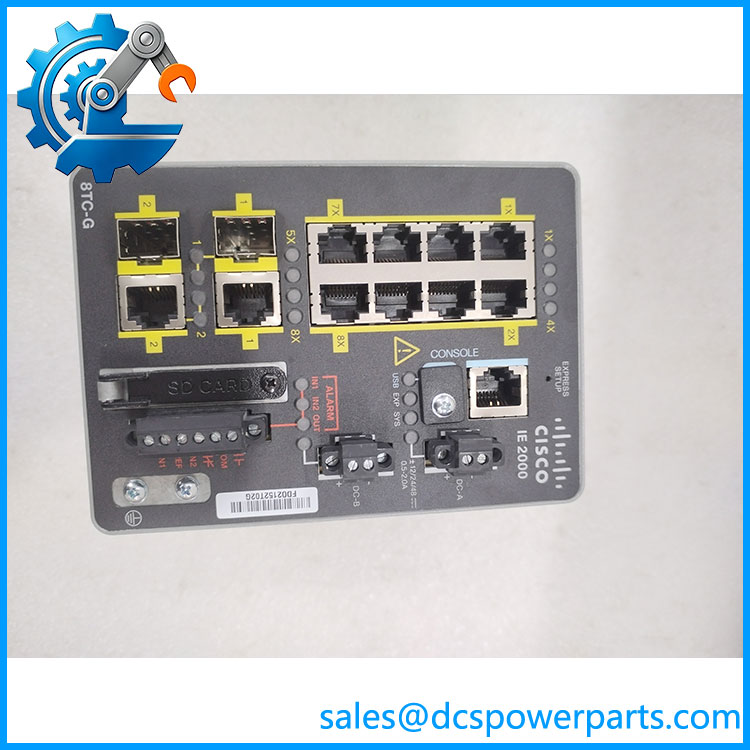
IE-2000-8TC-G-B
The LAN Base software configuration supports managed Layer 2 networking features used in industrial installations. Depending on the network design and software release, these include VLANs, network redundancy, traffic prioritization, and network monitoring. The switch is designed for DIN-rail installation in industrial control cabinets and supports dual DC power inputs for power-source redundancy.
Application Scenarios and Field Pitfalls
Typical applications
- PLC and remote I/O Ethernet networks.
- Industrial SCADA communication infrastructure.
- Factory automation network access.
- Oil and gas control system cabinets.
- Power generation and utility automation.
- Industrial machine communication networks.
Engineering checks before replacement
- Confirm the uplink type: The two Gigabit combo ports can support copper or compatible SFP connections. Verify the installed transceiver and fiber type.
- Check the software license: The
-BLAN Base version is not automatically equivalent to LAN Lite or enhanced LAN Base variants. - Verify power wiring: Check both DC input terminals, supply polarity, voltage range, and alarm wiring against the hardware installation guide.
- Preserve network configuration: Back up VLANs, spanning-tree settings, redundancy configuration, port assignments, and management IP settings.
- Check firmware compatibility: Confirm the existing IOS release and supported features before loading a configuration from another IE 2000 model.
- Evaluate enclosure temperature: Published temperature limits depend on enclosure ventilation and cooling conditions.
Related Products and Variants
| Model | Main difference |
|---|---|
| IE-2000-8TC-G-L | LAN Lite software license |
| IE-2000-8TC-G-E | LAN Base configuration with IEEE 1588 support |
| IE-2000-8TC-G-N | Enhanced LAN Base configuration with IEEE 1588 and NAT support |
| IE-2000-8TC-B | Eight Fast Ethernet ports with two Fast Ethernet uplinks |
These models share the IE 2000 platform but have different software features or uplink speeds. They should not be treated as direct replacements without checking the network requirements.
Procurement and Quality Control
Before purchasing a replacement, verify:
- Full model number:
IE-2000-8TC-G-B. - Cisco product serial number and hardware revision.
- LAN Base software license status.
- DC power input condition and terminal integrity.
- RJ45 port operation and Gigabit uplink functionality.
- SFP compatibility where fiber connections are used.
- IOS version and configuration backup.
- Port communication and network redundancy test results.
Procurement recommendation: Specify the complete Cisco model number rather than ordering a generic IE 2000 switch. The Gigabit uplinks and LAN Base license are important configuration details. A switch with the same number of Ethernet ports but a different license or uplink arrangement may not satisfy the existing industrial network design.