Description
Key Technical Specifications
| Parameter | Specification |
|---|---|
| Manufacturer | Beckhoff Automation |
| Model | CX1020-0111 |
| Product Family | CX1020 |
| Product Type | Embedded PC / PLC CPU |
| Processor | Intel Celeron M ULV, 1 GHz |
| CPU Cores | 1 |
| Operating System | Windows Embedded CE 6.0 |
| Control Software | TwinCAT 2 PLC Runtime |
| Main Memory | 256 MB DDR RAM |
| Flash Storage | CompactFlash |
| Ethernet | 2 × RJ45, 10/100 Mbps |
| Ethernet Architecture | Internal switch |
| Video Interface | DVI |
| USB | 2 × USB 2.0 |
| System Bus | 16-bit ISA / PC/104 |
| I/O Expansion | Via CX1100 power supply and CX-series modules |
| Cooling | Passive |
| Maximum Power Consumption | 11 W |
| Dimensions | 96 × 112 × 99 mm |
| Weight | Approx. 550 g |
| Operating Temperature | 0 to 50°C |
| Storage Temperature | -25 to +85°C |
| Relative Humidity | 95%, non-condensing |
| Protection Rating | IP20 |
| Approvals | CE, UL |
The current Beckhoff service documentation lists 256 MB DDR RAM, two 10/100 Mbps RJ45 ports, CompactFlash storage, passive cooling, an 11 W maximum power-consumption figure, and a 96 × 112 × 99 mm housing.
Product Introduction
The Beckhoff CX1020-0111 is an embedded industrial PC configured specifically for PLC control using TwinCAT 2 PLC Runtime. The 0111 configuration combines the CX1020’s 1 GHz Intel Celeron M processor with Windows Embedded CE 6.0 and factory-installed DVI/USB interfaces, making it suitable for compact machine-control and automation systems where PLC execution, visualization, and modular I/O are combined in one controller.
The CX1020 architecture is modular rather than a standalone PLC brick. Beckhoff specifies that the CPU requires a CX1100-series power supply module, while additional I/O and fieldbus functions can be added through the CX system architecture. The two onboard Ethernet ports are connected through an internal switch and can support a simple line topology without a separate Ethernet switch.
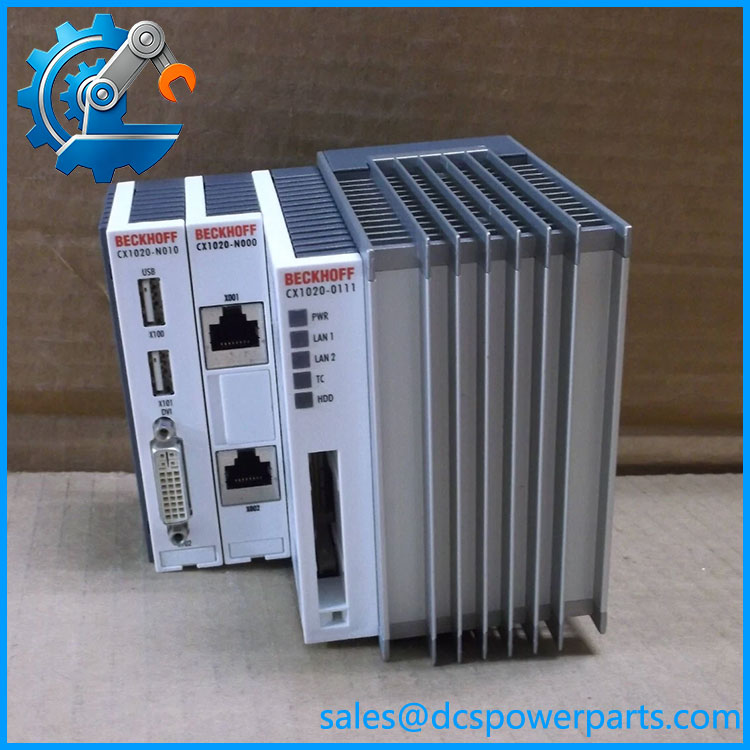
CX1020-0111
Engineering Pain Point
The important procurement issue with CX1020-0111 is the software configuration, not just the processor. The suffix 0111 identifies a specific combination of DVI/USB hardware, Windows Embedded CE 6.0, and TwinCAT 2 PLC Runtime. A CX1020 with the same CPU but a different suffix can have a different operating system or TwinCAT runtime, so replacing it by the generic “CX1020” designation can create a software compatibility problem.
Typical Applications
- Machine PLC control: TwinCAT 2 PLC Runtime provides IEC 61131-3 automation control on the embedded PC.
- Motion and machine automation: The platform was designed for higher-performance control applications and can be extended with appropriate TwinCAT motion runtimes and I/O.
- Industrial visualization: The DVI interface permits connection to compatible displays, while USB supports peripherals such as keyboards and other USB devices.
- Modular I/O systems: CX-series Bus Terminals, EtherCAT Terminals, and fieldbus interfaces can be integrated through the appropriate CX power/interface modules.
Technical Pitfalls to Avoid
- Do not confuse -0111 with -0110.
Both use DVI/USB and Windows Embedded CE 6.0, but 0111 includes TwinCAT 2 PLC Runtime, whereas 0110 is supplied without TwinCAT. - Do not substitute a different TwinCAT configuration without checking the project.
variants include PLC, NC PTP, NC I, no-TwinCAT, and Windows Embedded Standard configurations. The installed application determines which configuration is appropriate. - Verify the CX1100 power module.
The CPU does not operate as a conventional independently powered PLC CPU. Beckhoff specifies power through a CX1100-series power-supply module. - Check the CompactFlash image.
The operating system and control environment are associated with the controller’s storage configuration. For a replacement in an operating machine, preserve or verify the correct boot image and application data rather than assuming the CPU alone contains the complete control project. - Check the installed interface modules.
Beckhoff notes that certain system interfaces are factory-configured and cannot simply be retrofitted in the field. This matters when comparing a replacement CPU with the installed machine hardware. - Plan around lifecycle status.
Beckhoff currently lists the in the service phase and identifies newer CX2033/CX2043 models as recommended alternatives. For an existing machine, however, the correct replacement decision should be based on the installed TwinCAT project, I/O architecture, and machine certification rather than CPU specifications alone.
Related Products
- Beckhoff -0110 — DVI/USB version with Windows Embedded CE 6.0 but without TwinCAT PLC Runtime.
- Beckhoff -0112 — DVI/USB, Windows Embedded CE 6.0, TwinCAT 2 NC PTP Runtime.
- Beckhoff -0113 — DVI/USB, Windows Embedded CE 6.0, TwinCAT 2 NC I Runtime.
- Beckhoff -0011 — with Windows Embedded CE 6.0 and TwinCAT 2 PLC Runtime but without the DVI/USB option.
- Beckhoff CX1100-series — Required power-supply modules for the system.
- Beckhoff CX2033 — Current-generation alternative identified by Beckhoff for the service-phase product family; direct application replacement requires engineering verification.
- Beckhoff CX2043 — Another Beckhoff alternative listed for the service phase; compatibility must be established from the actual TwinCAT application and I/O architecture.
Procurement note: For CX1020-0111, specify the complete order number rather than simply “.” Before replacement, verify TwinCAT 2 PLC Runtime, Windows Embedded CE 6.0, DVI/USB configuration, CompactFlash image, CX1100 power module, connected I/O/fieldbus modules, and the existing TwinCAT project. Beckhoff’s current documentation places the in service phase, so maintaining an application-specific spare can be important for legacy machinery.