Description
Product Overview
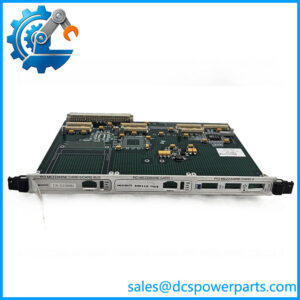
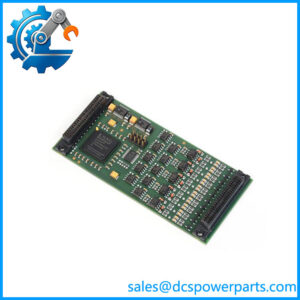
The Ansaldo VME-SSI AVMESSI is a specialized interface board designed around the VMEbus architecture and SSI (Synchronous Serial Interface) technology. Its primary purpose is to bring serial position or encoder information into a legacy VME-based control system, allowing the host controller to process accurate machine-position data for motion, drive, or process-control functions. Available technical references identify the module with Ansaldo Automation and describe its role as a VME-based SSI interface.
Within an industrial control cabinet, Ansaldo VME-SSI AVMESSI sits between the VME controller architecture and field devices that use SSI signaling. Typical applications include encoder feedback, shaft-position measurement, actuator position monitoring, and motion-control data acquisition. Some published references describe one to four SSI channels and VME64X/VME32 compatibility, but these figures should be treated as configuration-dependent until the actual board revision is inspected.
The practical value of VME-SSI AVMESSI is its ability to preserve an established VME control architecture without replacing the entire controller rack simply because an SSI interface has failed. This matters on older turbine, traction, power-generation, and industrial motion systems where the original application software and VME CPU remain serviceable. Public technical information is limited, and several secondary sources publish conflicting voltage, channel-count, and environmental specifications. For procurement, the board label, connector arrangement, firmware/EPROM identification, and existing system documentation should take precedence over generic online specifications.
Product Introduction
When a legacy VME system loses encoder or position data, the fault may be isolated to the interface board rather than the encoder itself. VME-SSI AVMESSI provides the SSI-to-VME interface needed to transfer this position information into the control system.
For a legacy VME replacement, preserving the existing SSI interface can avoid unnecessary changes to the host CPU and application software. The exact channel configuration and board revision should be confirmed before installation.
Key Technical Specifications
| Parameter | Value |
|---|---|
| Manufacturer | Ansaldo Automation |
| Model | VME-SSI AVMESSI |
| Product Type | VME SSI Interface Module |
| System Architecture | VME-based industrial control |
| Bus Interface | VMEbus |
| VME Standard | VME32 / VME64X reported |
| Signal Interface | SSI, Synchronous Serial Interface |
| Primary Function | Encoder / position-data acquisition |
| SSI Channels | 1–4 reported, configuration-dependent |
| Typical Device | SSI absolute encoder / position sensor |
| Field Interface | Serial synchronous position data |
| Application | Motion control, drive control, industrial automation |
| Board Configuration | Revision-dependent |
| Firmware / EPROM | Revision-dependent; verify physical board |
| Supply | VME backplane supply; exact requirements should be verified |
| Operating Temperature | Configuration-dependent |
| Condition | New Surplus, subject to inspection and functional testing |
Published references consistently identify the board as an Ansaldo VME/SSI module, while channel count and electrical specifications vary between secondary sources.
Related Products
- MVME162 — Motorola VME CPU family commonly associated with legacy VME control architectures. It provides computing resources rather than the dedicated SSI interface function.
- MVME177 — Higher-performance Motorola VME CPU family used in older VME control systems. It can serve as the host processor while the SSI board handles field position data.
- Ansaldo ECOPLC VME Modules — Related VME-based Ansaldo control hardware. These modules can form the surrounding control architecture in legacy installations.
- Ansaldo SICAM Hardware — Related Ansaldo automation hardware used in power and industrial control environments. The exact interface architecture differs by system generation.
- SSI Absolute Encoder Interface Modules — Functionally comparable hardware used when the application requires synchronous serial position feedback; connector, timing, and protocol compatibility must be checked before substitution.
- VME Digital I/O Modules — Complementary VME hardware for discrete field signals. These do not replace the dedicated SSI interface.
- VME Analog I/O Modules — Used for voltage/current measurement rather than serial encoder data, making them complementary rather than direct substitutes.
- Ansaldo VME CPU Boards — Host processing modules that execute the control application. VME-SSI AVMESSI normally serves as an I/O interface alongside this type of hardware.
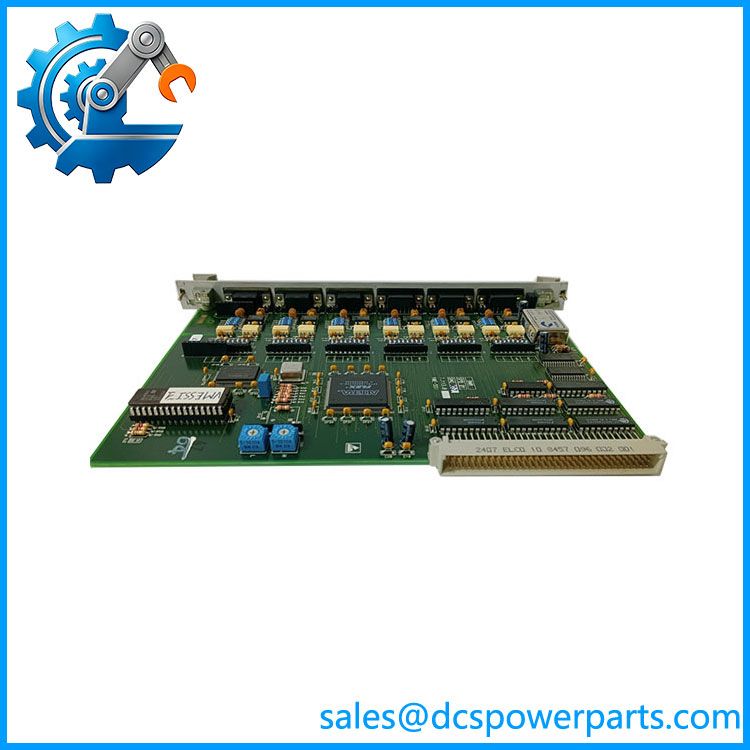
VME-SSI AVMESSI
Frequently Asked Questions
What is Ansaldo VME-SSI AVMESSI used for?
VME-SSI AVMESSI is an SSI interface module for VME-based control systems. Its main role is to acquire synchronous serial position information from SSI-compatible devices and make that information available to the VME control architecture.
It is particularly relevant where the existing controller depends on SSI encoder or position feedback.
Is VME-SSI AVMESSI an SSI encoder interface?
Yes. The available technical references identify SSI as the principal field interface, with applications involving encoders and position sensors.
The exact encoder timing, word length, number of channels, and electrical interface should be verified against the actual board and installed encoder before commissioning.
How many SSI channels does VME-SSI AVMESSI support?
Published specifications are not completely consistent.
Some references report 1–4 SSI channels, while other sources describe fewer independently configurable channels.
For procurement, I would not approve a replacement based on “VME-SSI AVMESSI” alone. Compare the PCB revision, connector configuration, jumper/DIP-switch settings, and the number of SSI devices connected to the existing board.
Can I hot-swap the VME-SSI AVMESSI?
Do not assume hot-swap capability.
The board uses a VME backplane, but a conventional VME installation does not automatically mean the entire control system supports live insertion. An SSI interface may also be connected directly to active encoder circuits.
Before removal, place the machine in the approved maintenance state and isolate the VME rack according to the system procedure.
Can I replace VME-SSI AVMESSI with another VME SSI card?
Not without checking the electrical and protocol details.
At minimum, compare:
- VME slot and board format.
- SSI electrical interface.
- SSI clock/data timing.
- Encoder word length.
- Number of SSI channels.
- Connector pinout.
- Interrupt/register mapping.
- Host software expectations.
A generic SSI interface may electrically read the encoder but still fail to communicate correctly with the original Ansaldo application.
Will replacing VME-SSI AVMESSI erase my control logic?
Normally, the interface board itself is not the primary location for the complete VME control application. The application is generally associated with the host CPU and system storage.
Still, record the board configuration before replacement, especially DIP-switch/jumper settings, channel assignments, SSI parameters, and VME address configuration. These settings can determine whether the replacement is recognized correctly.
How should I verify a New Surplus VME-SSI AVMESSI?
For this obsolete-style VME hardware, inspection should focus on identification and configuration.
Recommended checks:
- Exact VME-SSI AVMESSI marking
- Manufacturer/assembly identification
- PCB revision
- EPROM or firmware label
- VME connector condition
- SSI connector and pin configuration
- Number of populated SSI channels
- Jumpers/DIP switches
- Capacitor and component condition
- Power-on diagnostic test
- SSI encoder communication test
There is limited authoritative public documentation for this exact board, and secondary sources disagree on several electrical specifications. That makes physical-board verification and application-specific testing more important than relying on a generic catalog listing.