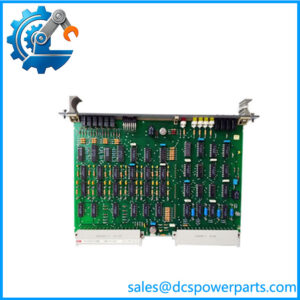
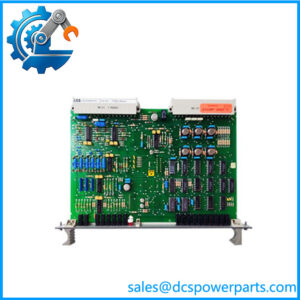
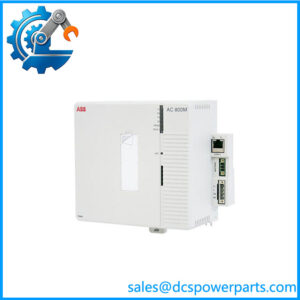
Description
ABB TBU810
Product Introduction
In a legacy turbine control cabinet, the termination base is easy to overlook because it does not contain the processor or protection algorithm. That is exactly why it can become a difficult failure point during replacement work. ABB TBU810 is the termination base unit used with ABB’s 800 Series turbine modules, providing the physical and electrical interface into which the applicable controller modules are installed. ABB identifies TBU810 as common hardware across the AS800, TP800, and VP800 turbine products.
For a TP800 installation, the CPM810 Common Processor Module and TPM810 Turbine Protection Module plug into the TBU810 to form the basic turbine protection assembly. ROM810 relay output modules can be connected to the TP800, while EIM810 and PCM810 provide additional system-specific functionality. TBU810 is DIN-rail mounted and uses the turbine-system field termination architecture rather than acting as an independent controller.
Key Technical Specifications
| Parameter | Specification |
|---|---|
| Manufacturer | ABB |
| Product Model | TBU810 |
| Product Type | Termination Base Unit |
| Product Family | ABB 800 Series Turbine Modules |
| System Family | Symphony Plus Turbine |
| Compatible Turbine Systems | TP800, AS800, VP800 |
| Primary Function | Module mounting and field/system termination |
| Mounting | Standard 35 mm DIN rail |
| System Supply | +24 VDC architecture |
| Associated TP800 Modules | CPM810, TPM810 |
| Associated Output Module | ROM810 |
| Additional Compatible Module | EIM810 |
| Communication Architecture | Profibus DP within the 800 Series turbine system |
| Active Processor | None |
| Base Unit Nature | Passive termination/interface assembly |
| Typical Application | Turbine protection, valve positioning, auto-synchronization |
| Weight | Approximately 0.7 kg reported in ABB product data |
| Exact Revision | Verify physical unit; ABB documentation identifies historical revisions |
ABB’s product documentation identifies as the termination base for the 800 Series turbine modules and specifies standard DIN-rail mounting. A product record also identifies approximately 0.703 kg for the .
Major Features / Advantages
Common 800 Series Platform
One of the important engineering characteristics of is its commonality. ABB documentation identifies CPM810, , and ROM810 as common components across the AS800, TP800, and VP800 turbine products. This reduces the number of different base assemblies that need to be maintained across an installation containing several turbine-control functions.
That commonality should not be confused with complete module interchangeability. The base unit provides the platform; the installed application module determines the actual control function.
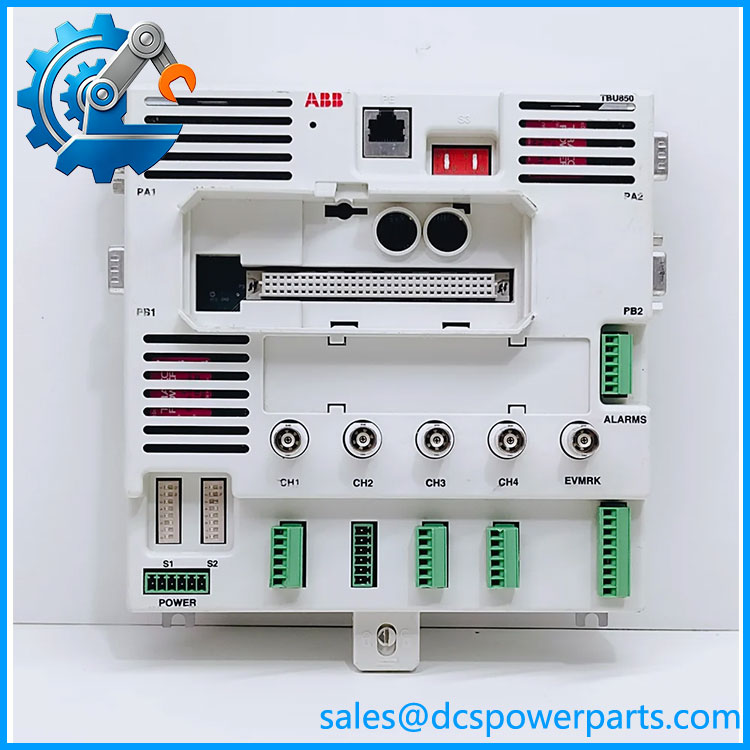
TBU810
Module Mounting and Electrical Interface
The provides the physical interface for the turbine modules. In a system, the CPM810 and TPM810 plug into the . ABB describes the resulting assembly as the basic turbine protection unit.
This makes the condition of the base mechanically important. A replacement processor may be electrically correct but still unreliable if the base has damaged connectors, loose locking hardware, contamination, or wiring damage.
DIN-Rail Installation
uses standard 35 mm DIN-rail mounting, which fits the cabinet architecture used by ABB’s 800 Series turbine solutions. ABB also highlights DIN-rail mounting as part of the flexible installation concept for the platform.
For retrofit projects, this can simplify mechanical replacement, but the installer still needs to confirm cabinet clearances and the existing wiring arrangement.
Field Wiring and Termination
is the point where the controller modules interface with the field wiring and associated system connections. Public technical descriptions identify terminals for power, field connections, and communication, while ABB’s catalog identifies as the I/O termination interface.
This is why should not be treated like a simple mechanical carrier. Incorrect terminal wiring can affect the behavior of the installed turbine module even when the active electronics themselves are functioning correctly.
Profibus-Based System Architecture
ABB’s 800 Series turbine documentation identifies Profibus DP as the system communication interface. forms part of the physical termination architecture supporting the applicable turbine module.
The communication protocol belongs to the complete turbine-system architecture; it should not be interpreted as meaning that itself is a standalone Profibus processor.
Support for Redundant Architectures
The 800 Series turbine platform supports redundant configurations. ABB documentation describes multiple modules for schemes such as two-out-of-three protection, with the specific quantity determined by the required protection architecture.
therefore has importance beyond basic mounting: its correct wiring and module interconnection are part of the overall turbine protection architecture.
Application Scenarios & Pain Points
Turbine Protection
For , the houses the CPM810 Common Processor Module and TPM810 Turbine Protection Module. ABB identifies the for functions including overspeed trip, overspeed protection, trip anticipation, load-drop anticipation, and power-load-unbalance protection.
AS800 Auto-Synchronization
The same platform is used with ABB’s 800 Series turbine specialty modules beyond protection. ABB identifies as common hardware for AS800, , and VP800.
VP800 Turbine Valve Positioning
also forms part of the 800 Series architecture used for valve-positioning applications. The exact installed module combination should be checked before replacing a base unit.
Retrofit and Obsolescence Maintenance
For older turbine installations, a replacement may be required because of damaged connectors, mechanical wear, terminal damage, or cabinet modifications rather than an electronic failure in the processor itself.
A useful procurement practice is to specify the complete designation plus the associated turbine module family instead of ordering a generic “ABB termination base.”
Related Products
- ABB CPM810 — Common Processor Module used with in the architecture.
- ABB TPM810 — Turbine Protection Module that plugs into to form the protection assembly.
- ABB ROM810 — Relay Output Module connected to the for additional digital relay outputs.
- ABB EIM810 — Extended I/O Module that can be connected to for additional inputs and outputs.
- ABB PCM810 — Phase Current Module used in applicable generator-current applications, including power-load-unbalance calculations.
- ABB SIM810 — Service module used for firmware upgrades and standalone configurations.
- ABB ROM830 — Relay/voting-related module used with the ROM810v2 architecture in applicable 2oo3 configurations.
These are associated 800 Series components, not blanket replacement options.
Engineer’s Guide: Field Pitfalls to Avoid
1. Do not mistake for an active controller.
The is the termination base. The actual processing and protection functions reside in the modules installed into it.
2. Check the installed module combination.
A uses and TPM810 on the . Other 800 Series turbine products use different application modules. Verify the exact system architecture before replacing the base.
3. Inspect the connectors carefully.
On an older installation, connector wear, contamination, damaged locking mechanisms, or poor seating can cause intermittent faults that look like processor or I/O failures.
4. Do not assume every 800 Series module uses the same configuration.
is common across several turbine products, but the installed module set determines the application and signal assignments.
5. Verify field wiring before removing the old base.
Label and photograph the existing termination arrangement. A termination-base replacement can involve substantially more wiring risk than replacing a plug-in processor module.
6. Check redundancy architecture.
systems can be configured with multiple modules for voting schemes such as 2oo3. A replacement base should be evaluated within that complete architecture rather than as an isolated component.
7. Verify revision markings.
ABB documentation identifies historical revisions, including a transition from revision A to revision 2.0. When maintaining an installed system, record the revision actually fitted before purchasing a replacement.
FAQ
What is ABB ?
ABB is a Termination Base Unit used with ABB’s 800 Series turbine modules. It provides the mounting and electrical termination interface for modules such as and .
Which ABB systems use ?
is used across the AS800, , and VP800 turbine products. ABB specifically describes , , and ROM810 as common hardware across these three turbine products.
Is a PLC or processor?
No. is a termination base/interface assembly. The active processing functions are performed by modules installed into the base, such as the .
What modules plug into ?
For a configuration, ABB identifies the Common Processor Module and Turbine Protection Module as the primary modules installed in the . ROM810, EIM810, and PCM810 can provide additional system functions depending on the application.
How is mounted?
The 800 Series documentation specifies standard 35 mm DIN-rail mounting for the .
Does provide Profibus communication?
The 800 Series turbine system uses Profibus DP for system communications. provides part of the physical termination/interface architecture; it should not be described as an independent Profibus controller.
What should be checked before buying a replacement?
Verify the model, physical revision, installed turbine product, module combination, terminal wiring, connector condition, DIN-rail mounting arrangement, and redundancy architecture. For a used unit, inspect the actual connectors and locking mechanisms rather than relying only on a catalog description.