Description
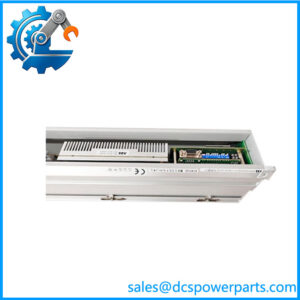
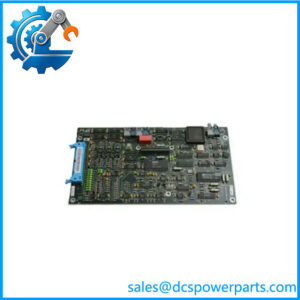
ABB SACO16D1-AA Digital Annunciator Unit
Product Overview
The ABB SACO16D1-AA is a 16-channel microprocessor-based digital annunciator designed to supervise on/off alarm contacts and provide immediate visual and audible indication when a monitored process condition changes. It belongs to ABB’s SPACOM family and was developed for power plants, substations, industrial processes, marine and offshore installations, building technical systems, and water-treatment applications. The unit can operate independently as a local annunciator or exchange alarm and event information with a higher-level monitoring or control system through its serial interface and SPA bus.
The SACO16D1-AA designation is particularly important during replacement. ABB documents the AA order-number suffix as the 80–265 V AC/DC auxiliary-supply version; the corresponding BA version is rated for 18–80 VDC. Internally, the annunciator generates a supervised 48 VDC field-contact supply, so the external alarm contacts themselves do not need a separate field-contact power source. Each of the 16 channels can be configured for normally open or normally closed contacts, rising or falling edge operation, or pulse counting, with selectable input/reset delays.
From a maintenance perspective, this is a dedicated alarm-management appliance rather than a generic remote I/O module. It provides front-panel LEDs, a four-digit first-out display, an internal event register, acknowledge/reset functions, group alarm retransmission, audible-alarm control, and continuous hardware/software self-supervision. For a legacy substation or process installation, replacing it with a modern PLC input card would require reproducing these functions in the control logic and operator interface; it is not a simple channel-for-channel substitution.
Product Introduction
Alarm annunciation is the primary job here. Sixteen field contacts can be monitored independently, with the unit identifying the first alarm, driving the appropriate visual indication, and activating configured retransmission or audible-alarm functions. The field-contact circuit itself is supplied and supervised internally at 48 VDC.
For legacy substation replacement, the AA supply version deserves particular attention. An SACO 16D1 with an AA auxiliary supply cannot be treated as equivalent to the BA version simply because the front-panel model designation appears similar. Verify the installed supply module, order suffix, SPA connection hardware, and field wiring before ordering a spare.
Key Technical Specifications
| Parameter | Value |
|---|---|
| Product Model | SACO 16D1-AA |
| Manufacturer / Brand | ABB |
| Product Family | SPACOM |
| Product Type | Digital Annunciator Unit |
| Alarm Channels | 16 |
| Field Contact Type | Potential-free NO or NC contacts |
| Field Contact Voltage | 48 VDC ±20% |
| Closed-Loop Current | 4 mA ±20% |
| Channel Input Delay | 5 ms, 20 ms, 100 ms, 1 s, 5 s, 20 s, 60 s, 160 s; other values via serial communication |
| Pulse Counter | Maximum 3 Hz; 0–29999 |
| External Acknowledge/Reset | 2 control inputs |
| Acknowledge/Reset Voltage | 48 VDC ±20% |
| Group Reflash Outputs | 2 relays |
| Audible Alarm Output | 1 relay |
| Self-Supervision Output | 1 relay |
| Relay Rating | 3 A / 250 V AC/DC |
| DC Breaking Capacity | 1 A at 48 VDC; 0.25 A at 110 VDC; 0.15 A at 220 VDC, L/R ≤40 ms |
| Communication | Fibre-optic serial bus / SPA bus via connection module |
| Communication Coding | ASCII |
| Data Rate | Selectable 4800 or 9600 Bd |
| Auxiliary Supply, AA | 80–265 V AC/DC |
| Auxiliary Supply, BA | 18–80 VDC |
| Power Consumption | Approximately 10 W quiescent / 25 W operating |
| Service Temperature | -10°C to +55°C |
| Transport/Storage | -40°C to +70°C |
| Panel-Mounted Protection | IP54 |
| Approximate Weight | 4.5 kg |
| Product Guide | 1MRS750406 |
| User Manual | 1MRS750944 |
ABB’s product guide specifies the above electrical, communication, environmental, and relay characteristics.
Major Features / Practical Advantages
16 independent alarm channels
The SACO 16D1 provides 16 independently configurable alarm channels. Each channel can work with either normally open or normally closed contacts, allowing the same hardware to supervise different field-device conventions. Rising-edge, falling-edge, and pulse-counting functions are also documented.
The pulse-counter capability is a useful detail that is easy to miss in a simple product listing. ABB specifies counting up to 3 Hz, with a stored count range of 0–29999. That allows selected channels to be used for event or operating-state counting rather than only steady-state alarm monitoring.
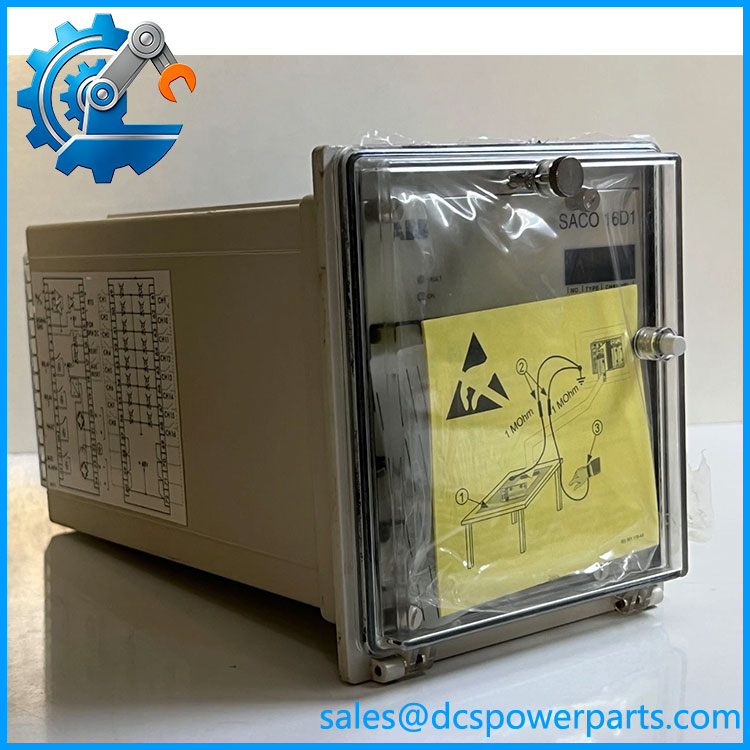
SACO16D1-AA
First-out alarm indication
When an alarm occurs, the unit can identify the first-out condition through its four-digit alphanumeric display. This is particularly useful where several alarms may appear during the same disturbance and the maintenance team needs to establish which condition occurred first.
The event register provides additional history. The original product guide describes storage of the last nine events, while the technical manual describes an event register for the 50 latest events. For a replacement specification, the manual’s later documentation should be treated as the more detailed reference for the event-register implementation.
Integrated 48 VDC field-contact supply
The annunciator generates its own 48 VDC field-contact voltage. ABB specifies 48 VDC ±20% at the field contacts, with approximately 4 mA loop current for a closed field-contact circuit. The field-contact supply is galvanically isolated from the annunciator’s electronic circuits and system earth.
This matters during retrofit work. The external contacts are expected to be potential-free; applying an arbitrary external voltage to the contact circuit without checking the original wiring arrangement can create a compatibility problem.
Four auxiliary output relays
The SACO 16D1 has four relay outputs with defined roles. Two are available for group alarm retransmission, one operates an audible device such as a horn or buzzer, and one belongs to the self-supervision system. The two group-alarm relays can be configured for different reflash functions.
The relay contacts are rated at 3 A / 250 V AC/DC. DC switching capability is lower and depends on voltage and load time constant, so a procurement specification should not simply repeat the 3 A figure as a universal DC switching rating.
Hardware and software self-supervision
Self-supervision continuously monitors the unit’s hardware and software, including the auxiliary supply and internal electronic voltages. When a permanent fault is detected, the front-panel fault indicator operates, the self-supervision relay changes state, and the outputs are blocked.
That diagnostic behavior is one reason the SACO16D1 should not be regarded as a collection of ordinary dry-contact inputs. Its internal alarm processing and fault handling are part of the functional design.
SPA bus communication
A rear serial interface permits connection to ABB’s SPA bus through compatible SPA-ZC connection modules. The documentation identifies SPA-ZC 17/S and SPA-ZC 21/S families for the electrical/optical interface, with plastic-core and glass-fiber variants. Data communication uses ASCII coding with selectable 4800 or 9600 baud operation.
For a replacement, check the actual SPA connection module installed in the cabinet. The annunciator itself and the optical interface module are separate elements.
Panel-mounted IP54 enclosure
The SACO 16D1 uses an aluminum enclosure intended for flush mounting. With the panel-mounted enclosure closed, ABB specifies IP54 protection. The rear terminals accept one or two conductors up to 2.5 mm².
The specified service temperature is -10°C to +55°C, with transport and storage from -40°C to +70°C. It also underwent IEC 60255-related dielectric, impulse, and disturbance testing specified in the product documentation.
Related Products
- SACO 16D3 — Related ABB annunciator product for larger or different alarm-system configurations. It belongs to the same general SACO annunciator family but should not be treated as a drop-in replacement without checking channel and system requirements.
- SACO 64D4 — Larger SACO annunciator architecture based around standardized 100 × 160 mm Euro-card modules. It is intended for substantially larger alarm annunciation systems.
- SPGU 240A1 — Internal auxiliary power-supply module used with the 80–265 V AC/DC SACO configuration.
- SPGU 48B2 — Alternative internal supply module for the 18–80 VDC version. It is associated with the BA configuration rather than the AA version.
- SWIM 2A1 — Input/output module used internally in the SACO 16D1 assembly.
- SWPM 3A1 — Alarm annunciator module forming the microprocessor-based alarm-processing section of the SACO 16D1.
- SWCM 3A1 — Connection module providing the plug-in interfaces and rear screw-terminal connections.
- SPA-ZC 17/S — SPA bus electrical/optical connection module with its own power-supply arrangement.
- SPA-ZC 21/S — SPA bus connection-module family powered from the host unit, with plastic-core and glass-fiber variants documented.
FAQ
Can I replace SACO16D1-AA with the BA version?
Not without checking the auxiliary supply. AA = 80–265 V AC/DC, whereas BA = 18–80 VDC. The suffix therefore represents an actual electrical difference, not merely an ordering variation.
Can I hot-swap the SACO16D1-AA?
It should not be treated as a generic hot-swappable PLC I/O module. The unit contains an internal power supply, processor, alarm-processing circuitry, and external field wiring. Replacement should follow the site’s approved isolation and alarm-system maintenance procedure.
Does SACO16D1-AA support 16 digital inputs?
Functionally, it supervises 16 on/off alarm channels, but calling it a conventional 16-channel PLC DI card is misleading. It generates its own 48 VDC contact voltage, provides configurable alarm sequences, first-out indication, event storage, acknowledge/reset functions, audible-alarm control, and self-supervision.
What is the field-contact voltage?
The internally generated field-contact supply is 48 VDC ±20%, with a specified closed-loop current of approximately 4 mA ±20%. The connected field contacts are intended to be potential-free.
Does communicate with a DCS?
It can communicate with higher-level monitoring and control systems through its serial interface and ABB SPA bus architecture. A compatible SPA-ZC electrical/optical connection module is required for the documented fiber-optic bus configurations.
Does it support pulse counting?
Yes. The technical documentation specifies pulse-counter operation up to 3 Hz, with a count range of 0–29999. This is separate from normal contact-based alarm operation.
What is the relay contact rating?
The documented rating is 3 A / 250 V AC/DC. For DC loads, the permissible breaking current is lower: ABB specifies 1 A at 48 VDC, 0.25 A at 110 VDC, and 0.15 A at 220 VDC for the stated L/R condition.
Does the AA version use 110 VDC?
It can. ABB lists 110/125/220 VDC and 110/120/230/240 VAC as rated supply voltages for the SPGU 240A1, whose operating range is 80–265 V AC/DC. Therefore a 110 VDC installation falls within the AA configuration.
Does this support firmware v3.1?
The model designation does not establish a firmware revision equivalent to the firmware terminology used by newer PLC/DCS platforms. Its configuration is performed through the front-panel controls or serial communication interface. Firmware compatibility should therefore be checked from the actual unit documentation and installed system configuration rather than inferred from the suffix.
Is still suitable as a new system design?
The unit is legacy ABB SPACOM equipment, with the cited product guide originally issued in 1999 and subsequently updated. It is more appropriately considered for maintaining an existing installation or as a controlled legacy replacement than as a default choice for a new automation architecture.
Procurement Note
When purchasing an , verify the complete designation and not merely “SACO 16D1.” The critical distinction is the auxiliary-supply suffix: AA corresponds to 80–265 V AC/DC, while BA corresponds to 18–80 VDC. Also check whether the existing installation uses SPA-ZC 17/S or SPA-ZC 21/S communication hardware and whether the field wiring relies on the unit’s internally generated 48 VDC contact supply.
For a cabinet replacement, compare the actual rear terminal arrangement, internal power-supply module, serial/SPA interface, front-panel configuration, and enclosure condition. The SACO 16D1 is a complete annunciation system, so replacing it with a visually similar contact-input device can remove first-out processing, event registration, audible-alarm control, or self-supervision that the original installation depends on.
For surplus or refurbished inventory, request photographs of the nameplate and confirm the RS 811 016-AA order designation where applicable. ABB’s original ordering documentation identifies RS 811 016-AA for the AA version.