Description
Woodward 8440-1935 easYgen-3500-1/P1 Generator Set Controller
Product Overview
The Woodward 8440-1935 is an easYgen-3500 generator set controller from the easYgen-3000 family, configured as Package P1 with 1 A current-transformer inputs and a front-panel display. It is designed for generator applications that go beyond basic engine start/stop control, including synchronization, generator breaker control, automatic mains failure operation, load-dependent starting and stopping, load sharing, and power import/export control. Woodward documentation also identifies the easYgen-3500 family for complex parallel applications using multiple generator and mains/busbar breakers.
The controller accepts a 12/24 VDC supply over an 8–40 VDC range and measures generator and mains electrical quantities through voltage and current inputs. For the 8440-1935 variant, the generator current transformer input is the 1 A nominal version, with a configurable measurement range extending to 32,000 A on the primary side. The controller provides isolated digital inputs, isolated relay outputs, configurable analog inputs and outputs, CAN interfaces, and RS-232/RS-485 Modbus RTU communication.
For a plant operating several synchronized generator sets, the Woodward 8440-1935 is more than a local genset start/stop controller. The easYgen-3500 architecture can coordinate up to 32 generator units and communicate with up to 16 Woodward LS-5 breaker controllers in the documented complex breaker application. It also supports island operation, grid-parallel operation, AMF/standby operation, peak-load operation, CHP applications, load-dependent sequencing, and generator-group breaker control.
Product Introduction
The engineering value of the 8440-1935 lies in combining generator measurement, synchronization, breaker logic, protection, and plant-level load management in one controller. This is particularly relevant when a genset installation has multiple generators or several network and bus-tie breakers rather than a single standby generator.
One procurement detail should not be missed: 8440-1935 is the 1 A CT version. Woodward separately identifies 8440-1934 as the corresponding 5 A CT version of the easYgen-3500 P1 package. That current-input distinction needs to match the installed CT secondary circuit; it is not a cosmetic model variation.
Key Technical Specifications
| Parameter | Value |
|---|---|
| Product Model | 8440-1935 |
| Manufacturer | Woodward |
| Series | easYgen-3000 |
| Controller Model | easYgen-3500 |
| Package | P1 |
| CT Input Version | 1 A |
| Supply Voltage | 12/24 VDC |
| Supply Operating Range | 8–40 VDC |
| Maximum Self-Consumption | 19 W |
| Operating Temperature | -20 to +70°C |
| Storage Temperature | -30 to +80°C |
| Relative Humidity | 95%, non-condensing |
| Generator Voltage Measurement | 3-phase / 3-wire; 3-phase / 4-wire; other supported configurations |
| Generator Voltage Setting Range | 50–650,000 VAC primary |
| Measurement Frequency | 50/60 Hz, 40–85 Hz range |
| CT Linear Measurement Range | 3 × nominal CT current |
| Grid/Earth Current Range | 1.5 × nominal CT current |
| CT Primary Setting Range | 1–32,000 A |
| CT Burden | <0.15 VA |
| Digital Inputs | Isolated |
| Digital Input Range | 12/24 VDC, 8–40 VDC |
| Digital Input Resistance | Approx. 20 kΩ |
| Relay Outputs | Isolated |
| Relay Contact Material | AgCdO |
| Analog Inputs | Non-isolated, configurable |
| Analog Output | Isolated, configurable |
| Analog Output Range | ±10 V / ±20 mA / PWM |
| CAN Interfaces | Up to 3, depending on configuration |
| Serial Communications | RS-232 / RS-485 Modbus RTU |
| Supported Generator Sets | Up to 32 in documented parallel applications |
| LS-5 Breaker Controllers | Up to 16 |
| Display | 5.7-inch color LCD, 320 × 240 pixels |
| Front-Panel Housing | Plastic |
| Front-Panel Dimensions | 282 × 217 × 99 mm |
| Panel Cutout | 249 × 183 mm nominal |
| Rear-Cabinet Housing | Sheet-metal version available in family |
| Front Protection | IP66 with screw mounting; IP54 with clamp mounting |
| Rear Protection | IP20 |
| Approx. Weight | Up to 2.17 kg for front-panel version |
The electrical, environmental, dimensional, I/O, and communications values above are from Woodward’s easYgen-3400/3500 product specification.
Major Features / Practical Advantages
1 A CT measurement architecture
The 8440-1935 is specifically the 1 A CT version of the easYgen-3500 P1 package. Woodward’s documentation gives a 1–32,000 A configurable primary-current range and a 3 × nominal-current linear measurement range. The current input itself is isolated, with a specified burden below 0.15 VA.
This matters during replacement. A 5 A CT controller such as the 8440-1934 should not be treated as a drop-in substitute merely because both belong to the same easYgen-3500 family. The CT secondary circuit must match the controller’s input configuration.
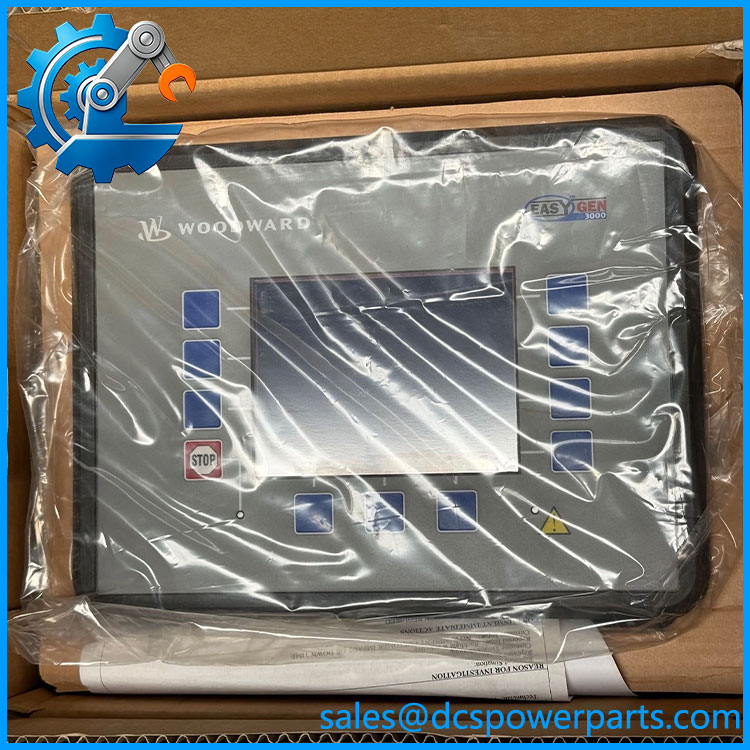
8440-1935
2 Complex generator parallel control
The easYgen-3500 family is intended for more demanding breaker arrangements than a basic single-generator controller. Woodward specifies connectivity for up to 16 LS-5 breaker controllers and operation with up to 32 generators in parallel applications. Supported functions include generator-group breaker control, mains and busbar breaker logic, automatic segment control, master/slave operation, and load-dependent generator sequencing.
That makes the 8440-1935 relevant to multi-generator power plants, industrial captive-power systems, and distributed-generation installations where breaker coordination is part of the controller’s job.
3 Integrated synchronization
The controller supports slip-frequency and zero-phase synchronization for generator and mains/busbar breaker operation. Woodward also documents starting synchronization, where multiple synchronous generators can be brought into load operation quickly while generator circuit breakers are closed during the controlled sequence.
In practical terms, synchronization settings should be checked against the actual generator, AVR, governor, breaker, CT/PT ratios, and utility interconnection requirements. Replacing the controller without transferring and validating those settings is not a commissioning shortcut.
4 Load management
The easYgen-3500 supports active and reactive power distribution for up to 32 generator sets, load-dependent starting and stopping, peak-load operation, and import/export control. These functions allow the controller to participate in plant-level generation management rather than simply operating one engine.
For plants with varying electrical demand, that distinction can materially affect how generators are dispatched and how the system handles transitions between island and grid-parallel operation.
5 Flexible control logic
Woodward’s LogicsManager allows internal measurements and states to be combined with Boolean operators and programmable timers. The documented controller also supports configurable PID controllers for functions such as heating circuits, water level, fuel level, pressure, and other process values.
That flexibility can reduce the need for auxiliary relay logic in some generator applications, but existing logic should be exported, documented, and reviewed before replacing a controller. A physically identical spare does not automatically contain the site’s application configuration.
6 Broad I/O capability
The P1/P2 family supports isolated digital inputs, isolated relay outputs, configurable analog inputs, configurable isolated analog outputs, CAN communications, and RS-232/RS-485 Modbus RTU. Woodward also documents external I/O expansion through CANopen and J1939 configurations.
The controller therefore occupies a position between a dedicated genset controller and a small power-management control platform.
7 Generator and mains protection
The documented protection functions include generator voltage/frequency protection, overload, reverse/missed power, unbalance, instantaneous and time-overcurrent, ground-fault protection, power factor, phase-sequence protection, engine overspeed/underspeed, and several mains protection functions including phase jump and ROCOF.
Protection settings should be treated as site-specific engineering data. They should not simply be copied from a generic controller template.
8 Marine approvals
Woodward’s published product specification identifies LR and ABS type approval for the easYgen-3400/3500 family, along with UL/cUL, CSA, CE, and VDE-AR-N 4105 certification/approval entries. The exact applicability should still be checked against the installed variant and project certification requirements.
Related Products
- 8440-1934 — easYgen-3500 P1 with 5 A CT inputs. Functionally related to 8440-1935, but the CT secondary-current configuration differs.
- 8440-1936 — easYgen-3500 P2 with 5 A CT inputs. P2 provides the expanded I/O configuration of the family.
- 8440-1937 — easYgen-3500 P2 with 1 A CT inputs. This is the closer 1 A counterpart when the application requires P2 functionality.
- 8440-1956 — easYgen-3400 P1 with 1 A CT inputs and rear-panel cabinet mounting. It belongs to the same broad controller family but is intended for a different application class.
- 8440-1945 — easYgen-3400 P1 with 5 A CT inputs. Useful for comparing 1 A and 5 A CT configurations within the easYgen-3400 family.
- 8440-2046 — Marine-package easYgen controller with 1 A CT inputs. Relevant where marine-specific package configuration is required.
- LS-5 — Woodward breaker controller family used with the easYgen-3500 for complex breaker and power-management applications. The easYgen-3500 documentation specifies connectivity for up to 16 LS-5 controllers.
- RP-3000 — Remote panel associated with the easYgen family for visualization and control applications.
- IKD1 — Woodward I/O expansion module family documented for digital and analog I/O expansion.
FAQ
Can I replace an 8440-1935 with an 8440-1934?
Not without checking the CT secondary circuit. 8440-1935 is the 1 A CT version, while 8440-1934 is the 5 A version of the easYgen-3500 P1 package. The two should not be considered interchangeable simply because the controller family and basic functions are similar.
Can I hot-swap the 8440-1935?
Do not assume live replacement is permissible. This is a complete genset controller connected to CTs, PTs, breaker circuits, engine controls, and potentially a live generator bus. Follow the plant’s shutdown/isolation procedure and Woodward maintenance instructions. In particular, CT circuits require proper handling before controller disconnection.
What is the biggest compatibility issue when buying an 8440-1935?
The 1 A CT input configuration is one of the first checks. Then verify the controller package, wiring harness/connectors, application configuration, firmware, voltage/PT ratios, breaker logic, communication network, and installed option configuration.
Does the 8440-1935 support Modbus?
Yes. Woodward specifies an RS-232/RS-485 Modbus RTU slave interface in the easYgen-3400/3500 family. The controller also provides CAN-based communication interfaces and supports external I/O through CANopen/J1939 configurations.
Does this controller support 32 generators?
The Woodward product specification states that the easYgen-3500 family can support up to 32 generators in documented multi-unit parallel applications. It also specifies connectivity for up to 16 Woodward LS-5 breaker controllers. Actual system capacity depends on the network architecture and application configuration.
Does the 8440-1935 have a display?
Yes. The 8440-1935 is the front-panel display version of the easYgen-3500 P1 1 A configuration. Woodward specifies a 5.7-inch color LCD with 320 × 240 pixel resolution and softkey operation for the easYgen-3500 family.
What is the power supply requirement?
The controller operates from 12/24 VDC, with a specified operating range of 8–40 VDC and maximum self-consumption of 19 W.
Does it support generator protection?
Yes. The documented protection functions include voltage/frequency, overload, reverse or missed power, unbalance, instantaneous and time-overcurrent, ground fault, power factor, phase sequence, overspeed/underspeed, and several mains protection functions.
Does the model number establish firmware compatibility?
No. The part number identifies the hardware/package configuration, but it should not be used as proof of a particular firmware revision or application configuration. For a replacement controller, compare the existing firmware, configuration file, I/O mapping, communication settings, and protection settings with the replacement unit.
Is 8440-1935 suitable for a 5 A CT system?
Not as the normal direct configuration. Woodward identifies 8440-1934 as the 5 A CT version of the easYgen-3500 P1, while 8440-1935 is the 1 A version. Verify the actual CT secondary rating before ordering.
Procurement Note
When sourcing a Woodward 8440-1935, treat the complete part number as significant. The important distinction is not simply “easYgen-3500”; 8440-1935 specifically corresponds to the P1, 1 A CT, front-panel configuration. Woodward’s own product specification lists 8440-1935 alongside 8440-1934, 8440-1936, and 8440-1937 as separate easYgen-3500 variants.
Before approving a replacement, compare the existing controller’s CT secondary rating, voltage transformer configuration, connector arrangement, display mounting, I/O configuration, communication interfaces, breaker logic, protection settings, and application file. If the controller is being installed into an operating generator plant, the CT and breaker circuits deserve particular attention; a controller replacement is not equivalent to changing a passive PLC card.
For legacy inventory, ask for a photograph of the actual Woodward nameplate and complete part number. Woodward also provides a Product History Lookup facility intended to identify product information from the product label and serial number, which is useful when distinguishing hardware revisions and upgrade paths.
Condition should be stated separately from technical identity. New surplus, refurbished, and previously installed 8440-1935 units can have very different procurement risk. For used or refurbished controllers, request evidence of power-up testing, display operation, I/O verification, communications testing, and configuration retention rather than relying on cosmetic condition alone.