Description
Product Introduction
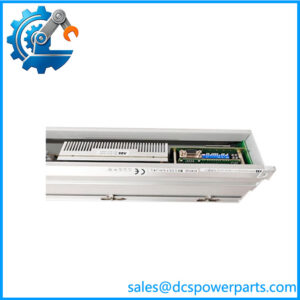
When a field device has only one PROFIBUS DP interface but the control network uses redundant communication paths, integrating that device without redesigning the network can become a practical engineering problem. The ABB RLM01 addresses this by linking a single PROFIBUS line with two redundant lines, using ports A, B, and M to manage signal forwarding and monitor communication activity.
Designed for PROFIBUS DP/FMS networks, the module supports transmission rates up to 12 Mbit/s, provides front-panel fault indication, and offers a signaling contact for external diagnostics. It is a fieldbus infrastructure component—not a PLC CPU, general-purpose Ethernet switch, or standalone controller.
Key Technical Specifications
| Parameter | Specification |
|---|---|
| Manufacturer | ABB |
| Model | RLM01 |
| Order number | 3BDZ000398R1 |
| Device function | PROFIBUS line redundancy |
| Supported protocols | PROFIBUS DP / FMS |
| Interface standard | RS-485 |
| PROFIBUS connections | A, B, M; three ports |
| Transmission rate | 9.6 kbit/s–12 Mbit/s |
| PROFIBUS slave address | Not required for the RLM01 itself |
| Power supply | 24 VDC, +20% to +33% |
| Typical current consumption | 150 mA at 24 VDC |
| Approximate power dissipation | 3.6 W |
| Electrical isolation test voltage | 500 V RMS |
| Alarm contact | Opens when an error is detected |
| Alarm contact rating | Below 60 VDC; maximum 1 A |
| Operating temperature | 0°C to +50°C |
| Storage/transport temperature | −30°C to +85°C |
| Relative humidity | Maximum 75%, non-condensing during operation |
| Protection rating | IP20 |
| Dimensions (H × W × D) | 134 × 56 × 70 mm |
| Weight | Approximately 330 g |
| Mounting | 35 mm DIN rail |
Specifications are based primarily on ABB’s published product information. Confirm the nameplate, wiring diagram, and applicable installation documentation before commissioning.
Application Scenarios & Engineering Pain Points
- Integrating single-interface field devices: Connect a device with one PROFIBUS DP interface to an architecture using redundant communication lines, subject to the network design.
- Reducing exposure to cable faults: The RLM01 monitors its three communication paths and can forward valid data through the available redundant line when a fault is detected.
- Supporting maintenance diagnostics: Front-panel LED indication and the signaling contact help technicians identify communication problems without relying solely on controller-side alarms.
- Connecting multiple PROFIBUS stations: ABB documents support for up to 31 PROFIBUS stations per interface; repeaters may be needed for larger networks or extended physical layouts.
Field engineering note: Redundancy at the link level does not eliminate every network failure mode. Incorrect bus termination, unsuitable cable routing, grounding problems, or a fault in a shared power source can still interrupt communications. Validate the complete A/B/M wiring arrangement and the power-supply design.
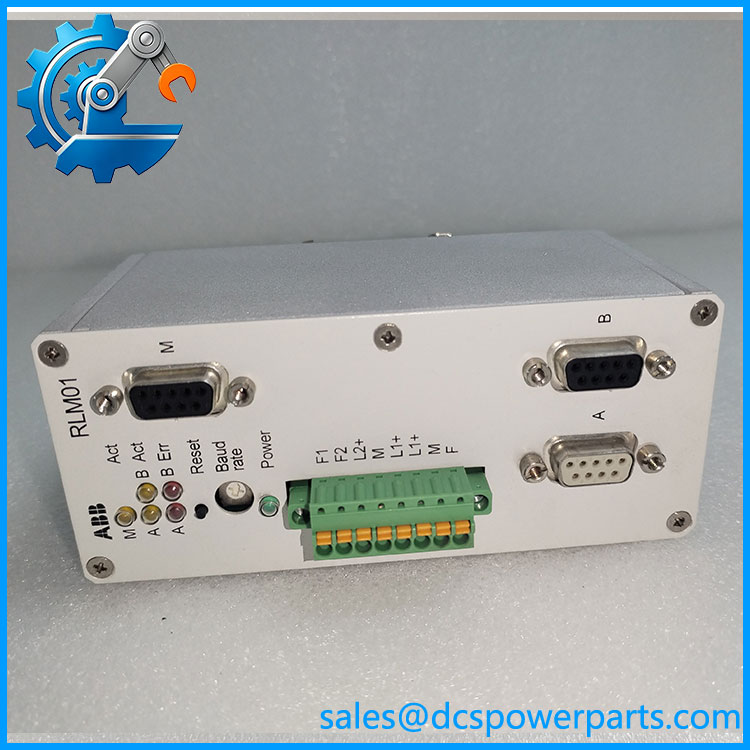
RLM01
Related Products
The following are related components or alternatives worth checking during a network review. They are not confirmed direct replacements for the RLM01.
- ABB CI854A — PROFIBUS DP-V1 communication interface used in certain ABB controller configurations.
- ABB CI854B — PROFIBUS DP-V1 communication interface; verify system generation and configuration requirements.
- ABB CI850 — PROFIBUS-related communication interface for supported ABB control architectures.
- ABB RFO810 — Fiber-optic repeater used in applicable ABB fieldbus network designs.
- ABB PDP800 — PROFIBUS DP interface associated with ABB Symphony Plus architectures.
- ABB AC 800M — Controller family that may be part of a wider PROFIBUS-based installation.
- ABB System 800xA — Distributed control system environment supporting configured fieldbus architectures.
- ABB Freelance — Control system family whose fieldbus infrastructure documentation includes the RLM01.
- ABB 3BDZ000397R1 — 24 VDC power-supply filter accessory listed for the ; relevant to specific surge-protection and marine certification requirements.
The Engineer’s Guide: Three Replacement Traps
Trap 1 — Confusing line redundancy with controller redundancy. The manages PROFIBUS communication paths. It does not, by itself, provide redundant CPU execution or redundant controller switchover.
Practical tip: Identify whether the fault-tolerance requirement concerns the cable path, fieldbus interface, controller, or entire control system before selecting a replacement.
Trap 2 — Treating every PROFIBUS coupler as equivalent. A standard repeater, a DP interface, and a redundancy link module perform different jobs. A device that repeats or regenerates a signal may not reproduce the ‘s A/B/M line-selection behavior.
Practical tip: Compare the original wiring diagram, supported protocol services, transmission rate, and fault-handling logic—not just the connector type.
Trap 3 — Ignoring power and installation details. The uses a 24 VDC supply with a documented input range of 20–33 VDC. Its IP20 enclosure is intended for protected installation, and marine certification requirements may call for a specified power-supply filter arrangement.
Practical tip: Check available supply voltage under load, the grounding and surge-protection scheme, DIN-rail space, and the cabinet environment before replacement.
Frequently Asked Questions
1. What is the ABB used for?
The ABB is a PROFIBUS DP/FMS redundancy link module. It connects a single PROFIBUS line to two redundant lines or combines redundant lines into one, allowing compatible field devices with a single bus interface to operate within a redundant network architecture.
2. What is the order number for the ABB ?
The ABB product documentation identifies 3BDZ000398R1 as the order number for the . Check the complete part number on the installed unit before ordering, especially when replacing older fieldbus equipment.
3. Which communication speeds does the support?
The published transmission-rate range is 9.6 kbit/s to 12 Mbit/s. The network must still be configured for a supported rate, with appropriate cable, termination, and segment design.
4. Does the need a PROFIBUS slave address?
ABB describes the module as transparent to PROFIBUS configuration, so the itself does not require a slave address. This should not be confused with the addressing requirements of field devices connected to the network.
5. Can the replace a standard PROFIBUS repeater?
Not automatically. Although the includes repeater functionality, its defining role is to manage redundant communication lines. A standard repeater may not support the same line selection and fault-monitoring behavior.
6. What should be checked before installing a replacement ?
Confirm the order number, A/B/M port assignment, PROFIBUS transmission rate, supply voltage, alarm-contact wiring, and network termination. Also verify that the replacement behaves correctly in the installed control-system architecture before returning the process to normal operation.
7. How can buyers verify the condition and lead time of an ABB ?
Request photographs of the actual unit’s nameplate and connectors, confirmation of the full order number, and a written condition statement identifying whether it is new, surplus, refurbished, or used. Ask whether the unit has been functionally tested and what that test covered. Warranty terms and dispatch dates should be confirmed in writing; they cannot be established from the model number alone.