Description
ABB RED670 1MRK002810-AC Line Differential Protection IED
Key Technical Specifications
| Parameter | Specification |
|---|---|
| Product Model | RED670 |
| Product ID | 1MRK002810-AC |
| ABB Type Designation | RED670, Ver. 1.2 |
| Product Family | Relion 670 |
| Product Type | Line Differential Protection IED |
| Main Protection | Line differential protection (87L) |
| 87L Configuration | 3 CT sets, 2–3 line ends |
| High-Impedance Differential | 1 instance identified |
| Distance Protection | 4 quadrilateral zones identified |
| Protection Architecture | Numerical multifunction IED |
| Typical Application | Transmission / sub-transmission line protection |
| Communication | Configuration-dependent; verify installed communication hardware |
| CT Input Rating | Configuration-dependent; verify relay nameplate and drawings |
| Auxiliary Supply | Configuration-dependent; verify exact hardware |
| Binary I/O | Configuration-dependent |
| Mounting | Relay panel / substation protection cabinet |
| Engineering | ABB PCM600 environment |
| Product Version | Ver. 1.2 |
The exact 1MRK002810-AC configuration is more specific than the generic RED670 family. Available configuration information identifies a three-CT-set, two-to-three-line-end 87L function, one high-impedance differential function, and four quadrilateral distance zones.
Do not transfer later RED670 specifications to this Version 1.2 unit automatically. Later RED670 generations use substantially different long-form ordering structures, firmware versions, and hardware configurations. A utility relay acceptance list, for example, distinguishes later Version 2.2 ordering codes from earlier versions.
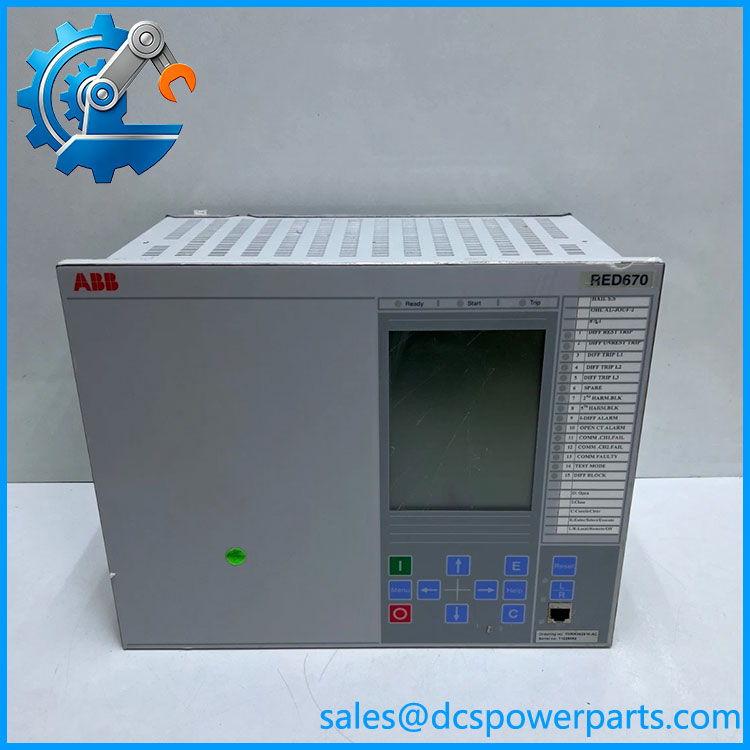
RED670 1MRK002810-AC
Product Introduction
The ABB 1MRK002810-AC is a Relion 670-series numerical protection IED configured primarily for line differential protection. Its 87L function compares electrical quantities associated with the protected line ends to identify faults within the defined protection zone. The exact configuration also includes high-impedance differential and distance-protection functions, giving the relay a broader protection role than a single-function differential relay.
For maintenance and retrofit work, the full 1MRK002810-AC identifier matters. units from different hardware and software generations should not be treated as interchangeable simply because they share the name. Protection settings, CT/VT interfaces, communication hardware, binary I/O, firmware, and the station engineering project all need to be checked before replacement.
Application Scenarios & Field Pitfalls — The Engineer’s Perspective
Engineering Pain Point
The hardest part of replacing an older is usually not mounting the relay. It is reproducing the protection scheme and communication behavior. Line differential protection depends on correctly engineered CT circuits and reliable communication between protection terminals. A replacement that powers up and communicates with the station network can still be unsuitable if its protection configuration, CT interface, firmware, or line-end communication arrangement does not match the original scheme.
Typical Applications
- Transmission-line protection: Main 87L protection for high-voltage overhead lines.
- Cable and mixed overhead/cable circuits: Differential protection where the line-end communication scheme is properly engineered.
- Multi-terminal line schemes: The exact 1MRK002810-AC configuration identifies an application supporting two-to-three line ends.
- Backup protection: Distance-protection functions can provide additional protection coverage alongside the differential scheme.
Technical Pitfalls to Avoid
- Preserve the complete order number.
alone does not uniquely identify the installed hardware and function configuration. - Verify CT polarity and phase assignment. Incorrect CT wiring can produce differential current under healthy load conditions or compromise fault detection.
- Confirm the number of line ends. This configuration is documented with three CT sets and two-to-three line ends; do not assume a simple two-terminal arrangement.
- Check the differential communication channel. Fiber, multiplexed communications, interface hardware, and channel engineering must correspond at both ends.
- Preserve the protection settings. Back up the existing settings, logic, disturbance records where required, and communication parameters before removing the relay.
- Verify distance-protection settings separately. The configured four quadrilateral zones should not be treated as generic defaults; impedance calculations depend on the protected line and system study.
- Check firmware and PCM600 compatibility. A later generation may use a different engineering environment or configuration structure.
- Do not open energized CT secondary circuits. CT circuits must be properly isolated and shorted according to the approved substation procedure before relay removal or wiring work.
Related Products
- — Same Relion 670 line differential protection family; the complete ordering code is required to determine hardware and function configuration.
- ABB REL670 — Relion 670 line distance protection IED, primarily oriented toward distance-based line protection rather than the ‘s differential-protection role.
- ABB RET670 — Relion 670 transformer protection and control IED; designed for transformer applications rather than line differential protection.
- ABB REC670 — Relion 670 bay control IED for substation automation and breaker/disconnector control.
- ABB REG670 — Relion 670 generator protection IED for generator and generating-unit applications.
- ABB REB670 — Relion 670 high-speed busbar protection IED, intended for busbar protection rather than line protection.
- ABB RED615 — Relion 615-series line differential protection platform; different generation and hardware architecture from .
Procurement Note
For ABB 1MRK002810-AC, procurement should preserve the exact 1MRK002810-AC identifier and verify the installed hardware revision, firmware, CT/VT configuration, line-end count, differential communication interface, binary I/O, auxiliary supply, protection settings, and PCM600 project.
The available configuration record identifies this part as Version 1.2, with 87L protection for three CT sets and two-to-three line ends, plus high-impedance differential and quadrilateral distance functions. Do not substitute a later version solely because the front panel and product name appear similar; compare the complete protection and communication configuration first.