Description
ABB REB611 HBAANA1NN11G
Product Introduction
The ABB REB611 HBAANA1NN11G is a configuration of ABB’s Relion 611 series REB611 busbar and multipurpose differential protection relay. REB611 is designed specifically for phase-segregated short-circuit protection, control, and supervision of single busbars, with particular emphasis on high-impedance protection schemes. ABB also specifies the relay for restricted earth-fault and residual earth-fault applications on generators, motors, transformers, and reactors.
The ABB REB611 HBAANA1NN11G is particularly relevant where a high-impedance differential scheme is required and dependable current-input supervision is part of the protection design. The REB611 uses application-specific standard configurations rather than requiring every protection function to be engineered from an empty platform. ABB also provides a web-based local HMI, self-supervision, disturbance recording, and configurable input/output logic. The 611 family supports IEC 61850 communication and GOOSE messaging on configurations equipped with the applicable communication hardware.
The exact ordering suffix matters considerably with this relay. ABB’s ordering structure differentiates current-input arrangements, communication hardware, protocol options, language, housing and other configuration elements. The HBAANA1NN11G configuration should therefore not be treated as interchangeable with another merely because the front-panel model label is the same. The available configuration documentation identifies the high-impedance 4I + 4BI arrangement for the 1/5 A current-input version, while the exact communication option must be checked against the complete order-code label.
Technical Specifications
| Parameter | Specification |
|---|---|
| Product Model | |
| Exact Order Code | HBAANA1NN11G |
| Manufacturer | ABB |
| Product Family | Relion 611 |
| Product Type | Busbar and multipurpose differential protection relay |
| Main Protection Principle | High-impedance differential protection |
| Current Inputs | 4 current inputs |
| Binary Inputs | 4 binary inputs |
| Current Rating | 1 A / 5 A configuration |
| Typical Applications | Busbar protection, REF, residual earth-fault protection |
| Relay Architecture | Withdrawable plug-in IED |
| Local HMI | Web-browser-based HMI / local relay interface |
| Communication | Configuration-dependent; exact HBAANA1NN11G communication option should be verified |
| IEC 61850 | Supported by applicable communication-equipped configurations |
| GOOSE | Supported by applicable IEC 61850 configuration |
| Modbus | Supported by applicable communication-equipped 611 configurations |
| Mounting | Relay panel / switchgear installation |
| Protection Rating | Verify against installation/manual requirements |
| Auxiliary Supply | Verify exact relay hardware/nameplate before procurement |
| Operating Temperature | Verify exact product revision and installation documentation |
Important Configuration Note
ABB’s ordering table distinguishes between:
- AA: High-impedance differential, 4I + 4BI, Io 1/5 A
- AB: High-impedance differential, 4I + 4BI, Io 0.2/1 A
- Communication options including 100Base-FX, 100Base-TX, RS-485, and 3-port Ethernet with HSR/PRP
- Protocol selections including IEC 61850 and Modbus
The supplied therefore needs to be matched character-for-character against the relay’s order-code label before replacing it.
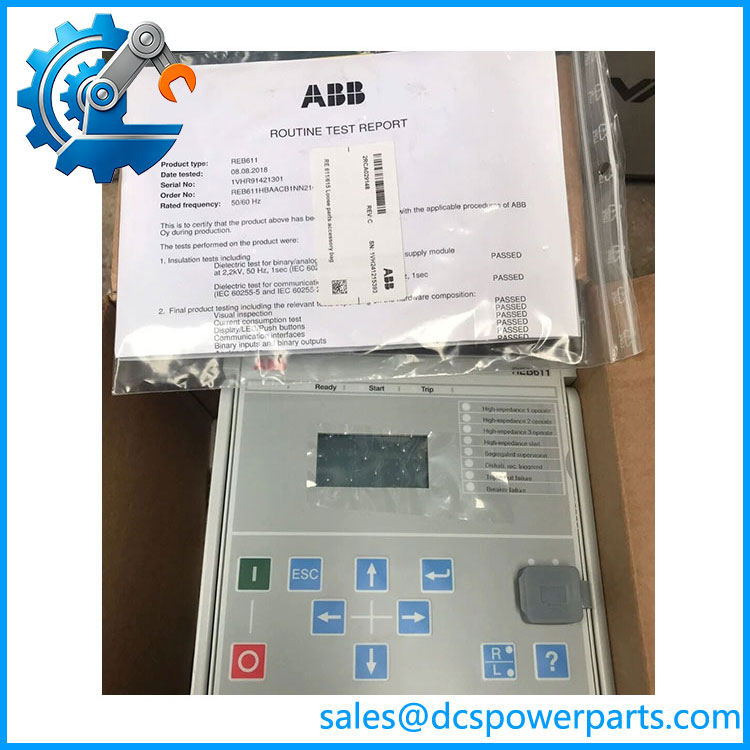
REB611
Main Features and Engineering Considerations
High-Impedance Differential Protection
The central function of is high-impedance differential protection. In a conventional high-impedance scheme, the relay works with appropriately selected CTs and external stabilizing components to discriminate internal faults from external faults. The relay itself cannot compensate for an incorrectly engineered CT circuit.
For an existing installation, CT ratio, CT class, secondary resistance, lead resistance, stabilizing resistor arrangement, and varistor/non-linear resistor arrangement should all be checked before commissioning a replacement relay.
Busbar and REF Applications
ABB specifically positions for single-busbar protection and also for restricted earth-fault and residual earth-fault protection of generators, motors, transformers, and reactors.
This makes the relay useful beyond a simple busbar differential application. A replacement should still be matched to the actual protection scheme because the relay settings, CT arrangement, trip logic, and binary I/O assignment are application-specific.
Withdrawable Construction
The 611 series uses a compact withdrawable-unit architecture. ABB describes this design as suitable for installation and testing, which is useful for maintenance teams working on energized switchgear where the protection circuit has been properly isolated and the site’s switching procedure permits relay withdrawal.
The physical fit alone should not be considered proof of electrical interchangeability. The relay’s order code, hardware revision, firmware, parameter set, and communication configuration all need to match the installed protection scheme.
IEC 61850 and Substation Integration
belongs to the Relion 611 family, which supports IEC 61850 Editions 1 and 2 and binary GOOSE messaging on suitable communication configurations. ABB also documents PRP and HSR redundancy capabilities for the 611 family when the applicable communication hardware is installed.
Do not assume that every order code contains the same Ethernet hardware. The communication suffix is part of the procurement specification.
Self-Supervision and Event Analysis
The 611 series continuously supervises relay operation and provides disturbance-recording capability for post-event analysis. These functions are valuable when investigating intermittent trip signals, CT circuit problems, relay failures, or unexplained busbar operations.
Application Scenarios
- High-impedance busbar differential protection
- Restricted earth-fault protection
- Residual earth-fault protection
- Transformer earth-fault protection
- Generator protection
- Motor protection
- Reactor protection
- Medium-voltage and high-voltage substations
- Industrial electrical distribution systems
- Switchgear protection and control panels
- Retrofit protection systems using Relion 611 equipment
Engineer’s Guide: Field Pitfalls
1. Do not substitute another configuration blindly.
The family contains multiple current-input and communications configurations. The full order code matters.
2. Verify the CT circuit before energization.
For high-impedance schemes, CT performance and secondary wiring are fundamental to protection stability. A relay replacement does not correct an incorrectly engineered CT circuit.
3. Confirm 1 A versus 5 A current inputs.
The ordering documentation distinguishes the 1/5 A high-impedance version from the 0.2/1 A version. These are not interchangeable assumptions.
4. Check communication hardware separately.
If the existing relay communicates with a substation automation system, verify the physical communication interface and protocol before ordering the replacement.
5. Preserve the protection settings.
Record the existing parameter set, binary input/output mapping, trip logic, alarm logic, disturbance-recorder configuration, and time-synchronization settings before removing the old relay.
6. Check firmware compatibility.
The 611 family has multiple firmware/product revisions. A replacement relay should be checked against the PCM600 engineering environment and the existing project before field installation.
7. Do not treat the relay as a generic I/O device.
is a protection IED. Its behavior depends on protection algorithms, CT circuits, logic configuration, settings, and system-level trip wiring.
Frequently Asked Questions
What is ABB ?
It is an ABB Relion 611-series busbar and multipurpose differential protection relay configuration, intended primarily for high-impedance protection applications.
What protection function does provide?
is designed for phase-segregated busbar short-circuit protection and can also be used for restricted earth-fault and residual earth-fault applications.
Is suitable for transformer REF protection?
Yes. ABB specifically lists restricted earth-fault and residual earth-fault applications for transformers, generators, motors, and reactors.
What does the AA configuration represent?
ABB’s ordering documentation identifies AA as the high-impedance differential configuration with 4 current inputs and 4 binary inputs for the 1/5 A current-input arrangement.
Does this exact have IEC 61850?
IEC 61850 is supported within the family, but the communication hardware is encoded in the order configuration. For , verify the physical communication option on the relay label before assuming an Ethernet or IEC 61850 interface is installed.
Is a PLC or DCS module?
No. It is a numerical electrical protection relay / intelligent electronic device (IED). It belongs to the electrical protection and substation automation domain rather than conventional PLC or DCS I/O.
Procurement Note
For procurement, specify the complete identifier as:
ABB Relion —
Do not purchase simply as “ relay.” The current-input configuration, communication hardware, protocol option, firmware/product version, and physical housing configuration can affect interchangeability.
For a critical protection replacement, compare the complete order-code label, serial number, hardware/firmware revision, CT input arrangement, binary I/O wiring, communication interface, and existing PCM600 project before approving the spare. For a high-impedance protection scheme, the CT circuit and stabilizing network should also be verified as part of commissioning—not treated as unrelated field wiring.