Description
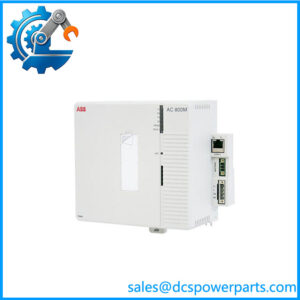
ABB REA101-AAA Arc Protection Relay
Key Technical Specifications
| Parameter | Specification |
|---|---|
| Manufacturer | ABB |
| Model | REA101-AAA |
| Ordering Code | REA101-AAA |
| Product Type | Arc Protection Relay / Main Module |
| System | ABB REA Arc Protection System |
| Supply Voltage | 110–240 VAC |
| DC Supply | 110–250 VDC |
| Frequency | 50–60 Hz |
| Fiber Interface | Optolink, plastic fiber |
| Arc Detection | Light detection with optional overcurrent supervision |
| High-Speed Outputs | 2 × isolated IGBT outputs |
| Relay Output | 1 × heavy-duty relay output |
| Extension Ports | 2 |
| Compatible Extension Units | REA 103, REA 105, REA 107 |
| Mounting | Flush, semi-flush, surface, or 19-inch rack options depending on kit |
| Typical System | Air-insulated LV/MV switchgear |
ABB iies specifically as an arc protection relay REA 101 for 110–240 VAC / 110–250 VDC operation. The same documentation lists -CAA for 24–60 VDC and -AAAG for the glass-fiber optolink version, so the suffix is an important procurement detail.
Product Introduction
The is the main module of the ABB REA arc-fault protection system, designed for rapid detection of electrical arcs in air-insulated low-voltage and medium-voltage switchgear. The relay receives optical information from fiber or lens-type arc sensors and can combine light detection with an adjustable overcurrent condition to improve discrimination between a genuine arc fault and non-fault light events.
For plant engineers, this is a dedicated electrical protection device, not a conventional PLC I/O module or general-purpose protection relay. Its job is to shorten the time between arc initiation and circuit-breaker tripping. ABB documentation describes the REA system as delivering trip commands in less than 2.5 ms when an arc fault is detected.
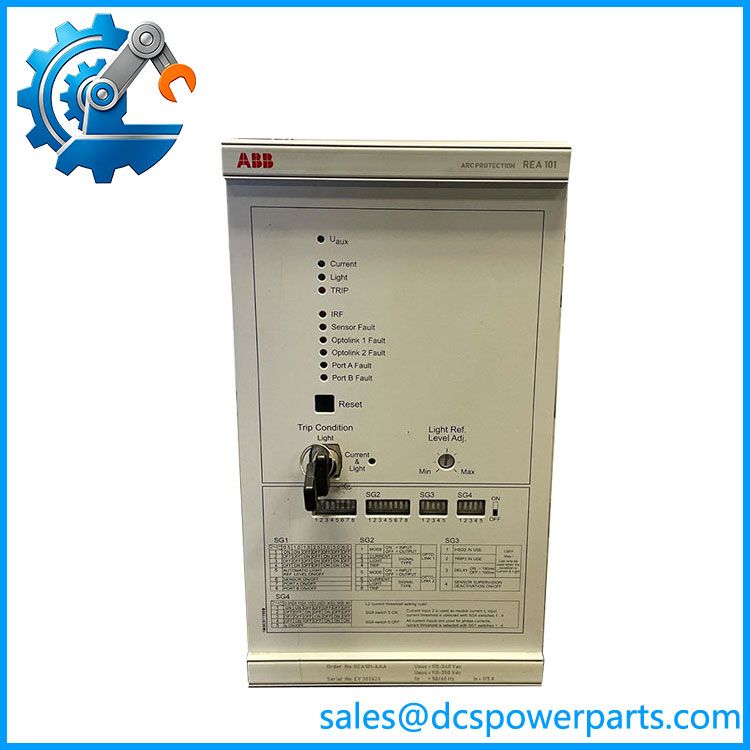
REA101-AAA
Application Scenarios & Field Pitfalls — The Engineer’s Perspective
Engineering Pain Point
An arc fault inside a switchgear compartment develops extremely quickly. Conventional control-system diagnostics are not intended to provide the same response path as a dedicated arc protection system. The protection challenge is therefore not simply detecting abnormal current; the system must recognize the characteristic intense light produced by an arc and issue the appropriate trip command before the fault causes greater equipment damage.
The addresses this function as the central REA 101 module. It can operate independently or as part of a larger REA installation using extension modules. ABB specifies two extension ports, with REA 103, REA 105, and REA 107 available for expanding the sensor and protection arrangement.
Typical Applications
1. Medium-Voltage Switchgear
The REA system is intended for arc-fault protection in air-insulated MV switchgear, where rapid isolation of an internal arc is a critical protection requirement.
2. Low-Voltage Switchgear
The same protection concept can be applied to suitable LV switchgear compartments where optical arc detection is required.
3. Legacy Switchgear Protection Upgrades
REA 101 hardware can be relevant when maintaining or extending existing switchgear protection systems without replacing the complete electrical protection architecture.
4. Multi-Compartment Switchgear
can be combined with REA extension modules and fiber sensors to cover additional switchgear compartments and protection zones. ABB lists REA103, REA105, and REA107 as compatible extension units.
Technical Pitfalls
Do not substitute the wrong supply version.
is the 110–240 VAC / 110–250 VDC version. -CAA is the 24–60 VDC version. These are not interchangeable simply because both carry the REA 101 designation.
Check the fiber-interface suffix.
uses optolink connectors for plastic fiber, while is the glass-fiber version. ABB documentation explicitly separates these ordering codes.
Do not treat it as a normal PLC input module.
The is part of a dedicated arc protection chain. Its sensor inputs, trip outputs, extension ports, and protection logic must be evaluated as one system.
Inspect the optical sensor circuit before replacing the relay.
A false or missing arc signal can originate from the fiber sensor, sensor routing, connector, optical interface, or extension module rather than from the REA 101 itself.
Review the trip circuit separately.
provides two high-speed isolated IGBT outputs and one heavy-duty relay output. The downstream breaker trip circuit, interposing relays, wiring, and breaker mechanism should all be checked when diagnosing a failure.
Check ambient-light compensation and protection settings.
The REA system includes automatic or manual compensation for ambient light. Incorrect sensitivity or compensation settings can affect unwanted-operation behavior, particularly around switching operations that produce flashes without representing an internal arc fault.
Verify the complete REA architecture.
A reent should be checked against the installed REA extension modules, fiber sensor arrangement, inter-module connections, and breaker trip logic. A correct relay part number alone does not establish that the entire protection scheme is correctly configured.
Related Products
- ABB REA103-AA — Extension unit for two additional loop-sensor zones.
- ABB REA105-AA — Extension unit providing one loop-sensor input with an independent trip function.
- ABB REA107-AA — Extension unit for up to eight lens-type sensors.
- — REA 101 main module with 24–60 VDC supply; different power varrom .
- — REA 101 main module with glass-fiber optolink connectors; verify fiber infrastructure before substitution.
- — Low-voltage DC supply version with glass-fiber optolink.
- ABB 1MRS120512 series — Pre-manufactured fiber sensors used with the REA protection system.
- ABB 1MRS120534 series — Lens-type arc sensors for REA installations.
- ABB 1MRS120511 series — Inter-module connection cables for REA 101 systems.
Procurement Note
For , the three details that should be matched first are supply voltage, fiber interface, and installed REA system architecture. ABB’s ordering information clearly separates the AAA, CAA, AAAG, and CAAG variants, so purchasing based only on the generic “REA 101” designation creates an avoidable compatibility risk.
For used or refurbished stock, request photographs of the front label, complete ordering code, fiber connectors, terminal area, and revision markings. Also verify the connected sensor type and breaker trip interface. In an arc-protection application, those details matter more than whether the replacement unit is simply described as “.”