Description
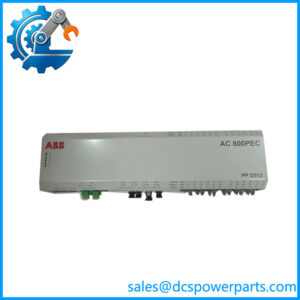
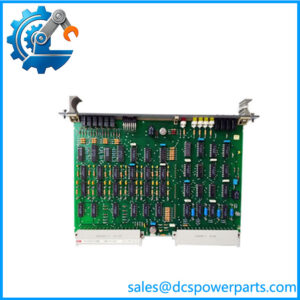
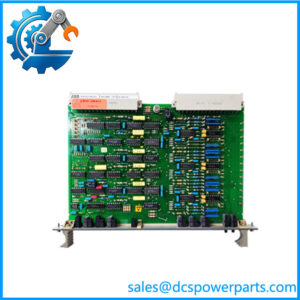
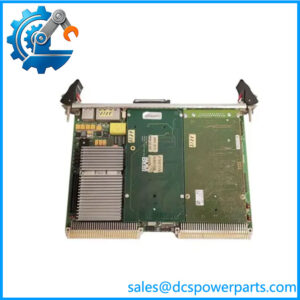
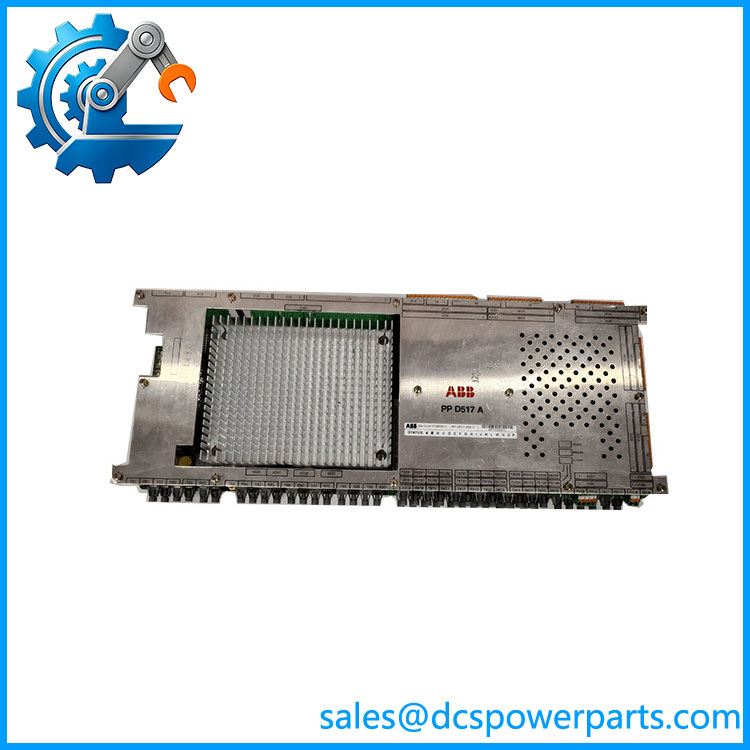
ABB PPD517A3011 3BHE041576R3011 AC 800PEC Excitation Control Unit
Key Technical Specifications
| Parameter | Specification |
|---|---|
| Product Model | PPD517A3011 |
| ABB Part Number | 3BHE041576R3011 |
| Manufacturer | ABB |
| Platform | AC 800PEC |
| Product Type | Excitation control / central processing unit |
| Primary Function | High-speed real-time excitation and power-control processing |
| System Application | Generator excitation and power-electronics control |
| Ethernet | AC 800PEC platform provides Ethernet TCP/IP connectivity |
| Serial Interfaces | RS-232 / RS-422 available within the AC 800PEC architecture |
| Fieldbus Expansion | AnyBus-S / CEX Bus options |
| Optical Interfaces | PowerLink and S800 Optical ModuleBus within supported configurations |
| High-Speed I/O | Typical AC 800PEC process I/O cycle down to approximately 25 µs |
| Standard I/O | Typical cycle approximately 10 ms |
| Programming Environment | Control Builder M |
| Service Interface | PECView service tool |
| Mounting Architecture | AC 800PEC modular installation |
| Exact Power Supply | Configuration-dependent; verify against system documentation |
| Exact Temperature Rating | Hardware/configuration-dependent; verify against ABB documentation |
ABB’s AC 800PEC documentation describes a modular high-speed control system with Ethernet, RS-232/RS-422, AnyBus-S/CEX expansion, optical PowerLink and S800 ModuleBus connectivity. It also identifies typical process I/O cycles of approximately 25 µs for fast I/O. These are platform-level characteristics, not claims that every interface is physically present on this exact assembly.
Product Introduction
The ABB 3BHE041576R3011 is an AC 800PEC-based control unit associated with ABB excitation-control applications. Its role is to provide the central processing required for fast closed-loop control, particularly where generator excitation, voltage regulation, reactive-power control, and power-electronics coordination require substantially faster response than conventional PLC scanning. The AC 800PEC platform combines high-speed control processing with modular I/O and optical communication interfaces.
In an excitation cabinet, the should therefore be considered a controller-level component rather than a standalone analog or digital I/O board. The processor works with the associated excitation I/O, measurement circuits, power-control interfaces, and engineering software to execute the application configured for the generator or converter. The complete part number 3BHE041576R3011 is important because AC 800PEC hardware is configured according to the application and system architecture.
PPD517A3011-3BHE041576R3011
Application Scenarios & Field Pitfalls — The Engineer’s Perspective
Engineering Pain Point
An excitation controller failure can present as unstable generator voltage, incorrect reactive-power response, loss of excitation control, communication faults, or unexplained regulator trips. Replacing the processor alone does not guarantee recovery because the controller is part of a larger closed-loop system containing measurement circuits, I/O modules, excitation power electronics, application parameters, and protection functions.
Typical Applications
- Generator excitation control — Central processing for synchronous-generator excitation applications.
- Automatic voltage regulation — Executes the control logic associated with generator voltage regulation.
- Reactive-power and power-factor control — Supports operating modes implemented in the configured excitation application.
- Hydroelectric generation — Applicable to excitation systems using AC 800PEC control architecture.
- Steam and gas turbine generators — Suitable for generator excitation-control cabinets using the applicable ABB architecture.
- Power-electronics control — AC 800PEC is also used where very fast closed-loop processing and optical PowerLink connections are required.
Technical Pitfalls
- Do not classify it as a generic PLC CPU.
The belongs to an AC 800PEC control architecture and is associated with specialized excitation and power-electronics applications. Its suitability depends on the installed application and surrounding hardware. - Do not confuse it with PPD513AOC or other PPD modules.
ABB uses several PPD-series assemblies within AC 800PEC systems. Similar-looking PPD numbers can perform different functions. The complete identification should be matched. - Platform specifications are not necessarily board specifications.
AC 800PEC documentation describes Ethernet, serial, AnyBus, PowerLink, and ModuleBus capabilities at the system/platform level. The physical interfaces actually available on a particular PPD assembly must be confirmed against its hardware configuration. - Application software is critical.
A replacement controller may require the correct application configuration, parameters, I/O mapping, control constants, and communication configuration. A board that powers up normally is not necessarily a functional replacement. - Check the complete excitation cabinet architecture.
Before substitution, identify the associated I/O modules, optical links, measurement boards, excitation power stage, redundant controller arrangement, and external DCS/HMI interfaces. - Do not rely on unsupported protection claims.
Some secondary listings attribute specific over-excitation, under-excitation, stator-current, loss-of-field, and black-start functions directly to the . Those functions can belong to the configured excitation application/system rather than being fixed hardware functions of every individual controller. Treat them as system-level functions unless the project documentation confirms otherwise. - Verify the replacement by complete ordering number.
Use 3BHE041576R3011 rather than only “PPD517” when checking inventory or engineering compatibility. Public listings consistently associate this order number with , while some unrelated pages incorrectly describe the same number as a power-protection/detection module.
Related Products
- ABB PPD513AOC-100440 3BHE039724R0C3D — AC 800PEC control assembly used for high-speed control and excitation/power-conversion applications.
- ABB PCD237A1011 3BHE028915R0101 — AC 800PEC-based controller used in excitation-control architectures.
- ABB PPD117A3011 3BHE030410R3011 — Related AC 800PEC control hardware; exact function must be matched to the application.
- ABB PPD539A102 3BHE039770R0102 — Another PPD-series AC 800PEC assembly requiring application-specific compatibility checking.
- ABB UNITROL 6000 — Excitation platform associated with AC 800PEC-based control architectures.
- ABB UNITROL 1020 — Smaller UNITROL-family excitation controller; not a direct substitute for an AC 800PEC controller.
- ABB S800 I/O — Modular I/O architecture that can be connected to supported AC 800PEC configurations.
- ABB PowerLink interfaces — Optical high-speed connections used between AC 800PEC control hardware and compatible power-converter equipment.
Procurement Note
For a replacement request, specify ABB , 3BHE041576R3011 exactly as marked on the hardware. The purchase specification should also include the excitation-system model, generator rating, controller configuration, hardware revision, application software/firmware information, I/O configuration, and available parameter backup.
For used or refurbished inventory, inspect the connectors, optical interfaces, PCB condition, processor/memory devices, mounting hardware, and revision markings. A simple power-on test is insufficient for an excitation controller. Where possible, acceptance testing should verify controller startup, diagnostics, communication with the associated I/O, application loading, signal acquisition, and closed-loop interaction with the excitation system.
Important identification note: some web listings incorrectly describe 3BHE041576R3011 as a high-power protection/detection module. That classification is not consistent with the stronger evidence associating with the ABB AC 800PEC excitation-control architecture. For technical procurement, the latter identification is the safer basis.