Description
Key Technical Specifications
| Parameter | Specification |
|---|---|
| Manufacturer | ABB |
| Model | PFTL 101BE-2.0 kN |
| Order number | 3BSE004214R1 |
| Product family | Pressductor PFTL 101 |
| Product type | Pillow-block load cell |
| Measuring direction | Horizontal |
| Measurement principle | Magnetoelastic Pressductor technology |
| Nominal load | 2.0 kN (2,000 N) |
| Overload capacity in measuring direction | 10 kN |
| Permitted transverse load | 30 kN |
| Accuracy class | 0.5 |
| Repeatability error | Less than ±0.05% |
| Deflection at nominal load | 0.015 mm |
| Spring constant | 130 kN/mm |
| Housing material | Stainless steel |
| Cable configuration | Fixed connection cable |
| Protection rating | IP66 |
| Typical applications | Paper machines, calenders, coaters, and winders |
| Condition | Confirm for the actual unit |
Application Scenarios & Pain Points
- Paper-machine tension control: Measures horizontal force at roll-bearing supports to provide feedback for web-tension monitoring.
- Calender and coating lines: Helps detect tension variations that may affect sheet handling and finished-material quality.
- Winding and unwinding systems: Provides force measurements used to maintain consistent web handling as operating conditions change.
- Legacy equipment maintenance: Provides a model-specific spare when the installed sensor is identified as PFTL 101BE-2.0 kN, order number 3BSE004214R1.
A fluctuating reading does not automatically mean the load cell has failed. Mechanical misalignment, damaged cable insulation, loose connections, or a load path that bypasses the sensor can also affect measurements. Inspect the installation and signal chain before replacing the component.
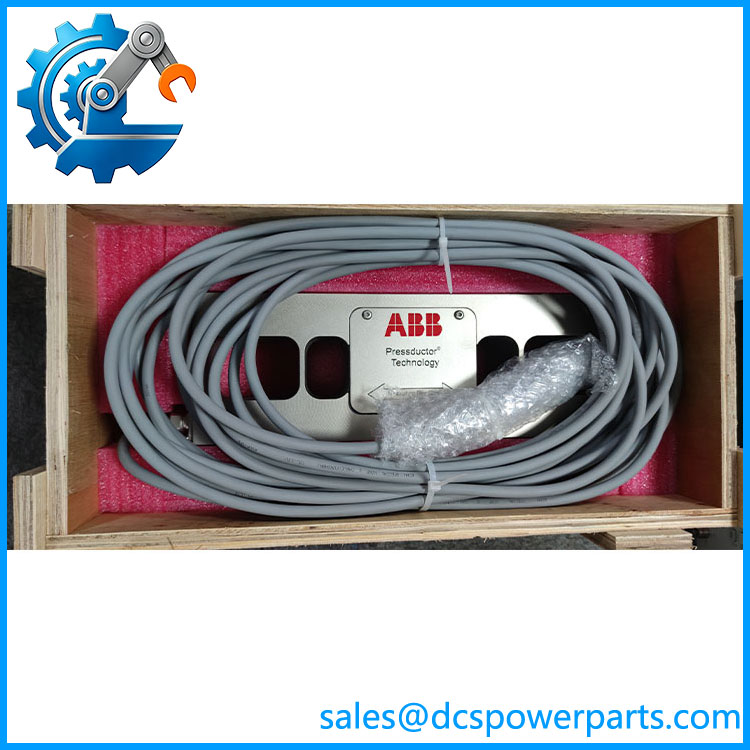
PFTL101BE 2.0KN 3BSE004214R1
Related Products
These are related ABB load cells with different configurations or ratings. They should not be treated as direct replacements without checking the machine requirements.
- PFTL101B-2.0 kN — 3BSE004185R1: Same nominal capacity, but the standard B version has a different cable connection arrangement.
- PFTL101BE-5.0 kN — 3BSE004215R1: Fixed-cable BE version with a higher nominal load.
- PFTL101BE-10.0 kN — 3BSE004216R1: Higher-capacity version for applications designed around a 10 kN nominal rating.
- PFTL101BE-20.0 kN — 3BSE004217R1: Higher-capacity fixed-cable version.
- PFTL101AE-2.0 kN — 3BSE004213R1: A-size, fixed-cable version; mechanical dimensions differ from the B-size family.
- PFTL101A-2.0 kN — 3BSE004172R1: Standard A-size version; confirm mechanical fit and cable requirements.
- PFTL101BER-2.0 kN — 3BSE023158R1: Acid-resistant version for suitable corrosive environments; verify installation requirements.
- ABB PFTL 101 Pressductor load-cell family: Related horizontal-force measurement products used in web-tension applications.
The Engineer’s Guide
Trap 1: Selecting by load capacity alone
Warning: PFTL101B and PFTL101BE variants can share the same nominal capacity while using different cable arrangements.
Practical tip: Match the complete model and order number. Check the fixed cable, terminal connections, and existing measurement electronics before approving the replacement.
Trap 2: Ignoring force direction and mechanical installation
The sensor is designed for horizontal force measurement. Incorrect alignment or an unintended mechanical load path can produce inaccurate readings or place excessive force on the unit.
Practical tip: Follow the manufacturer’s installation drawing, inspect the mounting surfaces and fasteners, and verify that the force acts along the intended measuring axis.
Trap 3: Assuming factory calibration eliminates commissioning checks
Factory calibration does not guarantee that the sensor will read correctly after installation in a different mechanical assembly.
Practical tip: Inspect the cable and connections, confirm the signal at the measurement electronics, and check the reading under a known operating condition. Follow the approved startup and calibration procedure for the installed system.
Frequently Asked Questions
1. What is the ABB PFTL101BE 2.0 kN used for?
It is a horizontal pillow-block load cell designed to measure force at roll-bearing supports. Typical applications include paper machines, calenders, coaters, and winders where force measurements are used for web-tension monitoring.
2. What does the 2.0 kN rating mean?
The nominal load in the measuring direction is 2,000 N. ABB lists a 10 kN overload capacity in that direction for the 2.0 kN B/BE variant. This is a specified overload limit, not a recommended continuous operating load.
3. Is PFTL101BE interchangeable with PFTL101B?
Not automatically. Both may have a 2.0 kN nominal capacity, but the BE version has a fixed connection cable, whereas the standard B version has a different cable connection arrangement. Verify wiring, mounting, and system compatibility before substitution.
4. What does the BE suffix indicate?
The BE designation identifies the mill-duty version in the PFTL 101 family. It uses a fixed connection cable and has IP66 protection. ABB recommends the AE/BE versions for web-tension measurement in paper-machine dryer sections.
5. What should I check if the tension reading fluctuates?
Start with the mechanical load path, mounting surfaces, fasteners, roll bearings, cable condition, and electrical connections. Then check the measurement electronics and the signal-processing configuration. Replace the load cell only after other likely causes have been assessed.
6. How can I verify the condition of a replacement unit?
Check the label for -2.0 kN and 3BSE004214R1. Request photographs of the actual unit and fixed cable, along with available inspection or functional-test records. Confirm whether it is new, surplus, refurbished, or used; a product description alone does not establish operating condition.
7. What are the lead time and warranty for 3BSE004214R1?
Lead time and warranty depend on the supplier and the specific unit. Request written confirmation of stock status, delivery estimate, warranty period, return terms, and any available test documentation. For production-critical installations, allow time for mechanical verification and commissioning before the planned restart.