Description
Key Technical Specifications
| Parameter | Specification |
|---|---|
| Product Model | PE1315A |
| ABB Part Number | 5FSE707630-7 |
| Manufacturer | ABB |
| Product Type | Opto-isolated pulse amplifier |
| Function | Pulse isolation, division and amplification |
| Number of Channels | 3 |
| Signal Channels | A, B and Strobe |
| Input Supply | 12–24 VDC |
| Output Supply | 12–24 VDC |
| Signal Type | Pulse trains |
| Isolation | Galvanic / opto-isolated |
| Pulse Division | Configurable |
| Mounting | DIN rail |
| Product Classification | ABB spare part |
The PE1315 family datasheet confirms that the A variant uses 12–24 V on both the input and output sides. It also documents three isolated channels and pulse-division capability.
Product Introduction
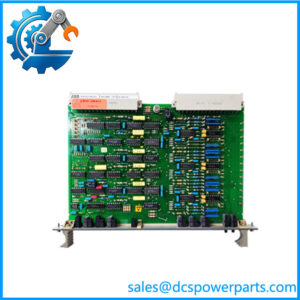
ABB PE1315A 5FSE707630-7 is a three-channel opto-isolated pulse interface designed to electrically separate and condition pulse signals. Channels A, B, and Strobe can receive pulse trains from a pulse generator, while the module provides galvanic isolation, signal amplification, and configurable pulse division. Its DIN-rail format makes it suitable for installation within an industrial control cabinet.
This is a specialized signal-conditioning component rather than a CPU, I/O controller, or excitation regulator. The distinction matters during procurement: the PE1315A sits between a pulse source and downstream control or measurement circuitry, so the signal type, supply voltage, pulse frequency, division requirement, and wiring arrangement need to match the existing installation.
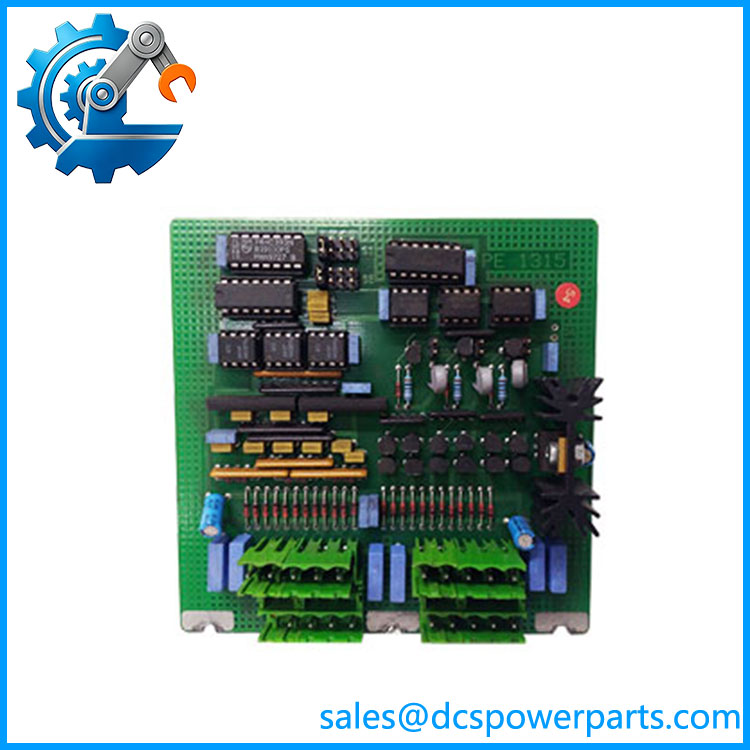
PE1315A
Application Scenarios & Field Pitfalls
Engineering Pain Point
Pulse generators can produce signals that cannot be directly connected to downstream electronics because of grounding differences, signal amplitude, noise, or interface requirements. The PE1315A addresses this by providing electrical isolation and pulse conditioning without requiring the control system to directly share the pulse generator’s electrical reference.
Typical Applications
- Rotational-speed measurement — conditioning pulse-generator signals associated with rotating machinery.
- Position and motion feedback — isolating A/B pulse channels before they enter control electronics.
- Industrial machine control — separating pulse-generating devices from sensitive controller-side circuitry.
- Legacy ABB control installations — maintaining an existing pulse interface where the PE1315A is already specified in the cabinet design.
The PE1315 documentation specifically notes compatibility with both complementary and non-complementary signals and identifies A/B/Strobe channels as the three signal paths.
Technical Pitfalls to Avoid
- Do not confuse PE1315A with an excitation controller. Some reseller pages incorrectly describe this part as a generator excitation-control module. ABB’s product documentation identifies it as an opto-isolated pulse amplifier.
- Check the PE1315 variant carefully. is 12–24 V input / 12–24 V output, while other variants in the family have different voltage combinations.
- Verify pulse-division settings. The datasheet notes that the division must be set to 1 when forward/reverse direction detection is required.
Related Products
- ABB PE1315B — same PE1315 pulse-isolation family, but with a different input/output voltage combination.
- ABB PE1315C — PE1315 variant with 12–24 V input and 5 V output; not electrically interchangeable with .
- ABB PE1315D — PE1315 variant using 5 V on both sides; intended for a different signal environment.
- ABB PE1354FD — a different ABB interface product associated with Profibus conversion; it should not be substituted for a pulse amplifier.
- ABB PM825 — controller hardware rather than a dedicated pulse isolation interface.
- ABB AI531 — analog input hardware serving a fundamentally different signal-conditioning function.
Procurement Check
For ABB 5FSE707630-7, verify the designation and 5FSE707630-7 part number together, then check the installed wiring against the A/B/Strobe channel arrangement. The most important electrical distinction is the 12–24 VDC input/output configuration. Do not substitute PE1315B/C/D based only on physical appearance; their voltage combinations differ. Also confirm whether the existing application requires pulse division and whether the direction-detection requirement calls for a division setting of 1.