Description
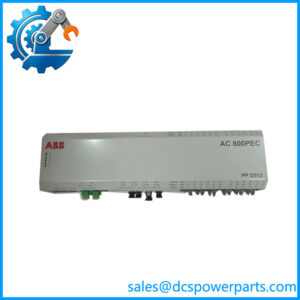
ABB IOR810 | S800 I/O Gateway | Symphony Plus HN800 Interface
Key Technical Specifications
| Parameter | Specification |
|---|---|
| Manufacturer | ABB |
| Model | IOR810 |
| Product Type | S800 I/O Gateway |
| System | Symphony Plus / S+ Control |
| Controller Side | HR Series and SD Series controllers |
| I/O System | ABB S800 I/O |
| Controller-Side Bus | HN800 |
| S800-Side Interface | Fiber-optic Modulebus |
| HN800 Communication Rate | 4 Mbaud |
| Bus Redundancy | Yes |
| Module Redundancy | Yes |
| Supported Devices | Up to 64 devices per electrical bus |
| HN800 Bus Segments | Up to 8 per electrical bus* |
| Devices per Bus Segment | Up to 24* |
| Intracabinet HN800 Distance | 30 m |
| Intercabinet Distance | Up to 3,000 m using RFO810 fiber-optic repeater |
| Power Supply | 21.6–28.0 VDC; 24 VDC nominal |
| Typical Current | 220 mA |
| Maximum Current | 250 mA |
| Mounting | 35 mm DIN rail, horizontal |
| Module Width | 54 mm |
| Module Height | 119 mm |
| Operating Temperature | 0 to 55°C |
| Storage/Transport Temperature | -40 to 85°C |
| Relative Humidity | 20–95% at 40°C, noncondensing |
*The maximum eight-segment configuration depends on the product revisions of the HBX01 bus extenders and TER800 bus terminators. Older revisions can reduce the allowable number of segments.
Product Introduction
The ABB IOR810 is a gateway between Symphony Plus controllers and ABB S800 I/O. It allows HR-Series and SD-Series Symphony Plus controllers to use S800 I/O as part of the control system while communicating through the HN800 I/O bus. On the side, the gateway uses fiber-optic Modulebus communication.
The IOR810 is particularly useful in systems where existing I/O needs to remain in service while the controller architecture is based on Symphony Plus. ABB specifies both bus and module redundancy, while the gateway can support SOE-capable digital input modules with timestamp accuracy down to 1 ms.
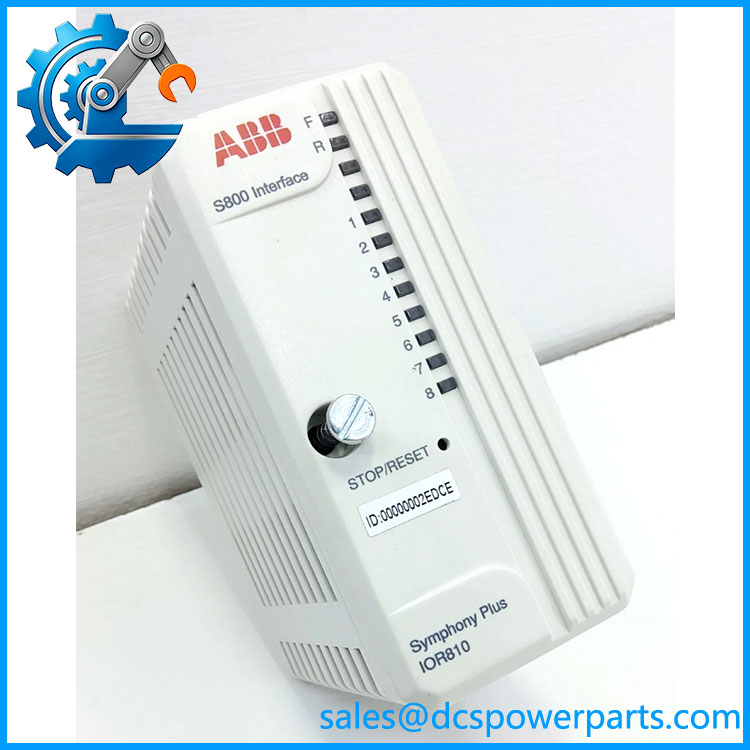
IOR810
Application Scenarios & Field Pitfalls — Engineer’s Perspective
Engineering Pain Point
A failed IOR810 can make an entire group of I/O appear unavailable even though the individual AI, AO, DI, and DO modules are healthy. For troubleshooting, the gateway, redundant pair, bus, fiber Modulebus path, power inputs, and cluster arrangement should be checked before replacing individual I/O modules.
Typical Applications
- ABB Symphony Plus HR-Series controller systems
- ABB Symphony Plus SD-Series control systems
- I/O integration through
- Power-generation and process-control installations using Symphony Plus
- systems requiring SOE-capable digital input integration
ABB lists numerous validated modules for IOR810, including AI801, AI810, AI815, AI820, AI825, AI830, AI835A, AI843, AI845, AI890, AO801, AO810, AO815, AO820, AO845, AO890, DI801, DI810, DI811, DI814, DI820, DI821, DI830, DI831, DI840, DI885, DI890, DO801, DO810, DO814, DO815, DO820, DO821, DO840, and DO890, along with pulse-input modules such as DP820 and DP840.
Technical Pitfalls to Avoid
- Do not treat as a conventional I/O module.
It is a gateway, not an analog or digital input/output card. Its purpose is to connect the Symphony Plus controller architecture with the I/O subsystem. - Check redundancy architecture before replacement.
ABB specifies module redundancy for . The current Symphony Plus catalog identifies the IOR810K02 bundle as two gateway modules with one IOR810N200 mounting base and two TB842 optical Modulebus ports. A single-module replacement should therefore be checked against the installed redundant configuration. - Inspect the bus and fiber path together.
The side can use electrical or fiber-based arrangements, while the Modulebus connection is fiber optic. A communication failure can therefore originate from bus extenders, optical modules, fiber connections, or the gateway itself. - Verify the HBX01 and TER800 revisions.
The maximum bus segmentation depends on the revisions of the bus extenders and terminators. Do not assume every legacy installation supports the maximum eight-segment configuration. - Do not overlook SOE configuration.
If the plant depends on sequence-of-events recording, verify that the installed digital input module is one of the supported SOE-capable types. The does not make every digital input module an SOE module.
Related Products
- ABB IOR810K02 — Redundant gateway package containing two modules, an IOR810N200 mounting base, and two TB842 optical Modulebus ports.
- ABB IOR810N200 — Mounting base used with the gateway.
- ABB TB842 — Optical Modulebus interface associated with the installation.
- ABB RFO810 — Fiber-optic repeater used to extend communication over longer distances.
- ABB HBX01L / HBX01R — bus extenders used for power and bus connections.
- ABB TER800 — bus termination hardware.
- ABB AI810 — Eight-channel analog input module supporting 0/4–20 mA and 0/2–10 V signals.
- ABB DI830 / DI831 — digital input modules that can be used for SOE applications with .
- ABB AO810 — analog output module supported by the gateway.
- — Distributed I/O platform accessed by Symphony Plus through the gateway.
Procurement Check
Before approving an replacement, verify:
- Exact model:
- Symphony Plus controller family
- Single or redundant gateway configuration
- IOR810N200 mounting base
- TB842 optical interface arrangement
- bus topology
- HBX01L/HBX01R bus extenders
- TER800 termination hardware
- RFO810 fiber-optic repeaters, if installed
- I/O module types
- Fiber-optic Modulebus connections
- cable length and segmentation
- Existing module firmware/revision
- 24 VDC redundant power arrangement
- SOE requirements and supported DI modules
Recommended procurement description:
ABB S+ Control Symphony Plus I/O Gateway, Interface, Fiber-Optic Modulebus, Redundant Gateway Support, 24 VDC, DIN-Rail Mounting, for HR-Series and SD-Series Controllers.
The key distinction is straightforward: is the communication gateway that lets Symphony Plus controllers use I/O; it is not the I/O itself and should not be selected as a replacement for an AI, AO, DI, or DO module. ABB also currently lists an IOR800-to- upgrade path, indicating that remains relevant for extending the service life of existing I/O installations.